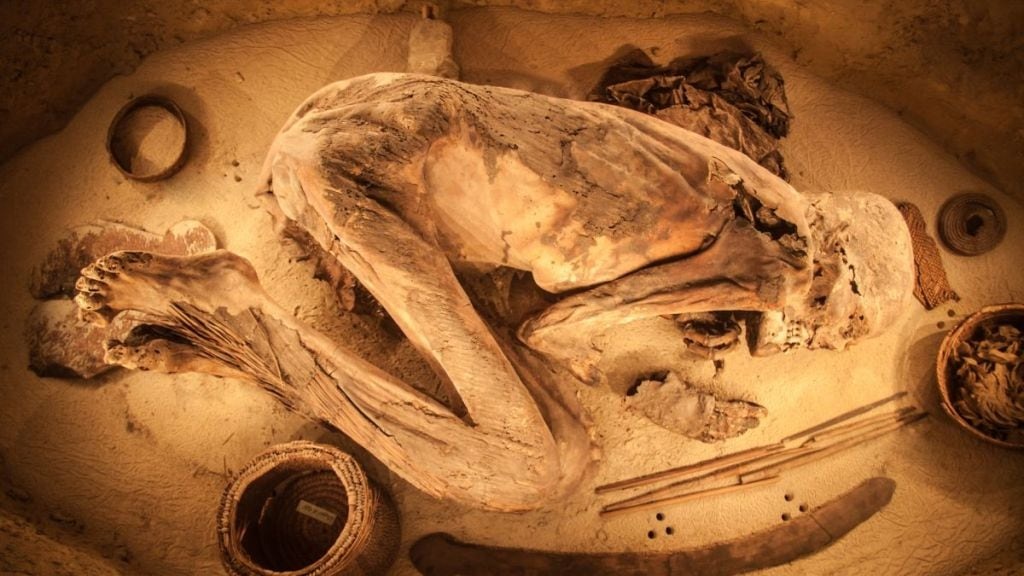

7,000-year-old mummies discovered by scientists in the Sahara don’t share DNA with modern humans
When a team of archaeologists entered the remote Takarkori rock shelter in the Central Sahara, they expected the usual: pottery fragments, scattered bones, faint reminders of nomadic communities that once passed through the region. Instead, they uncovered something that would ripple through the scientific community for years—a cluster of remarkably preserved 7,000-year-old human mummies whose genetic signatures did not match any known lineage on Earth.
At first glance, the discovery looked like another important but familiar milestone in African archaeology. But once geneticists began sequencing their DNA, the story veered into entirely new territory. The people of Takarkori were not ancestors of any modern group. They were not related to present-day North Africans. They did not share the genetic pathways commonly used to map ancient human migrations. They were, in essence, a chapter of humanity that had survived—and vanished—without leaving descendants behind.
The findings challenged everything researchers thought they understood about population continuity in North Africa. For years, historical narratives assumed that ancient Saharan populations gradually blended with incoming groups, producing the genetic tapestry seen today. But the Takarkori mummies, sealed within a rock shelter during a wetter, greener period known as the African Humid Period, told a different story—one where an entire lineage lived, thrived, and disappeared in isolation.
A Genetic Lineage With No Modern Echo
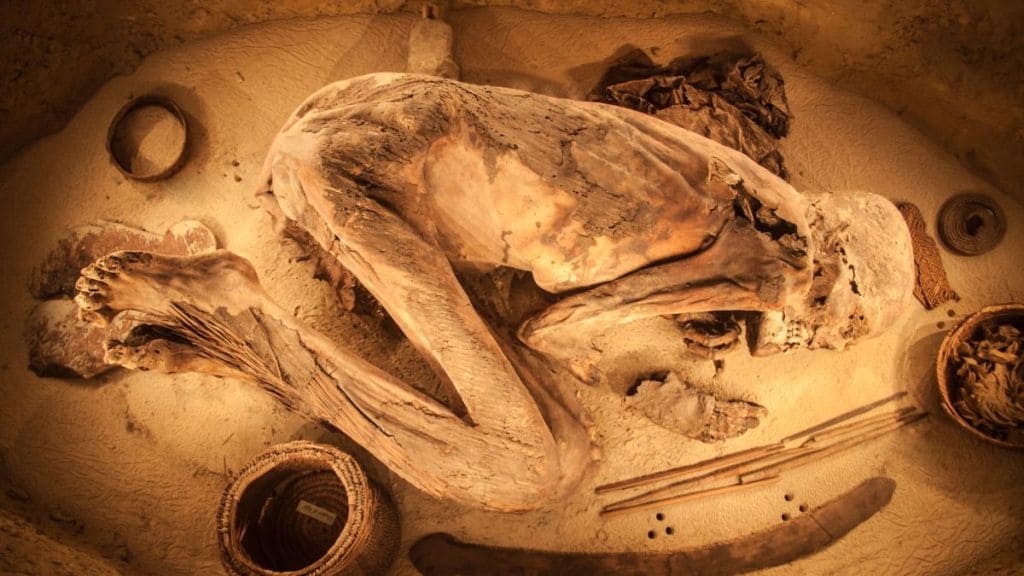
The most striking revelation came from genome sequencing. When scientists extracted and analyzed ancient DNA from the Takarkori remains, the results were unlike anything they had seen in African prehistory.
These individuals showed:
• Extremely low Neanderthal ancestry, much lower than typical Eurasian-influenced North African groups
• No detectable gene flow from sub-Saharan Africa, despite the region’s known mobility during the African Humid Period
• Genetic signatures belonging to no modern human population, even in diluted form
This placed the Takarkori community outside the genetic branches that contributed to today’s populations. They were not a missing link; they were an entirely separate branch—one that faded without merging into the dominant lines of human evolution.
The discovery forced researchers to confront a surprising reality: human history is not a single river branching into modern populations. It’s a braided system of streams—many of which dried up long before they could feed into the main flow of humanity.
Rethinking Contact, Migration, and Cultural Change

For decades, scholars assumed major cultural shifts in ancient North Africa—like the introduction of herding, early pastoralism, food storage, tool specialization, and burial rituals—were spread through migration. Population A moved into Region B, bringing innovations that replaced or blended with local practices.
But the genetic data from Takarkori disrupts this narrative.
If this isolated population had no gene flow from the surrounding regions, then cultural knowledge may have traveled without people moving in large numbers. Ideas could spread through small-scale contact, limited trade, symbolic exchange, or sporadic encounters, without leaving a genetic footprint.
This reframes the prehistoric Sahara not as a fully connected network of migrating groups but as a mosaic of communities—some interacting lightly, others scarcely at all—each developing distinctive practices in response to their shifting environment.
In Takarkori’s case, knowledge-sharing appears to have been selective. The people adopted new practices such as improved tool-making and environmental adaptation strategies but remained genetically isolated, preserving their unique lineage for thousands of years.
A Climate in Flux and a People Who Adapted
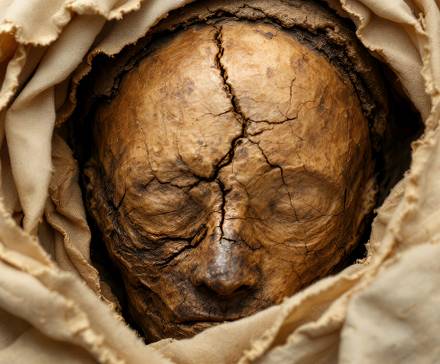
When these individuals were mummified, the Sahara was not the desert we know today. It was a vast green expanse of lakes, rivers, wetlands, and wildlife. The African Humid Period transformed the region into habitable land where humans could hunt, fish, forage, and eventually herd animals.
The Takarkori people adapted to this landscape with remarkable resilience. Analysis of their remains reveals:
• A mixed diet combining fish, small mammals, and early domesticated species
• Burial practices indicating symbolic or ritual meaning, suggesting complex social behavior
• Signs of environmental stress as the desert slowly reclaimed the region, forcing communities to adjust or migrate
• Tool fragments reflecting innovative responses to shrinking water sources and changing vegetation
Even without genetic ties to modern people, their cultural signatures echo broader human tendencies: the need to adapt, the instinct to preserve traditions, and the drive to form community bonds in an unpredictable world.
Why Did Their Lineage Disappear?

One of the most haunting questions is how an entire human line could simply vanish.
Several factors may explain this disappearance:
Environmental collapse:
As the Sahara dried, water sources disappeared. Groups unable to migrate long distances may have faced starvation or been absorbed into neighboring populations in ways that left no genetic trace.
Population size:
The Takarkori group may have been small. Small, isolated populations are more vulnerable to climate change, disease, or competition.
Cultural isolation:
Their refusal—or inability—to merge with surrounding groups may have sealed their fate.
Genetic drift:
Over thousands of years, even if some interbreeding occurred, the unique genetic signatures may have been diluted beyond detection.
Whatever the cause, their disappearance underscores an overlooked truth: not all human lineages were destined to survive. Many rose, thrived, and faded silently, leaving only faint archaeological footprints for future generations to rediscover.
Cultural Practices That Reveal a Shared Humanity
One of the most intriguing aspects of the Takarkori mummies is the evidence of ritualized care in their burials. Despite their genetic isolation, these individuals demonstrated:
• purposeful body placement
• careful wrapping or covering
• shared burial sites
• signs of symbolic meaning, possibly linked to beliefs about death
This is crucial because it suggests that complex social behavior did not require contact with other cultures. Even in isolation, the Takarkori people developed emotional responses to loss, community structures, and cultural symbolism.
It reinforces a growing body of evidence from archaeology:
Humanity’s instinct toward ritual, remembrance, and connection emerges independently across unrelated groups.
Their isolation did not limit their humanity. It simply shaped it differently.
The Broader Message: Human History Is a Forest, Not a Tree
The Takarkori discovery challenges the simplified narrative often taught in classrooms—the idea that modern humans descended in a direct line from a small set of ancient populations.
Instead, the evidence points to a world where:
• multiple human groups existed simultaneously
• many developed unique adaptations
• several lineages vanished entirely
• only a fraction contributed to the genetic landscape we see today
The Takarkori mummies remind us that much of human history remains unwritten. Many peoples lived full lives, built cultures, raised children, survived harsh climates—and then disappeared without leaving modern descendants.
Their story is not a footnote. It is a vital chapter in understanding the true diversity of ancient humanity.
Conclusion: A Hidden Lineage That Changes Everything
The 7,000-year-old Takarkori mummies are more than a scientific curiosity. They are a message from a forgotten world—one in which isolated, genetically distinct people thrived in the heart of a Sahara that was once green and full of life.
Their DNA challenges assumptions about continuity, migration, and cultural exchange. Their burials reveal emotional depth and social complexity. Their disappearance reminds us how fragile human existence can be.
Most importantly, their story expands our understanding of what it means to be human. It shows that humanity’s past is not linear but layered, intricate, and full of paths that ended long before our own began.
Sources
• Science Magazine – Ancient DNA studies on Sahara populations
• Nature – Genetic diversity in prehistoric North Africa
• National Geographic – Archaeology of the Green Sahara
• Journal of Human Evolution – Environmental adaptations during the African Humid Period
