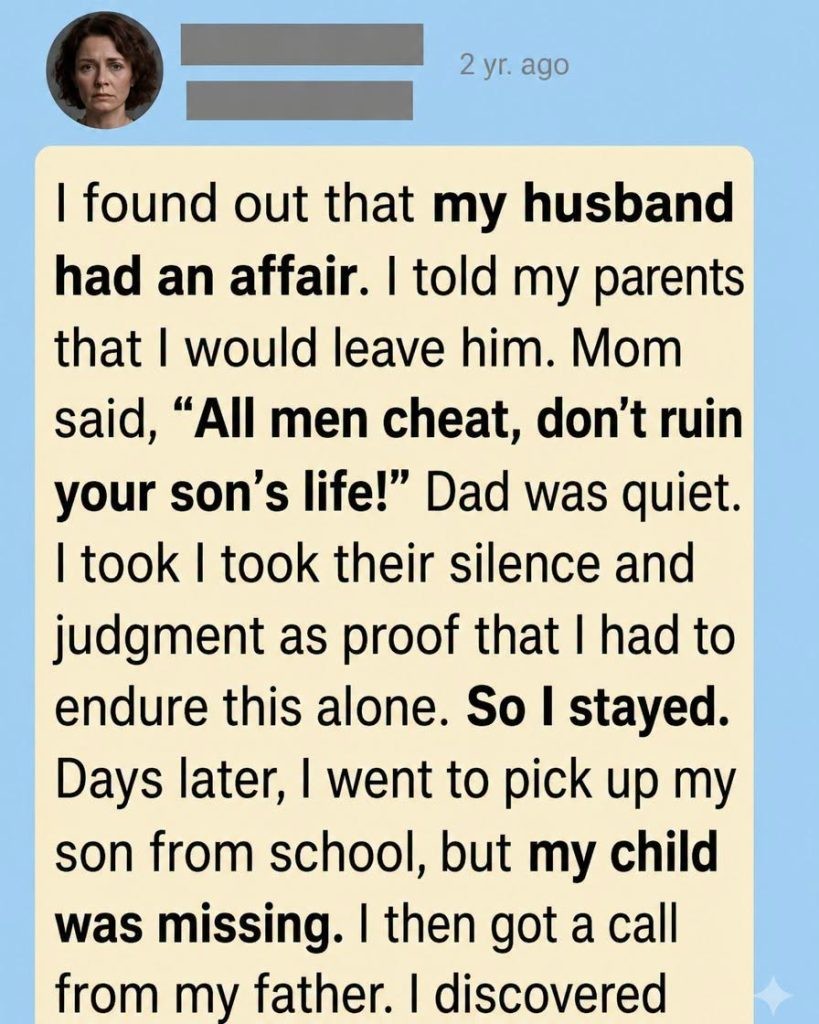

My Husband Cheated, but My Father Helped Me Start Again: The Day He Showed Me the Home I Never Knew I Needed
The evening I discovered my husband Michael’s affair, my entire world seemed to collapse.
His phone contained photographs, hotel reservations, and messages that left little room for doubt. After eleven years of marriage, I was looking at evidence that the man I had trusted had been living a life I knew nothing about.
I sat on the edge of our bed, staring at the screen. My hands were trembling. I kept rereading the same messages, hoping I had misunderstood something. Perhaps there was an explanation. Perhaps I was missing an important detail.
But there wasn’t.
When Michael returned home, I confronted him. I expected denial, excuses, or at least an apology. Instead, he looked at me and asked how much I had discovered.
That was when I realized he wasn’t surprised that I knew. He was only concerned about how much I knew.
He blamed the problems in our marriage, saying we had grown distant and that life had become predictable. He spoke as though his decision had been an unfortunate consequence of our circumstances rather than something he had chosen to do.
I asked him whether he was sorry.
He didn’t give me the answer I needed.
My greatest concern was our seven-year-old son, Daniel. I couldn’t bear the thought of him becoming caught between two parents who could no longer trust each other. I wanted to protect his childhood, even though I had no idea how to protect myself.
The following morning, I called my mother.
I thought she would listen. I thought she would let me cry and tell me that I didn’t have to make every decision immediately.
Instead, she told me that affairs happened in marriages and that I shouldn’t destroy eleven years of family life over one mistake.
“Think about Daniel,” she said. “Children need both parents. You can’t just walk away because you’re hurt.”
I tried to explain that this wasn’t simply about one mistake. It was about the lies, the secrecy, and the way Michael had looked at me when I asked him to take responsibility.
But my mother had already made up her mind.
After the call, I felt even more alone.
For several days, I questioned everything. Was I being unreasonable? Was staying together really better for Daniel? Could I somehow forgive Michael and return to the life we had built?
Yet every time his phone lit up, I remembered those messages.
Michael continued behaving as though nothing serious had happened. He went to work, watched television, and expected our household routines to continue. I moved into the guest bedroom, and our conversations became limited to Daniel’s school schedule, meals, and other practical matters.
I tried to keep things normal for our son.
I prepared his breakfast, packed his schoolbag, helped him with homework, and listened to his stories about classmates and playground games. I smiled when he showed me a drawing and praised him when he finished a difficult assignment.
But after he fell asleep, I often cried alone.
I wasn’t only grieving the marriage I had lost. I was grieving the future I had imagined: family holidays, birthdays, ordinary Sunday mornings, and the feeling that our home was a safe place for everyone.
Three weeks after discovering the affair, I arrived at Daniel’s school on a Thursday afternoon.
As children came through the gates, I watched them run toward their parents. Some carried colorful drawings. Others talked excitedly about their day. Daniel eventually spotted me and hurried over, his backpack bouncing against his shoulders.
“Mom! Grandpa is coming today!”
I looked at him in surprise.
“Grandpa?”
He nodded enthusiastically. “He said he has a surprise for us.”
My father, Robert, had always been a quiet man. He wasn’t someone who offered long speeches or tried to solve every problem with advice. When I was younger, he showed his love through small, practical things: repairing a broken bicycle, driving me home when it rained, or leaving a cup of tea beside me when I was studying late.
I hadn’t told him every detail about Michael’s affair, but he knew enough to understand that something was wrong.
When we reached the parking lot, I saw his familiar car waiting nearby.
He stepped out, greeted Daniel, and opened the back door for him.
Then he looked at me.
“Are you ready to take a little drive?”
I hesitated. “Where are we going?”
“Somewhere I want you to see.”
I was too tired to ask more questions, so I helped Daniel into the car and climbed into the passenger seat.
During the journey, my father asked about school, Daniel’s favorite subjects, and whether he wanted to stop for ice cream. He didn’t ask about Michael. He didn’t ask whether I had decided to leave.
For the first time in weeks, nobody was demanding that I explain or defend my feelings.
After about thirty minutes, my father turned onto a quiet residential street lined with trees. The houses were modest, with small gardens and front porches. Children rode bicycles along the pavement, and someone was watering flowers outside a gate.
He stopped in front of a pale blue house.
It wasn’t enormous or luxurious. It had white window frames, a small front garden, and a wooden porch that needed a little attention. A flowering plant stood beside the entrance.
Daniel pressed his face against the window.
“Is this someone’s house?”
My father smiled.
“Come and see.”
He took a key from his pocket and opened the front door.
Inside, sunlight entered through the living-room windows. The walls were freshly painted, and the floors were clean. There was a small kitchen at the back, two bedrooms upstairs, and a little room that could become a study or playroom.
Daniel ran from one room to another.
“This one could be my bedroom!”
My father followed him upstairs, letting him explore while I remained near the entrance.
I was confused.
“Dad, what is this place?”
He turned toward me.
“It’s a house.”
“I can see that. But why are we here?”
He took a breath before answering.
“I bought it.”
For a moment, I thought I had misunderstood him.
He explained that he had been saving money for years. He had originally planned to use it for a larger retirement property, but after hearing what had happened, he decided that helping his daughter and grandson establish a safe place to live was more important.
The house was not a gift with conditions. He wasn’t asking me to make a decision about my marriage that afternoon. He simply wanted me to know that I had somewhere to go if I needed it.
I felt tears gathering in my eyes.
“Dad, I can’t let you do this. It’s too much.”
He shook his head gently.
“You don’t have to decide anything today. But I don’t want you to believe that you have nowhere to go.”
He paused.
“Your mother may believe that keeping a marriage together is always the best answer. I understand why she thinks that way. But you are allowed to want honesty and respect. And Daniel deserves to grow up seeing that people can treat one another with kindness.”
I looked around the room.
For weeks, I had been thinking about what I might lose if my marriage ended. I had worried about the house, the routine, the financial uncertainty, and the questions Daniel might ask.
I hadn’t considered what it might mean to have a place where I could begin again without constantly remembering what had happened.
Daniel came running downstairs.
“Mom, can I put my books here?”
I laughed through my tears.
“Maybe. We still have to talk about a lot of things.”
My father smiled.
“That’s all right. There’s no rush.”
On the drive home, I felt something I hadn’t felt since discovering the affair.
Relief.
Not because my problems had disappeared, but because I no longer felt trapped by them.
When Michael learned about the house, he was angry.
He accused my father of interfering in our marriage and said that I was making a private family problem worse by involving other people.
I told him that my father had not created the problem. His choices had.
Michael insisted that we could work things out if I stopped listening to everyone else. He said he was willing to move forward, but he still avoided discussing the details of his affair.
I asked him a simple question.
“Are you prepared to take responsibility for what happened, rebuild trust, and accept that it will take time?”
He looked away.
That silence told me more than another argument would have.
I didn’t make an immediate decision about divorce. There were legal, financial, and parenting matters to consider, and I wanted to understand my options before taking any major step.
But I began preparing for the possibility of living separately. I gathered important documents, reviewed our finances, and arranged a consultation with a family lawyer so I could understand the implications for Daniel and me.
Most importantly, I stopped pretending that everything was normal.
A few days later, I took Daniel to the blue house again. We brought some of his books and a box of toys. He chose the smaller bedroom because it had a window overlooking the garden.
He placed his favorite stuffed animal on the bed and announced that it would be the official guardian of his room.
I watched him arrange his things and smiled.
For the first time, I could imagine a future that wasn’t built around Michael’s decisions.
My father came over that weekend with tools to repair a loose cupboard door. He helped Daniel plant flowers in the garden and showed him how to water them without flooding the soil.
At one point, I stood on the porch watching them.
My father looked older than I remembered. His hair had become almost entirely gray, and he moved a little more slowly than he used to. Yet he had found a way to offer me something I desperately needed: the reassurance that I was not alone.
I walked over and hugged him.
“Thank you,” I whispered.
He patted my shoulder.
“You don’t have to thank me for being your father.”
I eventually understood that the house was not simply a place to live. It represented a choice I had forgotten I was allowed to make.
I could take time to think. I could seek professional advice. I could decide what kind of relationship, if any, I wanted to have with Michael in the future.
And I could give Daniel a stable environment without teaching him that betrayal had to be accepted to keep a family together.
My marriage had changed in a way I could never undo. I didn’t know exactly what the next year would bring, and I wasn’t going to pretend that starting again would be easy.
There would be difficult conversations, financial decisions, and moments when I questioned myself.
But I no longer believed that the end of one chapter meant the end of my life.
Sometimes, the support that changes everything doesn’t arrive through a dramatic speech or a perfect solution. Sometimes, it comes from someone who quietly opens a door and reminds you that you still have somewhere to go.
My father hadn’t given me a perfect future.
He had given me room to build one.
And that Thursday afternoon, when he took Daniel and me to a small blue house, I discovered something I had almost forgotten: starting over was not the same as losing everything. Sometimes, it was the first chance to build a home where honesty, kindness, and peace could finally come first.