
A Simple Dance Studio Picture That Confuses the Eyes
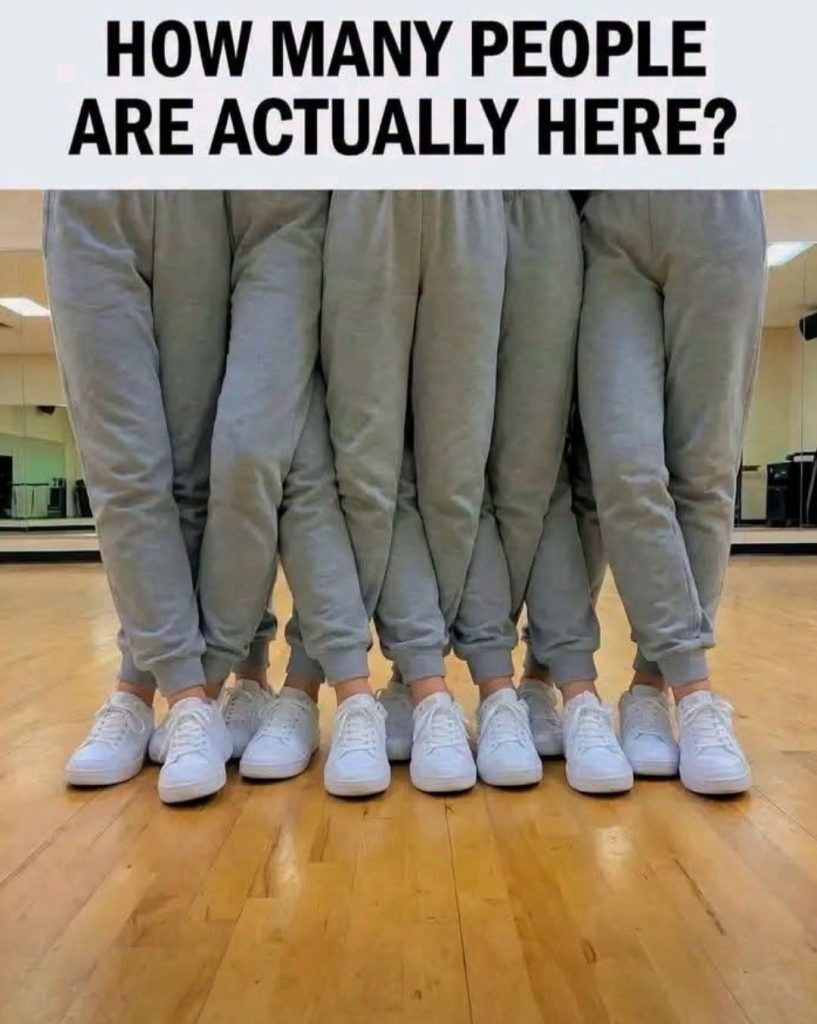
At first glance, counting the people in this dance studio should be an easy task. A group of dancers appears to be standing in a line, wearing matching grey sweatpants and clean white sneakers. Nothing about the scene seems particularly complicated.
Yet the moment you try to count everyone, the picture becomes surprisingly confusing.
Several pairs of legs overlap, making it difficult to determine where one dancer ends and another begins. Some bodies appear to merge into a single shape, while others seem to disappear behind the people standing in front.
You might initially count three or four dancers and feel confident about your answer. But take another look. There may be more people standing in the formation than your eyes first suggest.
This is what makes the image an entertaining optical illusion. Instead of relying on obvious differences between people, it uses similar clothing, overlapping positions, and visual distractions to make a simple counting task more challenging.
Why Is It So Difficult to Count the Dancers?
One of the biggest reasons this puzzle is confusing is the matching outfits.
Every dancer appears to wear grey sweatpants and white sneakers. Because there are no distinctive colors or patterns separating the individuals, the clothing creates a continuous visual pattern.
When several people stand close together, their trousers can overlap in a way that makes it difficult to identify individual legs. A leg belonging to someone standing behind another dancer may be partially hidden, while two separate pairs of trousers may appear to form one larger shape.
The arrangement also makes it difficult to use the upper bodies as a reliable counting method. If some dancers are positioned behind others, their torsos may be mostly or completely obscured.
As a result, the viewer may focus on the most visible parts of the formation and overlook the smaller details that reveal the actual number of people.
This is a common feature of visual puzzles. The information needed to solve the challenge is present in the image, but the way objects overlap makes it harder to interpret correctly.
The Secret Clue Is at the Bottom of the Picture
If you are struggling to count the dancers, try changing your approach.
Instead of concentrating on the waistlines or trying to identify every upper body, look down toward the floor.
The white sneakers provide a useful visual clue because they stand out against the grey trousers. Even when parts of the dancers’ bodies are hidden, their shoes may remain visible.
Each person should have two shoes. Therefore, identifying the individual pairs can help you work out how many dancers are present.
The important thing is to count separate sneakers rather than simply counting the visible white shapes at a glance. Some shoes may overlap or be partially hidden, so take your time examining their outlines.
How to Solve the Puzzle Step by Step
The explanation provided with the puzzle identifies 12 distinct white sneakers.
You can approach the image by dividing the formation into three sections: the left side, the center, and the right side.
Start with the far-left section. Look carefully at the shoes near the floor and distinguish each sneaker from the one beside or behind it. Some may be partially obscured, so pay attention to their separate shapes.
Next, move toward the center. This area can be particularly confusing because the dancers’ legs appear to overlap. Rather than following the grey fabric upward, concentrate on the individual white shoes.
Finally, examine the right side of the formation. Look for sneakers that may be partly hidden behind other feet or ankles. These details can be easy to overlook when viewing the picture as a whole.
According to the supplied solution, the total is 12 separate sneakers.
Once you have identified all 12, the final calculation is straightforward.
The Correct Answer: Six People
<escape>12 sneakers ÷ 2 sneakers per person = 6 people.</escape>
<escape>The answer is SIX PEOPLE!</escape>
The puzzle’s solution is based on the assumption that each dancer is wearing one pair of sneakers and that all 12 visible shoes belong to different pairs.
That simple calculation explains why the number of people may be greater than the first impression suggests.
If you initially guessed three or four, you were not alone. The overlapping clothing makes the formation look smaller than it actually is.
Why Optical Illusions Make Us Look Twice
Optical illusions are entertaining because they reveal how easily our visual perception can be influenced by the arrangement of objects.
When looking at a crowded picture, the brain tries to organize different shapes into recognizable patterns. It may interpret overlapping objects as one continuous form, especially when those objects have similar colors and textures.
This process is useful in everyday life because it allows people to make sense of complicated visual environments quickly. However, it can also lead to mistakes when an image is deliberately arranged to hide boundaries or create misleading patterns.
In this dance studio puzzle, the grey trousers make the dancers’ legs difficult to separate. The white sneakers offer a more distinctive feature, giving viewers another way to organize the information.
The challenge is not necessarily about having better eyesight. It is about noticing details that may not attract attention immediately.
A Small Change in Perspective Can Reveal the Answer
One useful strategy for solving visual puzzles is to avoid relying on a single part of the image.
If counting faces or upper bodies does not work, look for another repeated feature. It might be shoes, hands, shadows, accessories, or the edges of objects.
Breaking a complicated picture into smaller sections can also help. Instead of trying to understand the entire scene at once, examine the left, middle, and right sides separately.
This method reduces the chance of counting the same object twice or overlooking something hidden behind another shape.
It is also worth remembering that a visual puzzle should be treated as a fun challenge rather than a formal test of intelligence or cognitive ability. People may reach different answers because of screen size, image quality, viewing angle, or simply how they interpret overlapping shapes.
Did You Guess Six People?
The dance studio illusion demonstrates how a familiar scene can become confusing when similar objects overlap.
The matching grey trousers make the dancers difficult to distinguish, while the white sneakers provide a useful clue for counting them individually.
According to the supplied solution, there are 12 distinct sneakers, representing six pairs and therefore six people.
So, did you identify all six dancers on your first attempt, or did you need to look at the shoes before finding the answer?
Sometimes, solving a visual puzzle does not require complicated mathematics. It simply requires slowing down, examining the details, and looking at the picture from a different perspective.