
“If You Don’t Like What My Mother Is Saying, Settle the Bill and Go.”
The words landed harder than the expensive silverware against the plates.
I was sitting at a beautifully decorated table in one of the nicest steakhouses in the city. White tablecloths covered the tables, soft music played in the background, and the waiters moved quietly between guests carrying trays of food.
Across from me sat my son, David, his wife, Sarah, and Sarah’s mother, Brenda.
Then Sarah looked directly at me and said, “If you don’t like what my mother is saying, settle the bill and go.”
Brenda laughed.
David lowered his eyes toward his plate.
And I sat there, trying to understand how a dinner with my own family had turned into a moment in which I was being treated like an unwanted guest.
My name is Georgia Owens. I was sixty-four years old, a widow, and someone who had spent the previous five years helping her son build a comfortable life.
I had paid bills when money was tight. I had covered their phone plans, internet service, and other household expenses. I had given Sarah a credit card for emergencies, helped with unexpected purchases, and allowed them to store business inventory in my basement.
I had never considered those things burdens.
I thought I was helping my family.
But that evening, sitting beneath the warm restaurant lights while my daughter-in-law’s mother laughed at my expense, I began to see the situation differently.
I did not raise my voice.
I did not insult anyone.
I simply folded my napkin, placed it beside my plate, and stood up.
“Of course,” I said calmly.
Then I walked to the cashier, paid the $253 bill, left a generous tip, and headed for the door.
I did not turn around.
They probably expected me to cry in the car, call David later, or apologize for making the evening uncomfortable.
They were wrong.
Five Years of Helping Had Slowly Become an Obligation
After my husband died, my relationship with David became especially important to me.
He was my only son, and although he was an adult with a family of his own, I still wanted to know that he was doing well.
When David and Sarah began experiencing financial difficulties, I stepped in.
At first, the help seemed temporary.
They needed assistance with a few bills. Then there was an unexpected expense. Later, they needed help managing monthly payments while Sarah worked on building her business.
I told myself that families were supposed to support one another.
I did not mind paying for their phone lines or internet service. I did not object when Sarah used the emergency credit card I had given her. When she needed space to store boutique inventory, I offered the basement of my four-bedroom house.
There were nearly ninety-two boxes of merchandise down there eventually.
Clothing, accessories, packaging materials, and other products filled the available space. I could barely use parts of my basement, but I accepted the inconvenience because I believed I was helping them move toward a more secure future.
Over time, however, something changed.
The occasional requests became regular expectations.
Nobody asked whether I could afford another expense. Nobody seemed particularly interested in whether I wanted to continue paying for everything.
The money simply left my accounts each month.
And because I rarely complained, they appeared to assume I would always say yes.
I had mistaken their dependence on my generosity for a normal family arrangement.
What I had not noticed was how little gratitude remained in the relationship.
The Dinner That Finally Opened My Eyes
The evening at the steakhouse was supposed to be a family dinner.
Sarah had invited her mother, Brenda, and David had suggested that I join them. I assumed we would enjoy a pleasant meal and catch up.
But Brenda soon began making comments about my lifestyle.
She talked about how older people sometimes struggled to understand the needs of younger families. She suggested that parents should be willing to make sacrifices for their children, even when those children had different priorities.
At first, I tried to ignore the remarks.
I did not want to create an argument in a public restaurant.
But the comments continued, becoming increasingly personal. Brenda spoke as though I were an inconvenience in my son’s life rather than someone who had helped support his household for years.
Eventually, I responded.
I do not remember every word I said, but I remember making it clear that I did not appreciate being spoken to that way.
That was when Sarah turned toward me.
“If you don’t like what my mother is saying, settle the bill and go.”
Her mother laughed.
David said nothing.
That silence hurt almost as much as Sarah’s words.
I looked at my son, hoping he might finally say something. I did not expect him to start a fight with his wife or embarrass anyone. I simply wanted him to acknowledge that I deserved basic respect.
But he remained silent.
In that moment, I understood something painful: the people I had spent years supporting had become comfortable accepting my help without considering how they treated me.
So I paid the bill.
Not because I agreed with them.
Not because I believed I deserved to leave.
I paid because I wanted to end the evening without giving anyone another opportunity to humiliate me.
Then I went home.
And for the first time in five years, I began asking myself a question I should have asked much earlier.
What would happen if I stopped paying for their lives?
One Quiet Evening Changed Everything
When I arrived home, the house felt unusually peaceful.
I took off my coat, made myself a cup of tea, and sat at the kitchen table with my laptop.
I was not interested in revenge. I did not want to hurt David or make Sarah suffer.
But I was finished pretending that my financial support was something they were entitled to receive.
I opened my accounts and began reviewing the services I had been paying for.
First, I canceled David and Sarah’s phone lines.
Then I disconnected the internet account that was registered under my name and paid for with my money. I removed Sarah from my warehouse membership and deactivated the credit card I had given her for emergencies.
Each decision was deliberate.
I made sure I understood which services belonged to me and what cancellation arrangements applied. I was not trying to interfere with accounts or property that belonged to someone else.
I was simply ending the financial commitments I had voluntarily taken on.
Then I checked the credit card activity.
What I found surprised me.
During one month alone, Sarah had charged approximately $1,140 to the card.
The purchases included hair appointments, restaurant meals, shopping, spa visits, and concert tickets.
I stared at the transactions for several minutes.
I had given her that card because I believed it would help with emergencies. I had imagined situations such as an unexpected household expense or a necessary purchase when David was short on money.
But the spending I was looking at told a different story.
The card had become an extension of her personal budget.
I realized that I had never established clear limits, and they had never felt the need to ask whether I was comfortable with the way the money was being used.
That night, I made one final decision.
The ninety-two boxes in my basement had to go.
Ninety-Two Boxes Were Suddenly No Longer My Problem
Sarah’s boutique inventory had occupied my basement for months.
At first, I had agreed to store a few boxes temporarily. Then more merchandise arrived, and eventually the entire space became a storage area for her business.
I had repeatedly told myself that it was only temporary.
But temporary arrangements have a way of becoming permanent when nobody is in a hurry to change them.
After the restaurant incident, I decided I no longer wanted my home serving as a free warehouse.
I contacted a moving company and arranged for the boxes to be delivered to David and Sarah’s townhouse the following morning.
I made sure the arrangements were clear and that the delivery could be completed without damaging the merchandise.
Then I sent David a message.
I explained that I had canceled the services and financial arrangements I had been paying for. I told him that the inventory was being returned and that, from that point forward, he and Sarah would need to manage their own household expenses.
I did not insult him.
I did not mention every hurtful thing Sarah had said.
I simply stated that I was no longer willing to continue the arrangement.
For the first time in five years, I had stopped paying for their lives.
And I felt something I had not expected.
Relief.
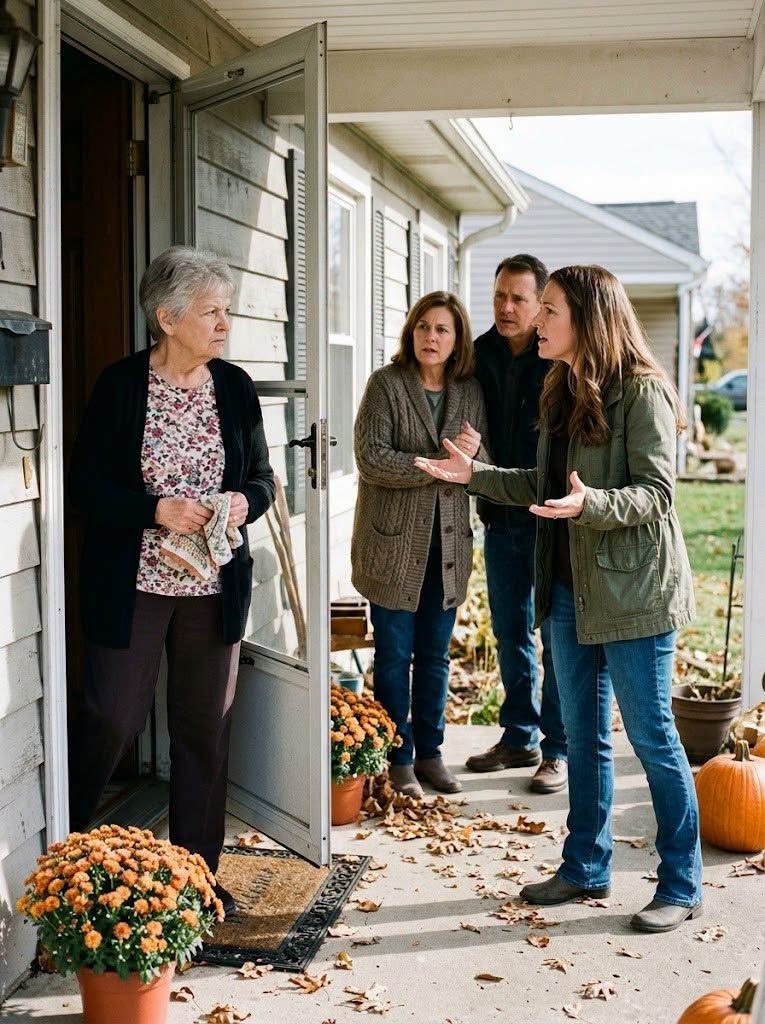
The Morning They Came to My Door
The next morning, my doorbell rang repeatedly.
When I looked outside, I saw David and Sarah standing on the front step. Brenda was with them.
Sarah appeared furious.
She demanded that I open the door and explain what I had done. She was particularly angry about the phone lines, the internet service, and the delivery of her inventory.
Brenda called my actions childish.
David looked frustrated and confused.
I opened the door but remained inside.
Sarah immediately began speaking.
“How could you do this without talking to us first?”
I listened before answering.
“I have been paying for these things for five years,” I said. “I am allowed to decide that I no longer want to pay for them.”
She insisted that I was making life difficult for her and David.
I reminded her that the accounts were in my name and that the financial support had always been voluntary.
Brenda interrupted, accusing me of trying to punish a young family because of one unpleasant dinner.
I looked at her calmly.
“It wasn’t just one dinner,” I said. “It was five years of being treated as though my help was something you were owed.”
David finally spoke, but he did not defend me. He wanted to know why I had not warned them that I was serious.
I told him that I had spent years making it easy for them to assume I would never stop.
Then Sarah made another threat.
She said that if I continued behaving this way, she might make sure I never saw my future grandchildren.
It was a cruel thing to say, and for a moment I felt the familiar pain of being pushed away by someone I had tried so hard to help.
But I refused to bargain for a relationship with children who did not even exist yet.
“That is your choice,” I replied.
I closed the door.
For once, I did not chase after them.
I Decided It Was Time to Leave the House, Too
In the days that followed, I began looking at my life from a different perspective.
My four-bedroom house had once been full of activity. It was where David had grown up, where my husband and I had celebrated birthdays, and where countless family memories had been made.
But after my husband’s death, the house had gradually become too large for me.
I was maintaining rooms I rarely used, paying for repairs, and allowing other people’s belongings to take up space that I could have enjoyed myself.
The basement had become a storage facility. My finances had become an extension of David and Sarah’s household budget. Even my free time seemed to revolve around their needs.
I had spent so long trying to make life easier for everyone else that I had forgotten to ask what I wanted.
So I made another decision.
I contacted a realtor.
After considering my options, I sold the four-bedroom house and bought a beautiful two-bedroom condominium near the lake.
It was smaller, but it had everything I needed.
There was a bright living room, a comfortable kitchen, a peaceful bedroom, and a view that made mornings feel special. The building was easier to maintain, and I no longer had to worry about a large property that required constant attention.
I kept the belongings that mattered most and let go of the things I no longer needed.
The move felt like closing a chapter of my life.
For the first time in years, every room in my home belonged to me.
I could leave a book on the coffee table without worrying about someone needing the space for merchandise. I could make dinner for one without feeling guilty. I could spend an afternoon by the lake simply because I wanted to.
My new home was smaller.
But it finally felt like my own.
When David Finally Understood What His Silence Had Cost
Time passed, and the anger slowly gave way to something more complicated.
David eventually came to see how much his silence at the restaurant had hurt me.
He had been so accustomed to my support that he had stopped recognizing the sacrifices behind it. He had allowed his wife and her mother to speak to me disrespectfully because confronting the situation might have created tension in his own household.
It was easier for him to look at his plate.
But avoiding conflict had come at a cost.
When he finally visited me at the condominium, he looked different. He seemed uncomfortable, but he also appeared ready to have an honest conversation.
He apologized for not defending me.
He admitted that he had taken my financial help for granted and that he had failed to recognize how much I had done for him and Sarah.
I listened.
I did not interrupt or turn the conversation into another argument. I had waited a long time to hear those words, but I also knew that an apology did not automatically erase years of hurt.
I told him that I loved him.
I also told him that things would be different from then on.
If he needed advice, I would listen. If he wanted to visit, my door would be open. If he and Sarah faced financial difficulties, they would need to make their own plans and decisions.
I would no longer be their automatic financial safety net.
David understood.
Or at least, he began to.
Sarah’s Apology Came Later
Sarah’s apology did not happen immediately.
For a while, our relationship remained distant. I did not call her to demand an explanation, and I did not try to force a reconciliation.
Eventually, she contacted me.
She admitted that she had mistaken my generosity for an obligation. Because I had helped so often, she had started treating the arrangement as something that would continue indefinitely.
She acknowledged that her behavior at the restaurant had been disrespectful.
I appreciated the apology, although I knew that rebuilding trust would take more than a conversation.
I did not expect her to become a different person overnight. I simply wanted a relationship in which kindness and respect went both ways.
Over the following months, David and Sarah began managing their household finances themselves.
They paid their own bills, adjusted their spending, and started putting money aside for emergencies.
They had to make choices that they had previously avoided because someone else had been covering the difference.
It was not always easy for them.
But it was their responsibility, and they gradually learned to manage it.
A Different Kind of Family Dinner
Several months after the restaurant incident, David and Sarah invited me to dinner.
This time, I agreed.
We met at a quieter restaurant, and the atmosphere was very different from the evening that had changed everything.
There was no expectation that I would automatically pay. Their bills were covered with their own money, and nobody treated my presence as an opportunity to discuss what I could contribute.
David apologized again.
He told me that he had been wrong to remain silent when Sarah spoke to me that way. He said he should have recognized that I was his mother, not simply someone who could be relied upon to solve financial problems.
I accepted his apology.
Sarah also behaved differently. She spoke to me respectfully, and the conversation was more relaxed than it had been in a long time.
We talked about ordinary things.
There were no arguments about money, no requests for another favor, and no uncomfortable assumptions about what I would pay for.
I realized that this was the kind of family relationship I had wanted all along.
I could love them without financing their lives.
I could spend time with my son without feeling responsible for every problem in his household.
And I could be generous when I genuinely wanted to be, rather than because everyone expected me to be.
I forgave David and Sarah.
But I never reopened my wallet.
At 64, I Finally Started Living for Myself
Sometimes I sit by the window in my new condominium and look out toward the lake.
The morning light reflects off the water, and the quiet reminds me how different my life has become.
I still love my son.
I still hope that Sarah and I can build a healthier relationship. I hope that if grandchildren eventually enter our family, they will grow up surrounded by love and respect.
But I no longer measure my value by how much money I can provide.
For years, I believed that being a good mother meant making sacrifices without asking for anything in return. I thought that if I kept helping, my family would always understand how much I cared.
Now I understand that love and financial support are not the same thing.
Helping someone is a choice.
It should not become a permanent obligation simply because the other person has grown accustomed to receiving it.
At sixty-four, I learned that setting boundaries does not mean you have stopped loving your family. It means you have finally recognized that your own well-being matters, too.
I lost a large house, but I gained peace.
I stopped paying bills, but I gained control over my future.
And I stopped trying to earn respect through generosity.
My name is Georgia Owens. I am a widow, a mother, and a woman who spent many years putting everyone else first.
Today, I live in a beautiful two-bedroom condominium near the lake. I pay my own bills, make my own plans, and decide how I want to spend my time.
My life is smaller in some ways.
But it feels bigger than ever.
Because for the first time in years, I am no longer anyone’s safety net.
I am simply Georgia Owens, living life on my own terms.
And that is worth more than any expensive dinner.