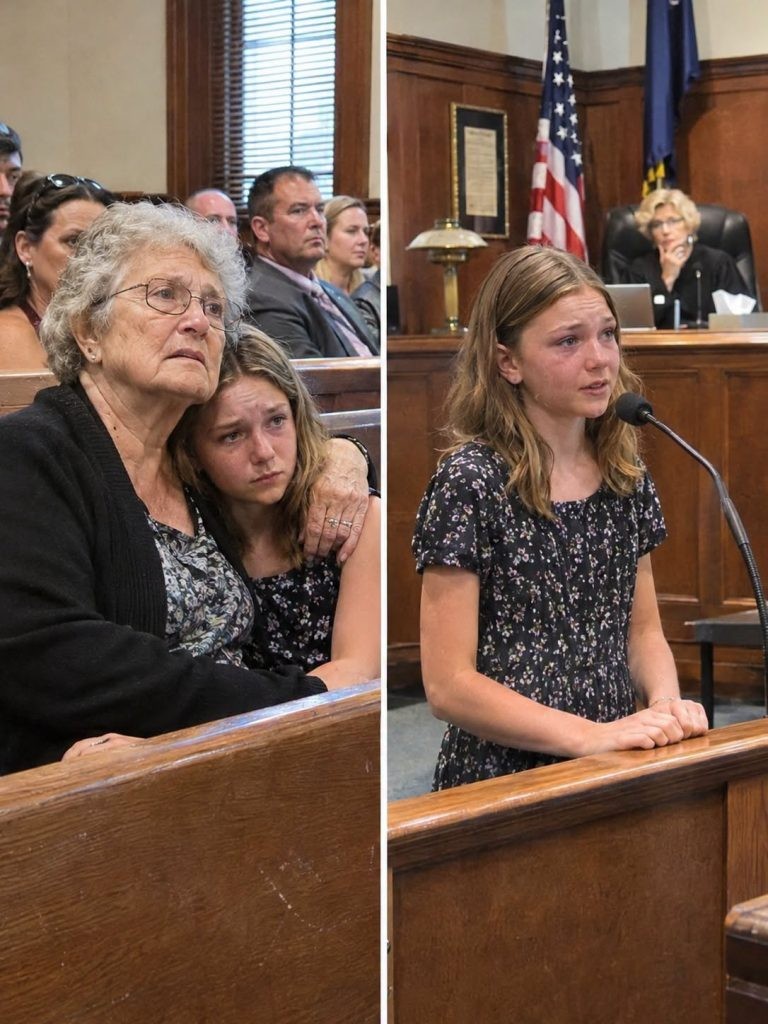

“Grandma, What Happens If the Judge Makes Me Go With Him?”
The question came quietly, almost like a whisper.
“Grandma, what happens if the judge makes me go with him?”
I looked up from the papers scattered across my bedroom floor. My eleven-year-old granddaughter, Hazel, stood in the doorway, holding her old stuffed rabbit against her chest. Her eyes were full of worry, and she looked much younger than her age.
I wanted to tell her that everything would be all right. I wanted to promise that no judge could ever separate us.
But I was seventy-five years old. I had learned that life did not always give us the answers we wanted, no matter how much we loved someone.
So I put down the documents, opened my arms, and invited her to sit beside me.
“We’re going to do everything we can to stay together,” I told her.
Hazel leaned against my shoulder. She had heard the arguments, seen the worried expressions on my face, and noticed the envelopes arriving in the mail. She knew something important was happening, even if she did not understand every legal detail.
Her father wanted custody of her.
And after eleven years of being absent, he suddenly believed he deserved to take her away.
The Little Girl I Had Promised Never to Abandon
Hazel’s mother was my daughter. When Hazel was only four months old, her mother died, leaving behind a tiny baby who needed someone to care for her.
Her father, Brandon, was still young. He had his own plans, ambitions, and ideas about the future. Instead of taking responsibility for his daughter, he made a choice that would shape Hazel’s childhood.
He left.
There were no bedtime stories from him, no birthday visits, no school celebrations, and no comforting phone calls when Hazel was sick. He did not watch her learn to walk or hear her first complete sentences. He was not there when she started kindergarten or when she came home crying because another child had made fun of her.
I became the person who did all those things.
I learned how to prepare bottles, change diapers, and calm a baby who woke up crying in the middle of the night. I rearranged my life around her needs. As she grew older, I helped her with homework, packed her lunches, attended parent meetings, and sat in the front row during school performances.
We did not have much money, but I tried to make our home feel safe.
Our house was small. The paint had begun peeling near the windows, and the front step had a crack that I had been meaning to repair for years. The furniture was old, and some of our belongings had been passed down through generations.
But Hazel had her own bedroom, a collection of books, school photographs on the wall, and a stuffed rabbit that had accompanied her through countless nights.
More importantly, she knew she was loved.
Whenever she asked about her father, I tried not to speak cruelly about him. I told her that adults sometimes made decisions they later regretted. I did not want her to grow up believing that she was somehow responsible for his absence.
For eleven years, Brandon remained away.
Then, without warning, he came back.
The Father Who Suddenly Wanted to Be a Parent
The first time Brandon contacted me about custody, I could hardly believe what I was reading.
He had married a wealthy woman named Caroline. They lived in a beautiful home with a swimming pool, spacious bedrooms, and everything money could buy.
Now he wanted Hazel to live with them.
His argument was simple: he could provide a better standard of living.
He had a large house. He had financial security. He could afford private lessons, expensive holidays, a comfortable bedroom, and opportunities that I could never offer on my limited income.
He presented his return as though it were an act of generosity.
But I could not stop thinking about the eleven years that had passed.
Where had he been when Hazel had a fever in the middle of the night? Where was he when she cried because she missed her mother? Where was he when she needed someone to hold her hand before her first day at school?
A swimming pool could not replace those memories. A beautiful bedroom could not make up for eleven birthdays without a father.
I was not against Hazel having a relationship with Brandon if that was something she wanted and if it could happen safely. But I could not understand why he believed that his financial situation gave him the right to suddenly become the center of her life.
When the custody case began, I realized how difficult the fight would be.
Brandon had money. I did not.
He could hire experienced lawyers and present photographs of his impressive home. I was a seventy-five-year-old grandmother living on a modest income, with little more than a lifetime of memories and a box full of documents.
Still, I refused to give up.
Preparing for Court With Everything I Had
I began gathering every piece of evidence that could show the life Hazel and I had built together.
I collected school reports, attendance records, medical documents, vaccination records, and photographs from birthdays and family celebrations. I found old receipts, letters from teachers, and other documents that demonstrated my involvement in Hazel’s daily care.
Every photograph seemed to tell a different part of our story.
There was Hazel on her first day of school, standing beside me with an oversized backpack. There was Hazel holding a birthday cake with frosting on her nose. There was a picture of her asleep on the sofa after a school concert, still wearing the costume she had insisted on showing me before bedtime.
I arranged everything carefully.
I wanted the judge to understand that I had not simply provided Hazel with a place to live. I had raised her. I had been there through the ordinary moments that make up a childhood.
Brandon prepared a different kind of presentation.
His lawyer showed photographs of the mansion, the swimming pool, the spacious living room, and the beautiful bedroom they had prepared for Hazel. Everything looked polished and expensive.
There were pictures of a comfortable future waiting for her.
But when Hazel was asked what she wanted, her answer was simple.
“I don’t want it. I want to stay with Grandma.”
Those words stayed with me long after she said them.
I knew that a child’s preference might not determine the outcome of a custody case. The court would have to consider her welfare and the circumstances surrounding her care. But hearing Hazel speak so clearly reminded me why I was fighting.
She did not want a bigger house.
She wanted the home she knew.
The Conversation Brandon Thought No One Would Hear
A few days before the hearing, something happened that changed everything.
Brandon visited, and I happened to overhear part of a conversation between him and Caroline.
He was explaining why Hazel had spent so many years living with me. But instead of admitting that he had chosen to walk away, he told his wife a very different version of events.
He claimed that I had kept Hazel from him.
According to his story, he had wanted to be involved in his daughter’s life all along, but I had prevented him from contacting her. He presented himself as a father who had been unfairly excluded from his child’s upbringing.
Caroline seemed troubled by the explanation.
I stood still, listening as Brandon continued to defend himself. He spoke as though the past eleven years had been something that happened to him rather than a consequence of his own decisions.
What he did not realize was that Hazel had heard the conversation, too.
She had been nearby and understood enough to recognize the lie.
Later that evening, she came to me with a serious expression.
“Grandma, he said you wouldn’t let him see me.”
I sat beside her and gently took her hands.
“I never wanted you to believe that your father didn’t care about you because of something I did,” I said. “I never stopped him from being your father.”
Hazel looked down at her stuffed rabbit.
“I know,” she answered.
Then she told me she had heard him say something else. He had admitted that he had chosen not to be involved when she was a baby because he did not want the responsibility.
I felt a mixture of sadness and anger.
For years, I had protected Hazel from the harshest parts of the truth. I had hoped that one day Brandon might explain his absence honestly. Instead, he was now trying to rewrite the past to make himself look like the victim.
But Hazel had heard the truth directly from him.
And she was not going to forget it.
The Day We Walked Into the Courtroom
The morning of the hearing arrived sooner than I expected.
I dressed carefully, choosing my neatest clothes. My hands trembled as I placed the documents into a folder. Hazel wore a simple outfit and carried her backpack.
Inside it was something she had not told me about.
Brandon arrived with his lawyer, looking confident. His expensive suit and calm expression made him appear completely comfortable in the courtroom.
His lawyer spoke first.
He described Brandon as a financially secure father who could provide a stable and comfortable home. He talked about the spacious property, the swimming pool, the opportunities available to Hazel, and the advantages of growing up in a wealthy household.
He also suggested that Brandon was ready to take an active role in his daughter’s life.
Then it was my turn.
I stood before the judge, feeling the weight of my age and the uncertainty of the situation. My voice shook at first, but I continued.
I explained that Hazel had lived with me since she was four months old. I described the routines we shared, the schools she attended, and the medical care I had arranged. I spoke about the birthdays, illnesses, school concerts, and difficult nights when she needed someone beside her.
I did not pretend that my house was perfect.
I admitted that it was old and that I could not offer Hazel the same luxuries Brandon could afford. But I also explained that she had a stable home, a familiar school, and a close support system.
Most importantly, I told the judge that Hazel had never been abandoned by me.
I had stayed.
When I finished, I looked toward my granddaughter.
She was sitting quietly, holding her backpack.
Then she stood up.
“Your Honor, I have something to show you.”
The courtroom became silent.
The Old Letter That Changed the Hearing
Hazel reached into her backpack and pulled out a folded piece of paper.
It was an old letter.
She explained that she had found it among the family documents. It had been written by Brandon shortly after he had left her in my care.
I had kept it for years, not because I wanted to use it against him, but because it was part of the history of what had happened.
Hazel handed the letter to the court.
The judge began reading.
In it, Brandon had admitted that he did not want a baby interfering with his future. He had made it clear that he was unwilling to take responsibility for raising a child at that point in his life. He had also instructed me not to contact him unless it was absolutely necessary.
The words were painful to read, especially after hearing him claim that I had kept him away from Hazel.
The judge looked toward Brandon.
“Is this your letter?”
For the first time that morning, Brandon seemed uncertain.
After a moment, he admitted that the letter was genuine.
The explanation he had given Caroline and the story his lawyer had presented were now difficult to reconcile with his own written words.
Hazel was not finished.
She opened her backpack again and took out a small photo album. Page after page showed the life we had shared over eleven years.
There were pictures of her first birthday, school performances, holidays, family dinners, and ordinary afternoons at home. Some photographs showed us smiling together. Others captured small moments that might have seemed unimportant to anyone else.
But they were the moments that had made Hazel’s childhood.
The album showed a little girl growing up with the same person beside her.
“Grandma Already Gave Me My Life”
Hazel stood quietly before the judge.
She looked nervous, but her voice was clear.
“My dad says he can give me a better life,” she said. “He has a big house and a swimming pool. But Grandma already gave me my life.”
I felt tears gathering in my eyes.
Hazel continued.
“She was there when I was little. She takes care of me when I’m sick. She helps me with school, listens to me when I’m sad, and makes me feel safe. I don’t know my dad the way I know Grandma.”
She paused, holding the photo album against her chest.
“I don’t want to leave the person who has always been there for me.”
No amount of money could have made those words more meaningful.
The judge listened carefully. The court had to consider more than the size of either home or the financial resources available. Hazel’s history of care, her emotional bonds, the circumstances of Brandon’s absence, and her own wishes all formed part of the picture.
When the judge finally delivered the decision, I could barely breathe.
Hazel would remain in my care.
The judge recognized the importance of the stable relationship we had built and the years of consistent care I had provided. Brandon’s sudden return and financial advantages did not erase his previous absence or automatically make his home the better choice for Hazel.
I reached for Hazel’s hand.
She squeezed it tightly.
For the first time in weeks, I felt that I could breathe again.
An Unexpected Change in Caroline
The hearing did not immediately repair everything that had been broken.
Brandon was disappointed, and our family still had difficult conversations ahead. But something unexpected happened afterward.
Caroline contacted me.
She apologized for believing Brandon’s explanation without knowing the full story. She admitted that she had not understood how much Hazel had already been through or how deeply I had been involved in raising her.
She also acknowledged that the letter had forced her to reconsider what Brandon had told her.
Over time, Caroline began to take a different approach.
She did not try to replace me or pressure Hazel into accepting a new family arrangement. Instead, she made an effort to build a relationship gradually, respecting Hazel’s feelings and boundaries.
She even helped arrange repairs to our old house, including the broken front step and parts of the exterior that had needed attention for years.
I was grateful for the kindness, but what mattered most was that she began treating Hazel as a child with feelings and a history, rather than someone who could simply be moved into a new home.
Eventually, she became part of Hazel’s life in a way that felt more natural.
Brandon also began to change, although trust could not be rebuilt overnight.
He sent Hazel an honest birthday card. It did not contain expensive promises or grand declarations. Instead, he acknowledged that he had missed many years and that he could not expect her to forget them.
He asked whether he might someday learn her favorite breakfast.
It was a small question, but perhaps it was a more meaningful beginning than another photograph of a mansion.
Hazel did not immediately know how to respond. She was allowed to take her time.
For once, the adults around her were beginning to understand that rebuilding a relationship required patience, honesty, and respect.
The Home That Money Could Never Buy
That evening, after everything was over, Hazel came into my bedroom.
She was holding her stuffed rabbit again.
She climbed onto the bed, wrapped her arms around me, and whispered:
“Grandma, you gave me everything.”
I held her close.
I thought about the eleven years behind us. The sleepless nights, the school mornings, the birthday cakes, the medical appointments, and the quiet conversations before bedtime.
I thought about the old house with its peeling paint, the furniture we had used for years, and the things I had never been able to afford.
For a long time, I had worried that not having enough money would make me less capable of giving Hazel the childhood she deserved.
But that night, I understood something I should have known all along.
A loving home is not measured by the size of its rooms, the price of its furniture, or the number of luxuries it contains.
It is measured by the people who make a child feel safe.
It is measured by who stays when life becomes difficult, who remembers the little things, who sits beside a sick child through the night, and who shows up even when there is nothing to gain.
Brandon could offer Hazel a mansion. He could give her a swimming pool, expensive clothes, and holidays in beautiful places.
But he could not buy eleven years of shared memories.
He could not purchase the trust that grows when someone keeps every promise.
And he could not erase the simple truth Hazel had spoken in court.
Her grandmother had already given her a life.
I was seventy-five years old, and I did not know how many years I had left. But I knew that every one of those years had been made richer by raising Hazel.
I had not given her everything money could buy.
I had given her something I hoped she would carry for the rest of her life: the certainty that she was loved, that she belonged, and that she would never have to face the world alone.
Sometimes, the greatest gift a person can give a child is not a perfect home.
It is simply refusing to walk away.