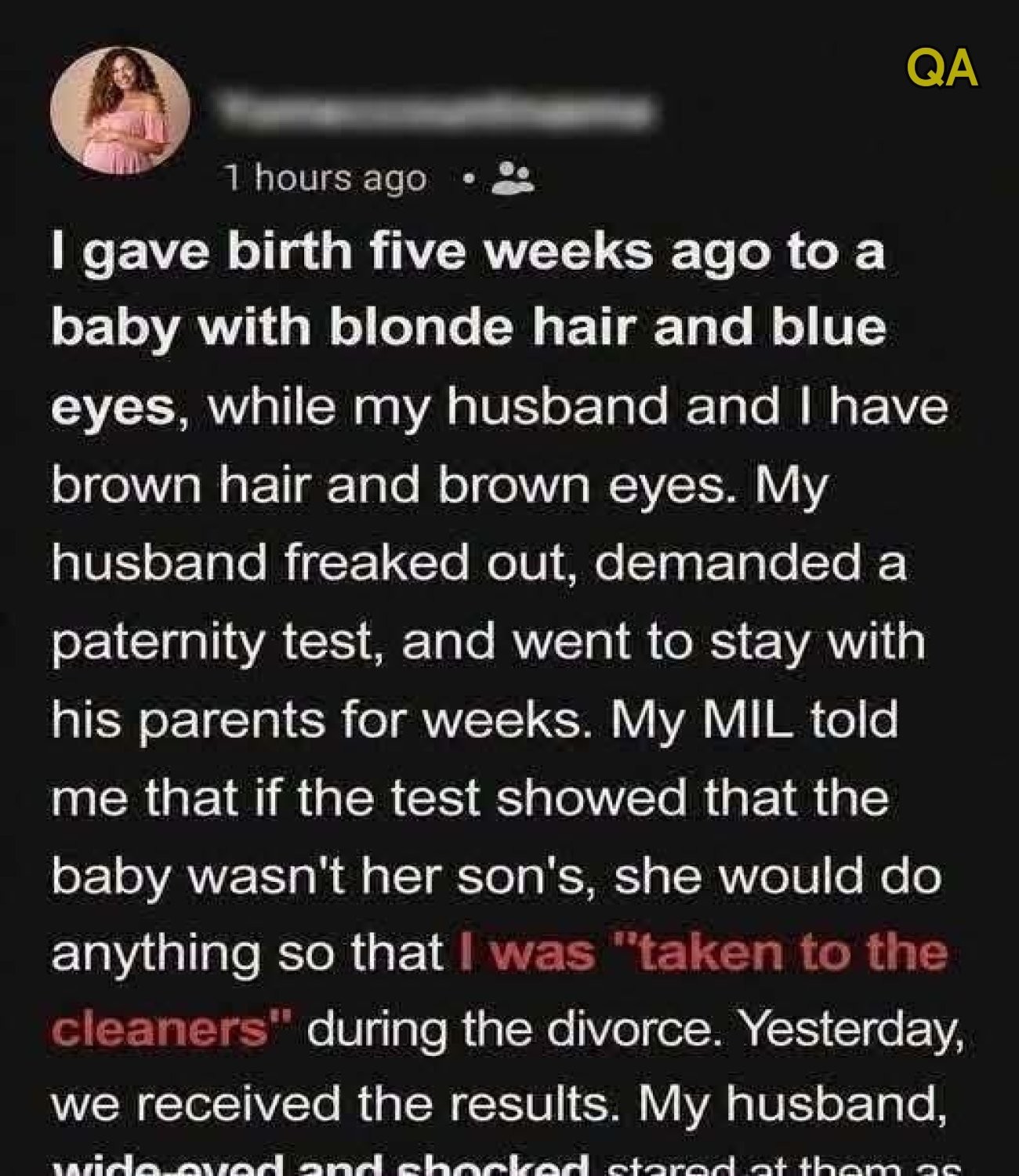

Five weeks after the birth of my daughter, Isla, my husband Rowan began questioning whether she was his child. His concern was based entirely on her appearance: Isla had blonde hair and blue eyes, while Rowan and I both have brown hair and brown eyes.
What followed was not simply a disagreement about genetics. It became a deeply painful test of trust during one of the most vulnerable periods of our lives. Rowan asked for a DNA test, then left to stay with his parents while he waited for the results. His mother, Barbara, added to the pressure by saying that a divorce should follow if the test showed Rowan was not Isla’s father.
When the results arrived, they confirmed that Rowan was Isla’s biological father. Her appearance was not evidence of wrongdoing. It was a reminder that inheritance is more complex than many people assume. Yet the test result did not instantly repair the hurt caused by the accusation. Rebuilding trust required honest conversations, accountability, clear boundaries, and time.
Why Newborn Appearance Can Be Misleading
It is understandable that parents notice every feature of a new baby, from eye color and hair texture to the shape of a nose or smile. However, physical traits are not always predictable from a parent’s most visible characteristics. A child’s appearance reflects a combination of genetic material inherited across many generations.
Hair color and eye color are influenced by multiple genes, rather than a single simple rule. Brown eyes are often associated with higher levels of melanin, but eye color inheritance involves several genes that affect pigment production and distribution. The same is true of hair color. A baby may inherit gene variants from grandparents, great-grandparents, or more distant relatives, including variants that are not obvious in either parent’s appearance.
Newborn features can also change considerably over time. Many babies are born with light-colored hair that darkens during infancy or early childhood. Eye color may shift during the first months of life as melanin develops in the iris. According to the American Academy of Pediatrics, it can take months for a child’s permanent eye color to become clearer.
In our case, Isla’s blonde hair and blue eyes were treated as a conclusion when they should have been understood as a possibility. Later, Rowan’s father, Norman, recalled a blonde-haired relative whom Isla resembled. That memory did not erase the damage, but it highlighted an important point: family traits can reappear unexpectedly.
The Emotional Weight of Paternity Doubts After Birth
The weeks after childbirth are often physically and emotionally demanding. New parents may be adapting to sleep deprivation, feeding schedules, recovery from delivery, changing routines, financial pressures, and the responsibility of caring for a newborn. In that setting, an accusation of infidelity can feel especially isolating.
For me, Rowan’s request for a DNA test was not only about science. It communicated that he had chosen suspicion over our relationship history and my word. I was still adjusting to motherhood when I found myself defending my integrity. His decision to leave and involve his parents made the experience feel even more public and destabilizing.
Rowan later said that fear and ignorance had driven his reaction. He acknowledged that he did not understand how genetics work and that his anxiety quickly became certainty. His apology mattered because it included responsibility. He did not blame Isla’s appearance, his parents, or a misunderstanding. He recognized that his response had caused real harm.
Still, an apology is the beginning of repair, not the end of it. Trust is built through consistent actions over time. For a couple facing a similar conflict, it can be helpful to separate the factual question from the emotional impact. A test may answer a biological question, but it cannot automatically resolve feelings of betrayal, humiliation, fear, or abandonment.
DNA Testing and the Importance of Respectful Communication
DNA testing can provide highly accurate information about biological relationships when performed through reputable laboratories using properly collected samples. In some circumstances, people seek such testing for legal, medical, or personal reasons. However, the way a request is made can have lasting consequences for a relationship.
When paternity concerns arise, respectful communication is essential. Instead of making accusations, a partner can explain their feelings, acknowledge uncertainty, and avoid treating appearance as proof. Statements such as “I am feeling anxious and I need help understanding this” are very different from claiming that someone has been unfaithful.
Privacy also matters. Couples should think carefully before involving relatives in an intimate conflict. Family members may feel protective, but their involvement can escalate tensions and make reconciliation more difficult. In our situation, Barbara’s immediate call for divorce made me feel judged before anyone had reliable information.
Before arranging any genetic test, people should also understand the legal and privacy implications in their location. Requirements for consent, testing procedures, and the use of results can vary. When legal matters are involved, advice from a qualified family-law professional may be appropriate. For emotional concerns, a licensed counselor can help partners have difficult conversations without turning them into personal attacks.
An Apology That Creates Space for Healing
After the results confirmed that Isla was Rowan’s daughter, he apologized. His voice shook as he told me that he should never have doubted me. I listened, but I also told him plainly how much his judgment had hurt. I did not want to pretend that the result had made everything normal again.
That honesty was important. Reconciliation does not require someone to minimize their pain in order to make another person feel better. It requires both people to recognize what happened and decide whether they are willing to do the work of moving forward.
Rowan and I began with small steps. We spent time together as a family and brought back a simple ritual we had enjoyed before Isla was born: sharing the highlight of our day. Sometimes the highlight was ordinary, such as a quiet walk, a successful nap, or a funny expression from Isla. Those moments helped us reconnect beyond the crisis.
Our first dinner out as a family was not a magical solution, but it felt meaningful. It reminded us that the relationship we valued still existed beneath the anger and uncertainty. Small, dependable moments can be especially powerful after a conflict because they create evidence of care and reliability.
Setting Boundaries With Extended Family
A few days later, Barbara arrived with pastries and an uncomfortable apology. She admitted that she had been overly protective of Rowan and that she had acted before knowing the facts. Her words could not undo what she had said, but they showed a willingness to take responsibility.
I accepted the apology cautiously. I wanted Isla to have a relationship with her grandmother, but I also needed respect. At a later coffee meeting, I explained that Barbara could be part of Isla’s life if our boundaries were honored. That meant no repeated accusations, no undermining either parent, and no treating Isla’s appearance as a reason to question her place in the family.
Healthy boundaries are not punishments. They are clear expectations that protect relationships from repeating harmful patterns. In many families, grandparents can provide valuable support to new parents and children. But that support works best when it respects parental authority, privacy, and the emotional well-being of everyone involved.
Barbara agreed to those boundaries. She also said that she could now see family resemblance in Isla. While that observation was welcome, it was not what mattered most. Isla did not need to look like anyone to deserve acceptance. She was already a loved child who deserved to grow up free from adult suspicion.
Supporting New Parents During a Stressful Transition
The postpartum period can affect the whole household. The U.S. Centers for Disease Control and Prevention notes that postpartum depression and anxiety can affect new mothers, and emotional health concerns may also affect partners. Persistent sadness, intense worry, anger, withdrawal, hopelessness, or difficulty functioning should be taken seriously.
Friends and relatives can support new parents by offering practical help rather than criticism. Bringing a meal, helping with errands, listening without judgment, or encouraging a parent to speak with a health professional can make a meaningful difference. The goal should be to reduce pressure, not add to it.
Couples can also protect their relationship by discussing concerns early and respectfully. This may include talking about sleep schedules, household responsibilities, finances, visits from relatives, and each partner’s need for rest. When conflict becomes difficult to manage alone, couples counseling can offer a structured and confidential setting for communication.
What This Experience Taught Our Family
The experience taught me that love can be strained by fear, misinformation, and outside pressure. It also taught me that repair is possible when people are willing to be honest about the harm they caused. Rowan’s apology did not erase my pain, and Barbara’s apology did not immediately restore my confidence in her. But both created an opening for a different future.
For Rowan and me, rebuilding trust meant choosing patience over quick resolution. It meant recognizing that genetic surprises are normal and that a child’s appearance should never be used as evidence of a parent’s character. It also meant making Isla’s well-being the center of our decisions.
Families do not need to be perfect to be loving. They do, however, need accountability, compassion, and boundaries. When trust has been damaged, forgiveness may be possible, but it should be accompanied by changed behavior. In our case, healing began when the people involved stopped defending their assumptions and started listening to one another.
Sources
- American Academy of Pediatrics: Newborn Appearance and Development
- MedlinePlus Genetics: Is Eye Color Determined by Genetics?
- MedlinePlus Genetics: Is Hair Color Determined by Genetics?
- CDC: Depression During and After Pregnancy
- National Institute of Mental Health: Perinatal Depression
- Mayo Clinic: Postpartum Depression
Disclaimer: This content is intended for entertainment purposes only and is not based on real events.