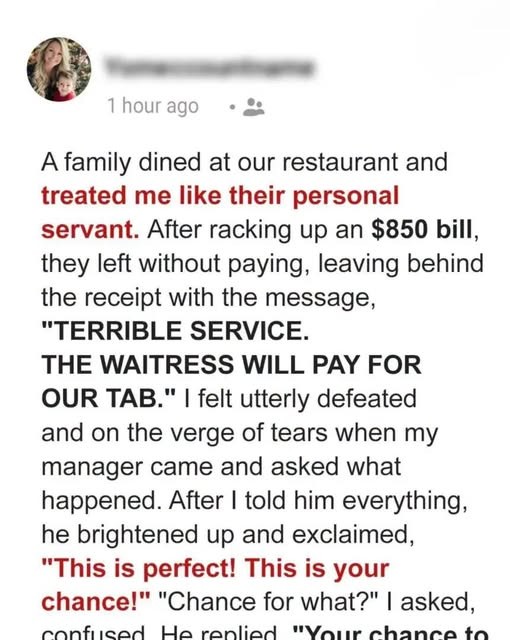

When a Family Skipped Out on an $850 Restaurant Bill
Editor’s note: The original account includes named individuals, a specific restaurant incident, and a claimed video recording that cannot be independently verified from the information provided. This article therefore does not present those details as established fact. Instead, it examines the broader, real-world issues raised by an alleged unpaid restaurant bill: staff treatment, business procedures, payment recovery, workplace support, and responsible public communication.
A busy restaurant shift can depend on dozens of small decisions going right at the same time. Servers coordinate with kitchen teams, managers handle guest concerns, and hosts work to keep tables moving smoothly. Most guests understand the pressure involved and treat restaurant employees with courtesy. Yet restaurants also face difficult situations, including customers who repeatedly complain, refuse payment, or leave before a bill has been settled.
An alleged $850 walkout, such as the one described in the original draft, would be a significant loss for many independent restaurants. It would also raise important questions: Should a server be held financially responsible? When should a manager contact law enforcement? Can video be shared publicly? And how can a restaurant defend its staff while maintaining a professional, safe environment for every customer?
These questions do not have one universal answer. Laws vary by country, state, and city, while each hospitality business has its own policies. Still, labor guidance, customer-service standards, and ethical communication practices offer a useful framework for handling payment disputes fairly and responsibly.
Restaurant Bill Walkouts Are a Business and Workplace Issue
Leaving a restaurant without paying is often described informally as a “dine and dash.” Depending on the circumstances and local law, an intentional failure to pay may be treated as theft of services, fraud, or a civil debt matter. The legal response can depend on evidence of intent, the value of the unpaid bill, whether the customer gave accurate contact information, and whether there was a genuine dispute over food or service.
For restaurants, the immediate concern is not only the lost revenue. A walkout can disrupt an entire shift. A server may feel personally blamed, kitchen staff may become frustrated after preparing costly dishes, and managers may have to document the event while still serving other guests. In a high-pressure environment, a measured response is essential.
Businesses are generally best served by creating clear procedures before an incident occurs. These may include verifying payment methods for large parties, requiring a card on file for private events, setting policies for split bills, and training managers to address escalating customer concerns early. A well-designed policy protects both the restaurant and its guests because expectations are communicated before a disagreement becomes more serious.
Why Frontline Restaurant Employees Need Support
Restaurant employees often work in public-facing roles where they must remain calm even when a guest is impatient, dismissive, or unfairly critical. Professional hospitality does not require staff to tolerate harassment or humiliation. Managers have an important duty to support workers who experience difficult behavior while performing their jobs.
The U.S. Department of Labor recognizes that restaurant and food-service work can involve wage, scheduling, and workplace-condition concerns. Employers should ensure that their internal rules comply with applicable wage-and-hour laws, including rules on deductions from employee pay. In the United States, federal wage rules can limit when deductions may be made if they reduce an employee’s pay below the required minimum wage or affect overtime obligations.
In practical terms, a restaurant should not assume that a server must personally cover an unpaid customer bill. Even where a business believes it may seek repayment under a local policy, it should obtain appropriate legal and payroll guidance. Policies should be disclosed clearly, applied consistently, and reviewed for compliance with labor laws. Placing the full financial burden on a worker who did not cause the loss can damage morale and may create legal risks.
Support can take several forms. A manager can step in during a tense table interaction, offer a staff member a brief break after an upsetting encounter, and document complaints objectively. Managers can also review whether service problems were real, such as an incorrect order or an unreasonable delay, rather than automatically accepting either side of the story. Fairness is more credible when it is based on records, receipts, staff accounts, and available security footage.
Handling Customer Complaints Before They Escalate
Not every demanding guest is acting in bad faith. Food allergies, dietary restrictions, long waits, billing errors, and incorrect orders can all lead to legitimate complaints. The challenge for restaurant staff is separating a solvable service issue from repeated demands that cannot reasonably be met.
Good customer-service practice begins with active listening. A server or manager can acknowledge the concern, restate it accurately, and offer a realistic solution. For example, if a dish is not prepared as ordered, the restaurant may replace it, adjust the bill where appropriate, or explain the expected preparation time. If the concern is about ambience or seating, staff can consider a move when space permits without promising an outcome they cannot deliver.
Documentation becomes especially useful when complaints are repeated or when a large bill is involved. Managers can note which items were replaced, what discounts were offered, and what the guest accepted. This record can help resolve a payment dispute later and reduces confusion among staff during a busy service period.
Restaurants should also give employees clear authority levels. A server may be able to replace a drink or alert a manager, while only a manager may approve a substantial discount or remove an item from a bill. Clear boundaries protect employees from pressure and ensure that guests receive consistent treatment.
Payment Recovery: Calm Documentation Matters
If guests leave without paying, the restaurant should focus first on safety and accurate documentation. Employees should avoid physically confronting customers or attempting to block them from leaving. A manager can preserve the bill, note the time and table number, identify any staff witnesses, and retain relevant security footage according to the business’s policy and local privacy requirements.
If the guests made a reservation, the restaurant may have contact details that can be used for a professional request for payment. Written communication should be factual and restrained. It should include the date of service, the amount due, a summary of prior efforts to resolve the matter, and a reasonable deadline for response. Accusatory language can make an already difficult situation worse and may create avoidable legal exposure.
When there is evidence that a guest deliberately left without paying, management may decide to contact local police or seek legal advice. This decision should be based on the facts of the incident and the law in the relevant jurisdiction, not on anger or public pressure. Restaurants should avoid making legal conclusions publicly before authorities or legal advisers have reviewed the situation.
For high-value bills, prevention can be just as important as recovery. Restaurants may consider periodic check-ins for large parties, earlier presentation of the bill when appropriate, and payment authorization procedures for events or tasting menus. These measures should be applied respectfully and consistently, without profiling customers based on appearance, nationality, race, age, or other protected characteristics.
Social Media Can Build Support but Also Creates Risks
The original draft describes a video that allegedly captured a customer dispute and later generated public support. In real life, social media can quickly amplify restaurant conflicts. A post may encourage loyal customers to support a local business, but it can also expose staff and guests to harassment, misinformation, or privacy concerns.
Before publishing footage or identifying details about a customer, a restaurant should consider privacy rules, consent requirements, platform policies, and the possibility that the facts are incomplete. Blurring faces may reduce some privacy concerns, but it does not eliminate every risk. People can sometimes be identified through clothing, location details, voice, companions, or contextual information.
A more responsible approach is often to communicate at a general level. A restaurant can thank its community for support, explain that it values respectful treatment of staff, and state that it is handling an incident through appropriate channels. This keeps the focus on workplace values rather than turning a conflict into public entertainment.
Businesses should also remember that viral attention is unpredictable. Online audiences may make assumptions, target individuals, or spread inaccurate claims. A restaurant’s strongest long-term asset is usually its reputation for fair service, calm leadership, and respect for both employees and customers.
Managerial Leadership During Difficult Service Incidents
Effective restaurant managers set the tone for how a team responds under pressure. A manager who listens to staff, checks the facts, and takes ownership of a payment dispute can prevent an employee from feeling isolated. This leadership is particularly important for newer workers, who may not yet know how to respond to aggressive complaints or complex payment issues.
Training should cover de-escalation, food-allergy procedures, service recovery, payment policies, and when to involve a supervisor. Staff should know that calling a manager is not a failure. It is often the correct step when a customer becomes hostile, repeatedly changes demands, disputes a large bill, or appears likely to leave without paying.
Recognition also matters. Employees who demonstrate patience, accuracy, and professionalism should receive constructive feedback and opportunities for growth. Promotion decisions, however, should be based on sustained performance, training, reliability, and leadership skills rather than a single highly publicized incident.
A Fairer Standard for Customers and Restaurants
Restaurants depend on mutual respect. Customers have the right to raise reasonable concerns about food, cleanliness, accessibility, billing, and service. Employees have the right to work without abuse, discrimination, or unfair financial penalties. Managers have the responsibility to investigate problems fairly and make decisions based on evidence.
When a bill dispute occurs, the best outcome is usually a timely, private, and documented resolution. Customers should explain concerns before leaving and allow a manager an opportunity to respond. Restaurants should address valid complaints transparently and avoid treating every dispute as misconduct. If someone intentionally refuses to pay, the business should use established procedures rather than relying on public shaming or confrontation.
The broader lesson is not that every difficult customer encounter should become a viral story. It is that restaurants need practical systems that protect people, preserve dignity, and reduce preventable losses. Clear payment policies, lawful wage practices, supportive management, and careful communication can help businesses navigate even the most challenging service situations.
Sources
- U.S. Department of Labor: Tipped Employees Under the Fair Labor Standards Act
- U.S. Equal Employment Opportunity Commission: Harassment
- National Restaurant Association: Restaurant Industry Research and Resources
- CDC/NIOSH: Work-Related Stress
- Federal Trade Commission: Social Media Privacy Information
Disclaimer: This content is intended for entertainment purposes only and is not based on real events.
