
I never imagined that one conversation could change my relationship with my daughter forever. But sometimes, the words we say in a moment of frustration become the wounds our loved ones carry for years.
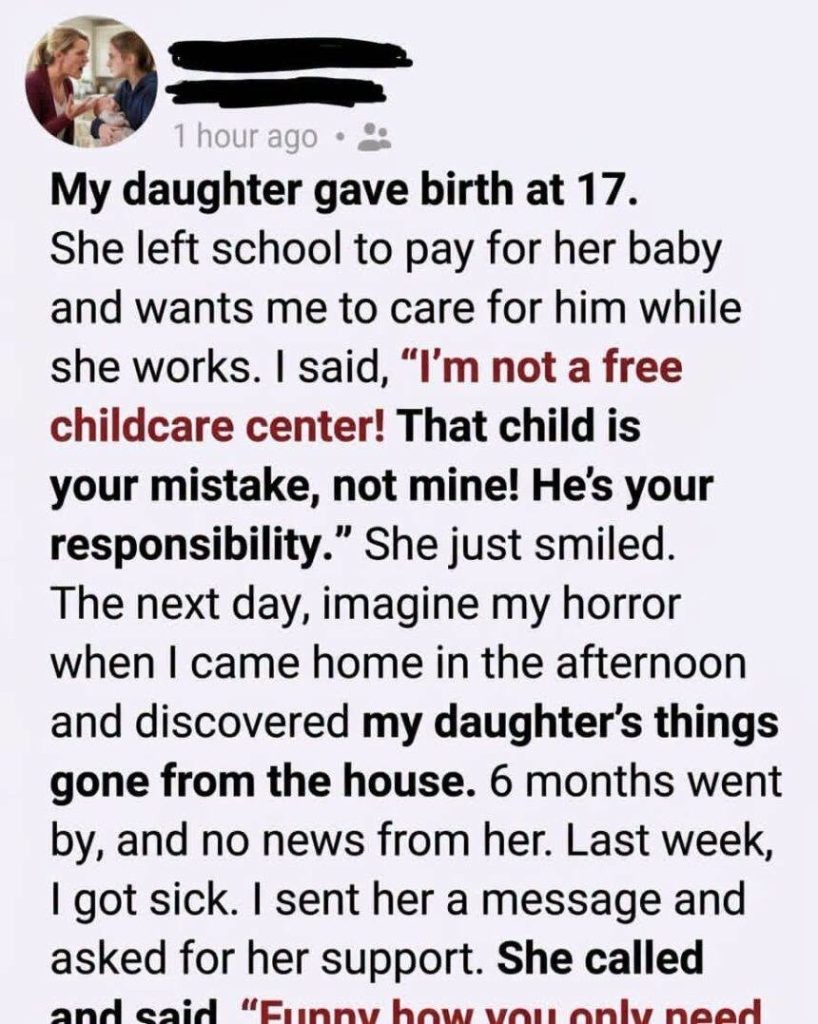
My daughter was only seventeen when she gave birth. One afternoon, she stood in my kitchen with her newborn baby in her arms, looking exhausted and frightened. She told me she wanted to leave school temporarily and find a job so she could support herself and her child.
Then she asked me for something simple, something I thought I could have understood if I had been willing to look beyond my own frustration.
She asked me to care for her baby until she could get back on her feet.
Instead of seeing a frightened young mother who desperately needed support, I saw a burden I didn’t want to take on.
“I’m not a free childcare service,” I told her. “You chose to have a baby, so you need to accept responsibility for your decisions.”
I convinced myself I was teaching her an important lesson about independence. I told myself that if I helped her now, she might never learn to stand on her own two feet.
What I failed to understand was that she wasn’t asking me to take responsibility for her entire life. She was asking her mother for a little help during one of the most overwhelming moments of hers.
My daughter didn’t argue. She didn’t cry or raise her voice. She simply nodded, gathered her belongings, and walked out of my kitchen with her baby.
The following morning, I discovered that she had taken everything, including the little blanket her newborn had been sleeping in.
On the kitchen table lay a short note.
She wrote that she understood my position and wouldn’t ask me for anything again. She also said I shouldn’t expect her to visit or call.
At first, I thought she was being dramatic.
I assumed that once reality became difficult enough, she would come back. Surely she would eventually realize that every mother had limits and that I had only been trying to teach her responsibility.
Days passed. Then weeks. Then months.
Neither my daughter nor my grandchild returned.
I could have picked up the phone. I could have admitted that I had spoken harshly, asked how they were doing, or offered help without expecting anything in return.
But pride kept me silent.
I told myself that she had made her decision and that it was her responsibility to live with the consequences. Whenever I thought about reaching out, I found another reason to wait.
I believed time would eventually fix what I had broken.
It didn’t.
Years passed, and the distance between us became a part of my daily life. I didn’t know the little things about my grandchild that grandparents often take for granted. I didn’t know what made the child laugh, what frightened them, or what their favorite bedtime story was.
I missed birthdays, milestones, and ordinary family moments that could never be recreated.
Still, I held on to my pride. Somewhere deep inside, I believed my daughter would eventually return and understand why I had acted the way I did.
Then my health began to deteriorate.
After several medical tests, my doctors diagnosed me with a serious illness. Suddenly, the future I had always assumed would be there seemed uncertain.
For the first time in years, I found myself thinking less about who had been right and more about what truly mattered.
I thought about my daughter as a little girl, running into my arms after a difficult day. I remembered the times she had needed reassurance, the times she had trusted me to make everything feel safe.
And I thought about the seventeen-year-old standing in my kitchen, holding her newborn and asking her mother for help.
I had looked at her fear and answered with judgment.
I had demanded that she learn responsibility while refusing to consider my own.
The realization was painful, but it was impossible to ignore.
Eventually, I picked up my phone and called her.
When she answered, I struggled to find the right words. I told her about my diagnosis and admitted that I was frightened. I said I needed her and hoped she might be willing to come see me.
For a moment, there was silence.
Then she spoke quietly.
“Mom, I’m not your free caregiver either.”
Her words caught me off guard. I reminded her that I was her mother, that I had raised her, and that I had sacrificed so much for her over the years.
I expected her to remember the good things I had done. I wanted her to understand that, whatever had happened between us, we were still family.
But she answered with a sentence I will never forget.
“And I was your daughter when I needed you most.”
Then she ended the call.
I sat alone, staring at my phone, unable to think of anything to say.
For years, I had told myself that my daughter was stubborn, ungrateful, and unwilling to forgive. I had focused on her decision to leave without considering what had driven her away.
Now I was beginning to understand that she hadn’t simply walked out of my kitchen that day.
She had walked away from the belief that she could depend on me when she was vulnerable.
And when I finally needed her, she was protecting herself from the same disappointment she had experienced years earlier.
My illness did not erase what had happened. My fear did not make my daughter’s pain less real. And being her mother did not automatically entitle me to her time, affection, or care.
That was perhaps the hardest lesson of all.
I had believed that motherhood gave me a permanent place in her life, no matter how I treated her. I had assumed that the sacrifices I made while raising her would always outweigh the moments when I failed her.
But love does not work like a bank account, where old deposits give us permission to keep withdrawing from someone forever.
Relationships need care in the present. Trust needs to be earned and protected. And apologies, however sincere, cannot demand that another person immediately open a door they spent years learning to close.
I still wish I had responded differently that afternoon. I wish I had asked my daughter what she needed most. I wish I had offered to watch the baby for a few hours, helped her explore her options, or simply held her while she cried.
Perhaps our lives would have unfolded differently.
I cannot know whether my daughter will ever be ready to speak to me again. I cannot demand forgiveness simply because I now understand the pain I caused.
All I can do is acknowledge my part in our estrangement and accept that she has the right to decide what kind of relationship, if any, she wants with me.
My illness has made me think about the time I have left, but it has also forced me to confront something I should have understood long ago: love is not proven by demanding loyalty from the people closest to us. It is shown through compassion when they need us most.
I wanted my daughter to learn responsibility when she was seventeen. Instead, I taught her that asking me for help could leave her more alone than before.
Now, as I face an uncertain future, I am learning that some consequences cannot be undone simply because we finally regret our choices.
If there is one thing I wish I had understood earlier, it is this: when someone you love comes to you in their most vulnerable moment, listen before you judge. Offer understanding before you offer a lecture. And never assume that the people who love you will always be there, no matter how often you turn them away.
Sometimes, the person you refuse to help today is the person you will wish you had treated differently tomorrow.
And sometimes, the most painful part of losing someone is realizing that the distance between you began with a moment when you could have chosen love, but didn’t.
Editorial note: This is presented as a personal-style story. The events have not been independently verified.
