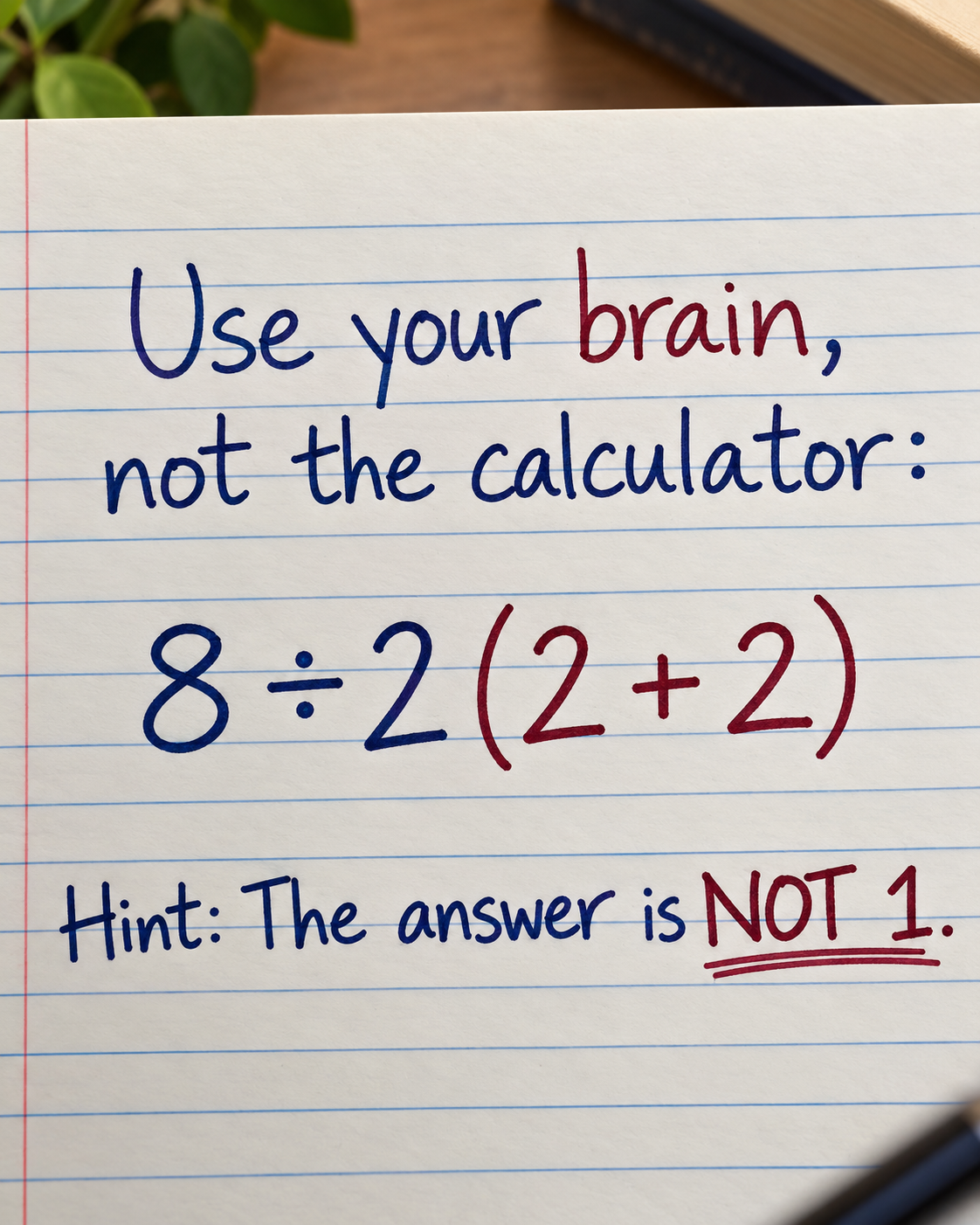

Have you ever seen a math problem that instantly splits the internet into two opposing camps?
The intrigue of mathematics often lies not only in its complexity, but sometimes in its deceptive simplicity. Every so often, a single mathematical expression can spark massive debate, with millions worldwide striving for consensus over its solution. Such is the case with a classic math puzzle, which continues to divide internet users into two fervently opposing groups: those confident the answer is 1, and those equally certain it is 16.
The Viral Math Puzzle and Its Widespread Controversy

This math puzzle, usually presented in the form “8 ÷ 2(2 + 2)”, transcends typical classroom discussions and enters mainstream culture, trending across social platforms and even featuring in educational debates. At first glance, it appears to be a straightforward arithmetic problem, something any primary school student would be expected to solve. Yet its viral nature stems from the enduring disagreement about its correct answer, as well as the underlying rules governing mathematical computation.
What Makes This Problem So Confusing?
Mathematics is universally regarded as the language of logic and precision. But when it comes to the interpretation of notational conventions and operational rules, unexpected ambiguities may arise—especially when expressions are written in formats that allow multiple valid readings. The puzzle “8 ÷ 2(2 + 2)” stands as a classic illustration of how such ambiguity can occur, particularly when thousands of users across the globe propose different solutions and justify their answers with equal confidence.
Several prominent mathematicians and educators have commented on this viral problem over the years, noting that its confusion stems from two main sources: the use of parentheses (brackets) and the sequence in which operations are performed. In mathematics, these are governed by clear rules, but notation matters, and subtle variations in writing can sometimes change the result.
The Fundamental Rule: Order of Operations
To understand why debate persists over the puzzle’s answer, it is essential to analyze the fundamental principles behind solving such expressions. The order of operations—a rule universally taught and applied in mathematics—decides which computations occur first. This is typically encapsulated by the acronyms PEMDAS (Parentheses, Exponents, Multiplication/Division, Addition/Subtraction) and BODMAS (Brackets, Orders, Division/Multiplication, Addition/Subtraction).
Both PEMDAS and BODMAS prescribe that parentheses or brackets always have the highest priority. The process for solving the puzzle begins by evaluating the numbers within the parentheses:
- (2 + 2) = 4
By replacing (2 + 2) with 4, the puzzle is now rewritten as:
- 8 ÷ 2(4)
Step-by-Step Breakdown: Clarifying the Notational Ambiguity
At this point, the expression presents a notational ambiguity. The juxtaposition of “2” and “(4)” indicates multiplication, so “2(4)” is interpreted as 2 × 4. The puzzle now reads:
- 8 ÷ 2 × 4
The crucial question is whether to multiply or divide first. Many contend that multiplication precedes division, thus:
- 2 × 4 = 8
- 8 ÷ 8 = 1
However, mathematicians clarify that multiplication and division share equal priority. According to the official rules, operations with the same priority are performed left-to-right.
- 8 ÷ 2 = 4
- 4 × 4 = 16
Following this protocol, the correct answer is 16.
Historical Context: How Notational Conventions Evolved
Historically, mathematical notation has evolved to mitigate ambiguities. Early algebraic texts often used the juxtaposition of numbers and parentheses to indicate multiplication (e.g., 2(4)). As mathematical instruction became more formalized, educators began emphasizing precise notation—using explicit multiplication signs and rewritten expressions to remove uncertainties. Today, textbooks typically encourage writing ambiguous formulas as “8 ÷ [2 × (2 + 2)]” or “8 ÷ 2 × (2 + 2)” to avoid misunderstanding.
Internationally, standards such as the ISO 80000 recommend clarity in mathematical expression, especially for electronic communication where context may be lacking. Despite these moves toward clarity, ambiguities like those in “8 ÷ 2(2 + 2)” remain common, highlighting the enduring importance of notation in mathematics.
Expert Perspectives: Mathematicians and Educators
Leading mathematical organizations and educators worldwide unanimously support the standard order of operations applied left-to-right for expressions involving multiplication and division. Dr. Peter Rowlett, a senior lecturer in mathematics, explains in interviews that confusion is often a product of how teachers present formulas early in a student’s education. He suggests that ambiguous expressions should be rewritten for clarity, but also notes that following PEMDAS/BODMAS strictly and computing left-to-right yields the answer 16.
The American Mathematical Society, among other organizations, recommends that ambiguous statements like this be avoided in formal writing, but confirms that left-to-right evaluation is correct for multiplication and division, since neither operation outranks the other.
Global Public Reaction: Why the Debate Continues
Public reaction to this puzzle has been vast, spanning social media, online discussion forums, and even televised programs. In 2011, an identical puzzle went viral on Twitter, leading to debates among celebrities and mathematicians alike. The phenomenon repeated in subsequent years, each time prompting renewed discussions about pedagogy and the importance of mathematical literacy.
Many online polls reveal strong splits between those answering 1 and those answering 16—often influenced by local educational standards, exposure to differing mathematical conventions, or simply the context in which the problem was first presented. Internationally, educators encourage students to ask for clarification and seek consensus on the most precise notational practices, reminding learners that mathematics is about communication as well as computation.
The Puzzle in Education: Lessons Learned
This viral puzzle is frequently referenced in mathematics classrooms as a teaching tool, illustrating the necessity of rigorous adherence to computational rules and notational standards. Teachers point out that misunderstandings can arise not just from a lack of knowledge about the order of operations, but from how expressions are written and interpreted. The puzzle serves as a memorable example of why mathematics education should prioritize precision, clarity, and methodical reasoning.
Educational authorities such as the National Council of Teachers of Mathematics have issued guidelines encouraging instructors to help students recognize and resolve notational ambiguities. The puzzle has even featured in standardized test prep, highlighting its persistent relevance and educational value.
Conclusion: Finding the Truth Behind the Puzzle
Ultimately, the answer to “8 ÷ 2(2 + 2)”—when solved according to universally accepted mathematical conventions— is 16. The puzzle reminds us that mathematics is not only about logic and computation but about clarity and communication. The global debate it inspired underscores the importance of understanding the order of operations, precise notation, and the pedagogical role controversial puzzles can play in improving widespread mathematical literacy.
Whether you find yourself in the camp favoring 1 or that favoring 16, the discussion highlights how math continues to engage, educate, and sometimes confound us. The lesson from this viral puzzle is clear: when faced with ambiguity, seek clarity, consult established rules, and when in doubt, work step-by-step using left-to-right computation—because that’s where universal mathematics leads us.
Sources
Disclaimer: This content is intended for entertainment purposes only and is not based on real events.
