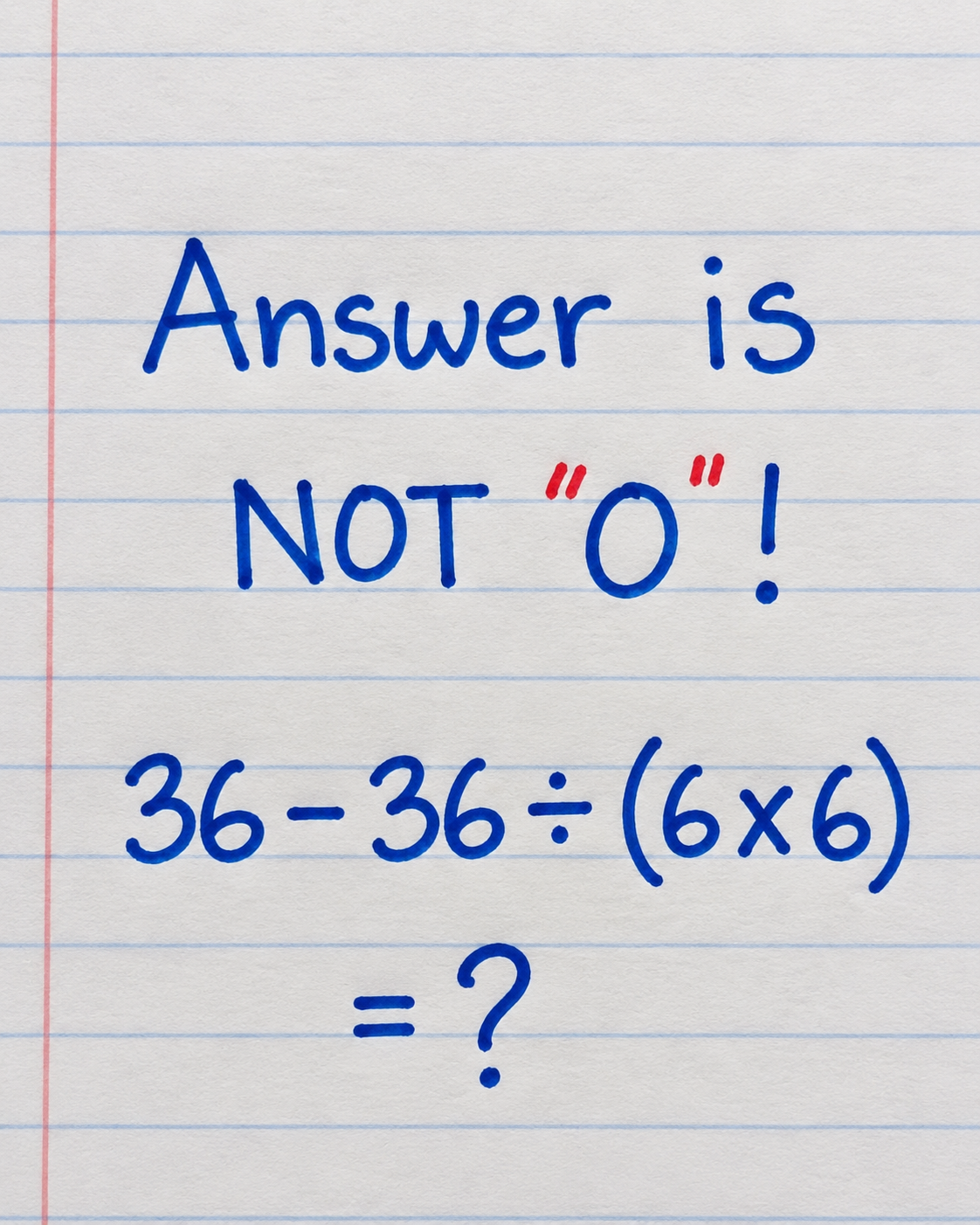

Math Puzzle: Why the Answer to 36 − 36 ÷ (6 × 6) Is 35, Not 0
Introduction to Mathematical Puzzles and Order of Operations
Mathematical puzzles are widely used both in academic settings and in recreational mathematics to encourage logical reasoning and problem-solving skills. They often highlight subtle details in mathematical notation, testing not only calculation ability but also knowledge of fundamental rules and concepts. One such puzzle that has captured the interest of learners and enthusiasts is the calculation of the expression:
36 − 36 ÷ (6 × 6)

At first glance, the combination of numbers and operations appears straightforward. Many people instinctively conclude that the answer must be 0, since it seems to be a simple subtraction: 36 minus 36. However, this assumption misses a crucial detail regarding how the expression should be interpreted.
Looking Beyond the Obvious: The Structure of the Expression
Expressions in mathematics are not always solved in the order they are written. Instead, mathematicians rely on a set of conventions known as the order of operations (often remembered with the acronym PEMDAS: Parentheses, Exponents, Multiplication and Division, Addition and Subtraction). These rules ensure that complex calculations yield consistent and correct results.
In the puzzle 36 − 36 ÷ (6 × 6), the temptation is to perform the subtraction first, leading to 36 − 36 = 0. This approach, however, ignores the proper sequence of computations. The division operator and the parentheses significantly affect how the calculation is carried out.
Step-by-Step Analysis: Solving the Puzzle Accurately
Let’s carefully break down the expression following the standard order of operations:
- Parentheses: The expression inside the parentheses should be dealt with first. Inside the parentheses, we have 6 × 6, which equals 36.
- Division: The next step is the division: 36 ÷ 36. This results in 1.
- Subtraction: Finally, subtract the result of the division from the initial 36: 36 − 1 = 35.
Why the Answer Is Not 0: Understanding the Trap
This puzzle is structured to lead many to the incorrect answer of 0. The misstep occurs when someone ignores the division and parentheses, focusing only on the subtraction. It is a powerful reminder of why the order of operations matters in mathematics. Doing the subtraction before the division can alter the result dramatically.
The mistake is common, especially among those less familiar with operational precedence. Educational researchers have documented similar errors in everything from mathematics classroom exercises to standardized test responses. According to math education experts, such puzzles are designed to reinforce attention to detail and procedural discipline among students.
To clarify the correct structure, the expression can also be rewritten using additional parentheses:
36 − (36 ÷ 36)
This makes the division’s priority explicit. With the division resolved, it is evident that 36 ÷ 36 = 1, which simplifies the calculation to 36 − 1 = 35. This reinforcement of notation demonstrates the utility of careful mathematical practice.
The Order of Operations: Why It Matters
The order of operations is not just a set of arbitrary rules; it is a foundational principle in all mathematical reasoning. Without it, people would arrive at different answers for the same expression, undermining the integrity and consistency of mathematical communication worldwide.
Historically, the development of notational conventions and operational precedence enabled mathematics to grow as a rigorous discipline. Scholars in antiquity, such as Euclid and later mathematicians, recognized the necessity of standardizing calculations. Today, the order of operations is taught to students from an early age and forms the basis of both arithmetic and higher-level mathematics.
In global mathematics education, the promotion of these conventions is considered essential, with standardized guidelines outlined by organizations such as the National Council of Teachers of Mathematics and similar bodies worldwide.
International Context: Mathematical Errors and Their Impact
Misunderstandings caused by incorrect application of the order of operations are not isolated to individual learners. They can carry ramifications in professional fields where precise computation is critical, such as engineering, computer programming, and finance. In fact, software development commonly requires explicit use of parentheses and operational precedence to ensure unambiguous calculation by computer algorithms.
Globally, mathematical literacy is a priority for educational systems, with international assessments such as PISA (Programme for International Student Assessment) measuring mathematical reasoning skills among students. Misinterpretation of operational sequences is one of the most frequent sources of error in such assessments.
Experts agree that puzzles like 36 − 36 ÷ (6 × 6) help students and lifelong learners consolidate these skills in a practical and approachable way.
Expert Views: Explaining the Puzzle’s Appeal
According to mathematics professor Dr. John Allen Paulos, puzzles that exploit operational precedence “highlight the importance of careful reading and logical thinking” in mathematics. Educators and psychologists alike note that the human brain tends to prioritize patterns and visual cues over rigorous rule-following, making such traps easy and instructive.
Mathematics teachers recommend that when confronted with ambiguous-looking expressions, learners should always:
- Identify all parentheses and resolve them first.
- Recognize multiplications and divisions before moving to addition and subtraction.
- Consider rewriting the expression for clarity, especially when ambiguity exists.
Puzzles of this nature are commonly used in classroom instruction, online quizzes, and even standardized testing preparation. They demonstrate, in a single line, the impact of operational discipline and careful calculation.
Educational Implications and Societal Reactions
When puzzles such as this one are posted online or in social media platforms, they often go viral, sparking lively debates and discussions across international communities. Some users share their solutions, while others argue over the answer—often providing insight into how mathematical thinking varies across cultures and age groups.
Such discussions underscore the shared importance of mathematical literacy and reasoning. In surveys of STEM educators, puzzles that hinge on operational precedence rank among the most useful teaching tools for demonstrating “hidden traps” and the consequences of skipping procedural steps.
Further, scientific studies on cognitive development suggest that mastery of operational rules forms a strong foundation for higher mathematical achievement. In global contexts, ensuring a population’s mathematical literacy is seen as vital to economic competitiveness and scientific advancement.
Solving the Puzzle with Confidence
For anyone faced with a similar puzzle, remembering the order of operations is essential:
- Parentheses: Calculate 6 × 6 = 36
- Division: Compute 36 ÷ 36 = 1
- Subtraction: Finally, evaluate 36 − 1 = 35
So, the final answer to the puzzle 36 − 36 ÷ (6 × 6) is 35.
Conclusion: The Value of Careful Calculation
The solution to this mathematical puzzle not only demonstrates the importance of following strict conventions but also serves as a reminder to carefully read and analyze mathematical expressions. When performed correctly, the calculation is simple, but neglecting operational precedence can lead to errors that are instructive for both students and professionals alike.
As mathematical puzzles continue to engage learners worldwide, they reinforce the need for accuracy, discipline, and clarity in all forms of computation. Whether in academic study or everyday life, respecting the order of operations ensures that everyone arrives at the same answer—an example of universal logic that connects people across cultures.
Therefore, the Final Answer Is: 35
Post Views: 430
Sources
Disclaimer: This content is intended for entertainment purposes only and is not based on real events.
