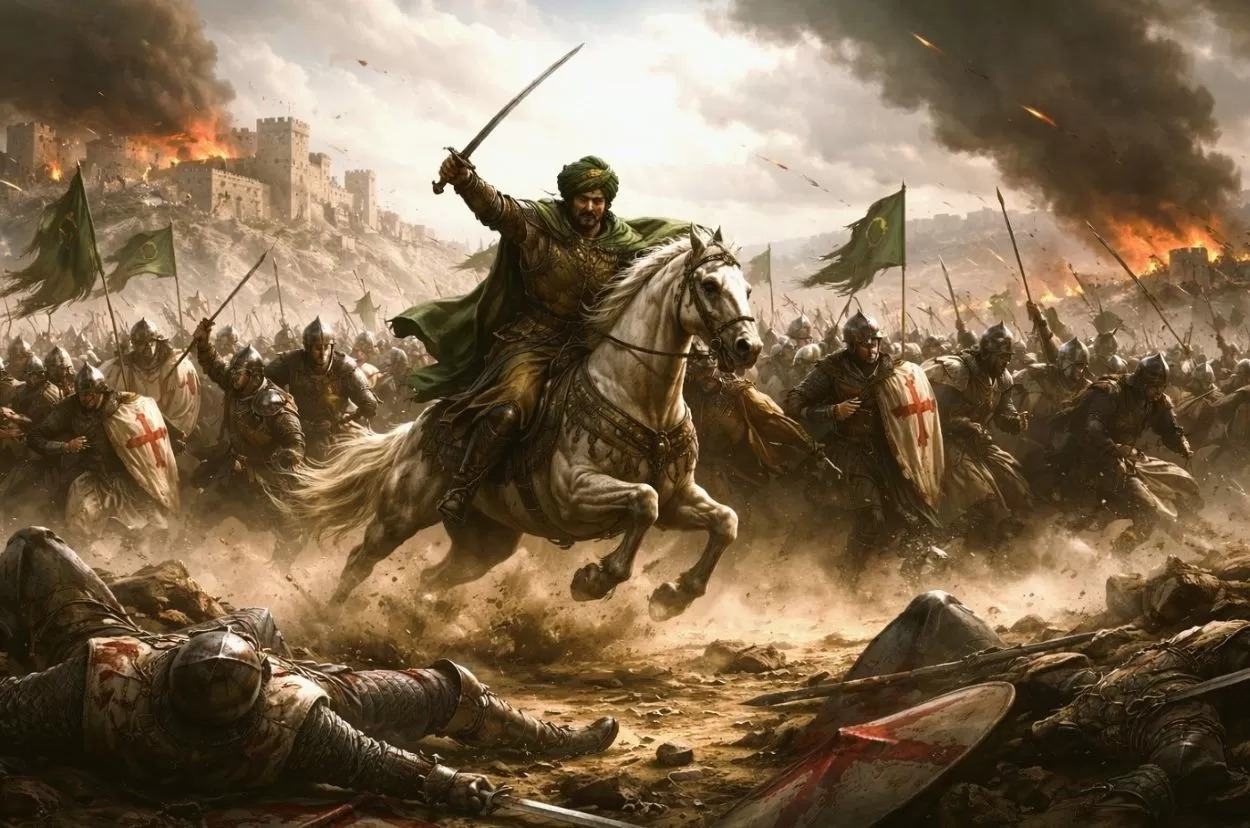

In September 1187, one of the most consequential military campaigns of the medieval era was still unfolding.
Saladin, the Muslim ruler who had defeated the Crusader army at the Battle of Hattin, was advancing along the eastern Mediterranean coast. His victory had dramatically weakened the Kingdom of Jerusalem, opening the way for further campaigns against important Crusader strongholds.
But victory in the field did not mean every city would fall easily.
Ascalon stood before him, protected by formidable fortifications and positioned along a strategically important stretch of coastline. Its walls presented a different kind of challenge from the battlefield Saladin had just conquered.
An army could win a decisive battle and still face a difficult siege.
For Saladin, the question was not simply whether he could attack Ascalon. It was how to secure the city without wasting time, soldiers, and resources that might be needed elsewhere.
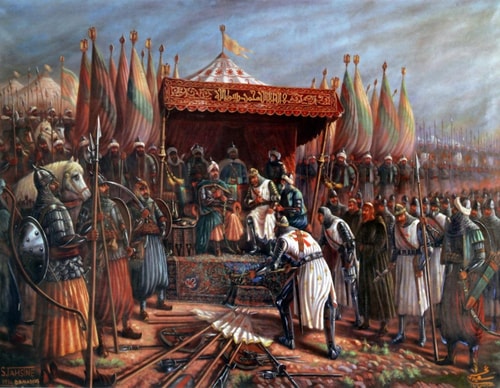
After Hattin, the Balance of Power Changed
The Battle of Hattin, fought on July 4, 1187, was a devastating defeat for the Crusader forces.
Saladin’s army surrounded and overwhelmed the opposing army near the Horns of Hattin, capturing King Guy of Jerusalem and numerous important Crusader leaders. The defeat severely damaged the kingdom’s ability to defend its territory.
The consequences extended far beyond the battlefield.
With much of the Crusader field army destroyed or captured, towns and fortified cities suddenly faced a more dangerous strategic situation. Some strongholds could no longer expect a large relief force to arrive in time.
Saladin now had an opportunity to expand his control across the region.
Yet each fortified settlement presented its own problem. A defeated army could not easily be replaced, and a fortified city could still resist even when the surrounding countryside was vulnerable.
Why Ascalon Mattered
Ascalon was more than another walled settlement.
Located on the Mediterranean coast, the city held strategic importance because of its position between Egypt and the Crusader territories farther north. Its fortifications made it a significant military obstacle, while its coastal location connected it to the wider struggle for control of the eastern Mediterranean.
For the Kingdom of Jerusalem, Ascalon was an important defensive position.
For Saladin, gaining control of the city would help consolidate his campaign after Hattin and strengthen his position along the coast.
But taking a fortified city was rarely as simple as arriving with a large army.
Walls, gates, defenders, supplies, and the possibility of outside assistance all influenced the outcome. Even a powerful army had to consider the cost of an assault.

Why Not Simply Storm the Walls?
From a distance, a direct attack might have seemed like the obvious choice.
Saladin had won a major victory, his army had momentum, and the Crusader kingdom was struggling to recover. But storming a fortified city could be a costly undertaking.
Defenders had several advantages.
They could occupy elevated positions along the walls, observe approaching forces, and use the fortifications to make attackers vulnerable. Assaulting those defenses could require siege engines, ladders, sustained preparation, and a willingness to accept casualties.
A failed attack could weaken an army that still had other objectives to pursue.
Time mattered, too.
A commander conducting a wider campaign had to think beyond a single fortress. Every prolonged siege consumed supplies and required troops to remain in one place rather than move toward other targets.
The decision therefore involved a difficult balance: attack quickly and risk heavy losses, or use pressure and negotiation to seek a different outcome.
The Role of Negotiation in Medieval Sieges
Medieval warfare was not fought through combat alone.
Negotiations, surrender terms, threats, demonstrations of force, and calculations about survival could all influence the fate of a city.
Defenders who believed that resistance was hopeless might consider surrender if acceptable terms were offered. Commanders, meanwhile, could prefer a negotiated settlement if it allowed them to avoid a costly assault and preserve their troops.
That did not mean negotiations always succeeded.
A fortified city might refuse to surrender, especially if its defenders believed they could hold out or expected assistance. In other circumstances, the threat of an attack could be enough to change their calculations.
The outcome depended on the people involved, the strength of the defenses, available supplies, and the wider military situation.
For a commander like Saladin, diplomacy and military pressure could be complementary tools rather than opposing strategies.
What Happened at Ascalon in 1187?
The historical record shows that Ascalon became part of Saladin’s campaign following the Battle of Hattin.
The city was besieged in September 1187 and eventually surrendered to Saladin. Its fall formed part of the wider collapse of Crusader defenses that followed Hattin.
Jerusalem itself would also fall to Saladin later that year, surrendering in October after a siege.
These events transformed the political and military landscape of the region. They also helped set the stage for the Third Crusade, launched by European rulers in response to the loss of Jerusalem and other territories.
Ascalon’s surrender was therefore not an isolated episode. It belonged to a much larger campaign in which battlefield victories, fortified settlements, negotiations, and strategic positioning all shaped the outcome.
The Difficult Decisions Behind a Siege
The image of a medieval army gathered outside a city’s walls often suggests that the next step was inevitable: an assault, a breach, and a final battle.
In reality, siege warfare required difficult choices.
Commanders had to assess the strength of the defenses, the morale of the defenders, the condition of their own troops, and the time available before other threats emerged.
They also had to consider what would happen after the city fell.
A fortress captured at great cost might leave an army too weak to continue its campaign. A surrender achieved through negotiation could potentially preserve soldiers and infrastructure, although the terms and consequences varied from one siege to another.
These calculations were as much a part of medieval warfare as swords, cavalry, and siege engines.
Saladin’s Campaign Was Bigger Than One City
After Hattin, Saladin’s campaign moved rapidly against Crusader-held territories.
The defeat had left the Kingdom of Jerusalem in a precarious position, and a number of its strongholds came under pressure. The capture of Ascalon helped strengthen Saladin’s position before his campaign turned toward Jerusalem.
Yet the wider struggle did not end with these victories.
The loss of Jerusalem prompted a major response from western Europe. The Third Crusade brought prominent rulers, including Richard I of England, into the conflict. Subsequent campaigns would challenge Saladin’s control of parts of the coast and lead to further battles and negotiations.
The events of 1187 therefore marked a turning point, not the conclusion of the Crusades.
They demonstrated how quickly a military balance could change—and how the fate of one city could influence the strategy of an entire region.
Final Thoughts
In September 1187, Ascalon presented Saladin with a challenge that no battlefield victory could automatically solve.
Its walls, coastal position, and strategic importance meant that the city required careful consideration. A direct assault carried risks, while pressure and negotiation offered alternative ways to secure its surrender.
Ultimately, Ascalon did fall to Saladin, becoming another important step in the campaign that followed Hattin.
The episode reminds us that medieval warfare was not only about who had the larger army or who won the previous battle. It was also about patience, logistics, diplomacy, and choosing when to fight.
