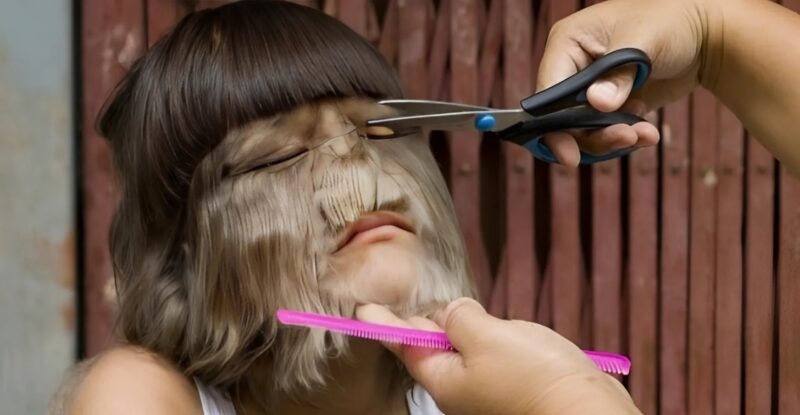

When Supatra Sasuphan was a child in Thailand, people noticed something unusual about her appearance.
Her face and body were covered with much more hair than most people typically have. As she grew older, the difference became increasingly noticeable, attracting attention from classmates, strangers and eventually international media.
Yet her story was never simply about appearance.
Behind the photographs that traveled around the world was a young girl growing up, attending school, making friends and learning how to live confidently with a rare genetic condition.
Years later, photographs of Supatra with a much less visible amount of facial hair began circulating online again. The transformation surprised people who remembered her childhood photographs.
But perhaps the most interesting part of her story is not how different she looks.
It is how her attitude toward herself changed.

Who Is Supatra Sasuphan?
Supatra Sasuphan, sometimes known as “Nat,” is a Thai woman who became internationally recognized as a child because of an exceptionally rare condition associated with excessive hair growth.
Reports from 2011 identified her as an 11-year-old girl from Thailand who had been recognized by Guinness World Records for her unusual amount of body hair. At the time, she was widely described in the media as the world’s hairiest girl.
The condition has commonly been associated with Ambras syndrome, a very rare form of hypertrichosis.
Hypertrichosis refers broadly to excessive hair growth in areas of the body where the amount of hair is unusually high.
Ambras syndrome is an especially rare form.
Because of its rarity, many people have never encountered anyone with the condition in person. That unfamiliarity can sometimes lead to curiosity, staring or insensitive comments.
For Supatra, those reactions became part of childhood.
Growing Up Different
School can be challenging for any child who looks noticeably different from their classmates.
For Supatra, facial hair made that difference especially visible.
Media reports from her childhood described how other children sometimes gave her unkind nicknames and made comments about her appearance. At the same time, she also spoke positively about having friends and being accepted by people around her.
That contrast is important.
Her story was not simply one of isolation.
She had family members who supported her, friends who accepted her and a community that eventually became familiar with her appearance.
In interviews reported at the time, Supatra herself expressed a remarkably positive attitude. Rather than viewing her appearance only as something negative, she said that being different had also made her special.
That perspective became one of the most memorable parts of her story.

Why Did She Have So Much Facial Hair?
The unusual hair growth was not simply a cosmetic issue.
According to reports about Supatra, her appearance was connected to Ambras syndrome, a rare form of congenital hypertrichosis.
The medical terminology is important because conditions involving excessive hair growth can have different causes.
Some forms are inherited, while others can develop later because of medications, hormonal changes or other medical factors.
Ambras syndrome is particularly uncommon.
Historical medical literature contains only a small number of documented cases, which is one reason Supatra’s story attracted so much attention when she was young. Sky News reported in 2011 that only around 50 cases had been documented over several centuries.
Because the condition is so rare, it is also easy for internet stories to exaggerate or oversimplify it.
The Story About Laser Hair Removal
One of the most frequently repeated details in stories about Supatra concerns attempts to remove her facial hair.
The viral version of the story often claims that laser treatment made her hair grow back faster and thicker.
That statement should be treated carefully.
Older reports do indicate that attempts were made to reduce the hair and that the results were not successful. However, saying that laser treatment directly caused the condition to become worse is a much stronger medical claim and should not be presented as an established fact without reliable clinical evidence.
The more important point is that removing visible hair did not eliminate the underlying condition.
For someone with a rare form of hypertrichosis, hair removal may become a recurring part of personal grooming rather than a permanent solution.
That distinction is often lost in viral social-media posts.

From Guinness Recognition to Global Attention
Supatra’s childhood changed dramatically when she received international recognition.
In 2011, major news organizations reported that Guinness World Records had recognized her as the world’s hairiest girl.
For many children, becoming internationally known at such a young age would be overwhelming.
For Supatra, however, the attention was not entirely negative.
She reportedly enjoyed the recognition and even said that it made her more popular at school.
That reaction challenged the way outsiders viewed her.
People looking at photographs often focused on the unusual physical characteristic. Supatra herself appeared more interested in living an ordinary life.
She attended school.
She had friends.
She enjoyed ordinary activities.
And she continued growing up just like anyone else.
Learning to Accept Her Appearance
As the years passed, Supatra’s relationship with her appearance evolved.
When she was younger, facial hair was something that made her stand out immediately. Later, she became increasingly comfortable with her distinctive appearance.
That acceptance is particularly meaningful because physical differences can affect how people see themselves when they are constantly reminded that they look different from those around them.
Rather than allowing other people’s reactions to define her identity, Supatra gradually developed her own approach.
She could choose whether to remove her facial hair or leave it visible.
She could share photographs publicly or keep her private life away from the spotlight.
Those choices belonged to her.
The Transformation Seen in Later Photographs
Years after she became famous as a child, photographs of Supatra began circulating again.
This time, many people were surprised to see her with a much smoother-looking face.
But the change was not necessarily evidence that her underlying condition had disappeared.
Reports have explained that she began regularly shaving or removing the visible hair. More recent coverage has continued to describe her as someone living with the condition rather than someone who had been permanently cured.
That distinction matters.
A person can change how a visible condition appears without the underlying biological cause disappearing.
In Supatra’s case, grooming became a practical way of managing her appearance.
Love and Relationships
Another chapter of Supatra’s story attracted considerable attention when reports emerged that she had found a romantic partner.
In 2018, media outlets reported that she had married at around the age of 17 and had shared photographs with her partner on social media.
However, later reporting suggests that her relationship history is more complicated than the simple “she removed her facial hair and got married” storyline repeated by viral websites.
Later photographs and reports have shown Supatra with other partners, while details of her private relationships have not always been publicly explained.
This is another reason to be cautious with viral headlines.
Her decision to shave her facial hair should not automatically be presented as something she did because she needed to find a partner.
She had already spent years developing her own identity, and her relationships are ultimately part of her private life.
What Her Story Says About Beauty
Perhaps the most powerful part of Supatra’s story has little to do with hair.
It concerns the way society defines beauty.
Most cultures develop ideas about what a typical face or body should look like. Those standards can influence fashion, advertising, entertainment and even the way people judge themselves.
Someone who falls outside those expectations can quickly become the subject of curiosity.
But unusual does not necessarily mean unattractive.
And looking different does not make someone less deserving of friendship, respect or love.
Supatra’s childhood experience illustrates this clearly.
The same feature that caused strangers to stare eventually became something that made her internationally recognizable.
Yet the most meaningful change came from within.
She became more comfortable with herself.
A Rare Condition That Helped Raise Awareness
Stories about rare medical conditions can sometimes become sensationalized online.
Photographs are often presented without context, while dramatic labels are used to attract clicks.
Supatra’s story provides an opportunity to approach the subject differently.
Rare genetic conditions are part of human diversity. They can affect appearance, daily life and social experiences, but they do not define the entire person.
Hypertrichosis itself includes different forms and causes, and not every person with excessive hair growth has Ambras syndrome.
That is why diagnosing a person from photographs alone would be inappropriate.
In Supatra’s case, the diagnosis has been repeatedly associated with Ambras syndrome in media reports, but the broader medical subject deserves careful treatment rather than internet speculation.
More Than a Before-and-After Photograph
Today, many viral posts focus almost entirely on the contrast between old and new photographs.
One image shows the young Supatra with extensive facial hair.
Another shows her with a much more conventional appearance.
The difference is striking.
But reducing her entire life to a “before and after” transformation misses the bigger story.
The child in those early photographs grew up.
She developed friendships.
She experienced relationships.
She became comfortable making choices about her appearance.
And she continued living beyond the attention created by her childhood record.
That is much more interesting than simply saying that someone “looked completely different.”
The Real Transformation
Supatra’s story is sometimes presented as though removing facial hair was the moment when her life finally became better.
A more thoughtful interpretation is different.
Her most important transformation may have been learning that her identity was not determined by the way other people reacted to her appearance.
Hair removal changed what people could see.
Self-acceptance changed how she could see herself.
Those are two very different things.
Her story also reminds us how quickly the internet can turn a real person’s life into a simplified headline.
A rare medical condition becomes a nickname.
A personal grooming decision becomes a dramatic transformation.
A relationship becomes a viral “happy ending.”
But real lives are rarely that simple.
Supatra’s journey is better understood as the story of a young woman who grew up under extraordinary public attention and gradually found her own way of living with a rare physical characteristic.
And perhaps that is the most valuable lesson hidden behind the photographs.
Beauty does not always begin when a person changes their appearance.
Sometimes it begins when they stop believing that they need to change in order to deserve acceptance.
Sources
- Sky News — Reporting on Supatra Sasuphan’s childhood and Guinness recognition.
- IBTimes UK — Background on Supatra and Ambras syndrome.
- Znews — Later reporting on Supatra’s appearance and life.
- LADbible — Later coverage of Supatra’s changed appearance.
- World Record Academy — Historical reporting on her Guinness recognition.
