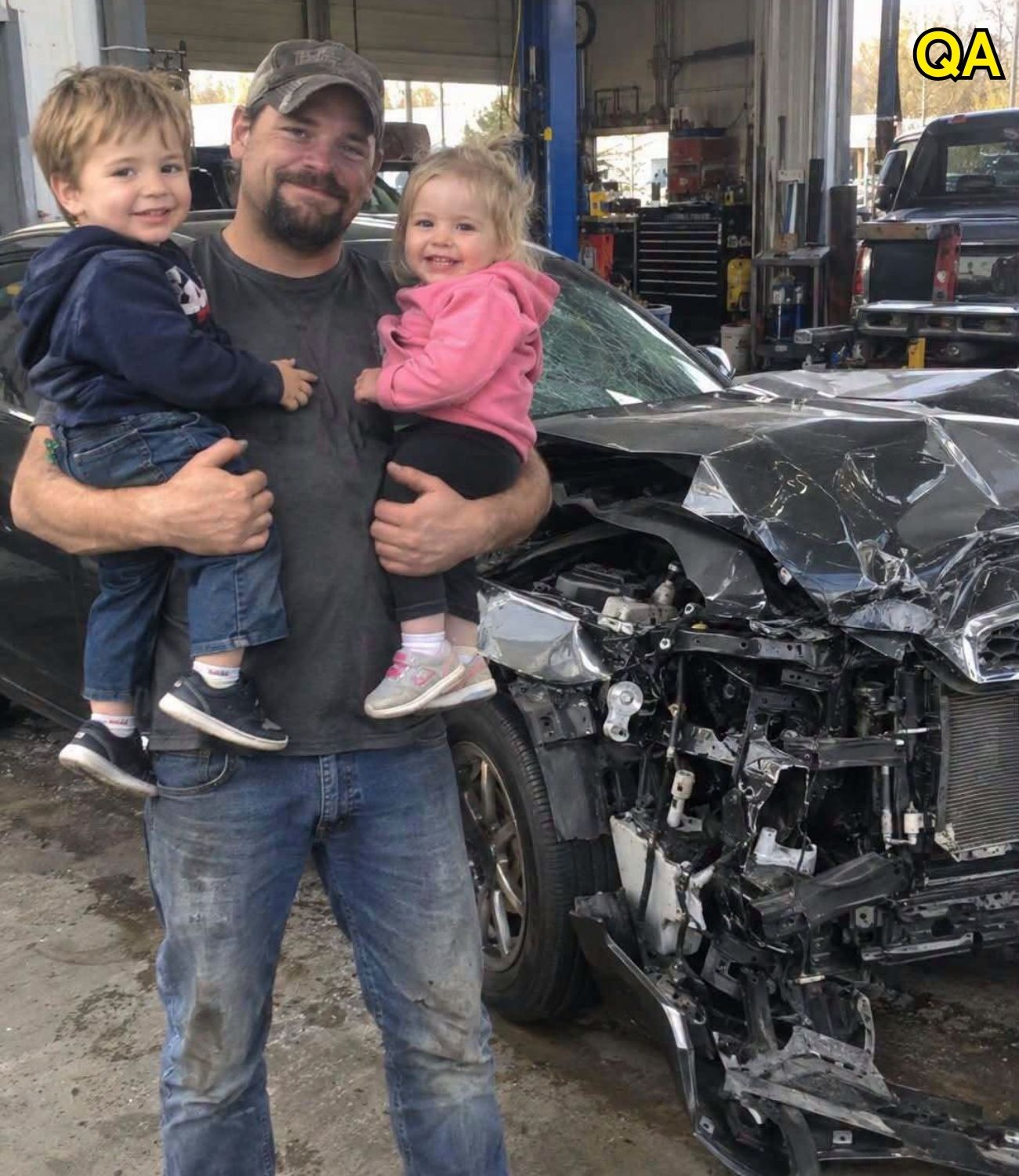

The red-lettered sign above my garage read CRAIG’S AUTO REPAIR. The paint had faded, peeling slightly at the edges where the wood had weathered decades of rain, snow, and blazing summer sun. My sons, Rick and Noah, had painted it when they were seven and four years old. Noah, with his little hands covered in crimson paint, had completely botched the letter C, slanting it far outside the lines. Rick, methodical even as a child, had carefully and meticulously filled in the rest, ensuring every letter stood straight and proud. I had kept that imperfect, handmade plywood sign nailed above the garage door through every storm of my life. It was my anchor, a daily reminder of why my calloused hands worked twelve-hour days beneath a greasy car lift.
Life hadn’t always been measured in engine oil and wrench sizes. Five years prior, my world had imploded with surgical precision. My wife, Laura, decided that a life of quiet stability in a modest suburban home with a struggling mechanic wasn’t quite grand enough for her ambitions. She left me for Brent Harlow—a sleek, silver-tongued local car dealership magnate who wore expensive Italian suits, drove high-end sports cars, and smelled relentlessly of expensive cologne and cheap deceit.
The divorce was ruthless. Laura took half of what little we had, and as she walked out the door with her new life dangling from her arm, she looked back at me with a cold, pitying sneer.
“Face it, Craig,” she had said, adjusting her designer sunglasses. “You’re going nowhere in life. You’re chained to this grease pit, while we’re moving up in the world.”
Things got worse before they got better. Scarcely a month after the ink dried on the divorce papers, the corporate franchise dealership where I had worked for a decade went under, laying off every mechanic on the floor. With my last savings and a heavy dose of stubborn pride, I rented a small, drafty industrial garage on the edge of town and hung up Rick and Noah’s old sign. Business was slow at first, hanging by a thread, but I survived. The only silver lining in that dark, lonely period was the custody agreement: I had my boys every other weekend and every Wednesday evening. They were my oxygen, my light, and my reason for breathing.
Yet, Laura weaponized those visits like a tactical commander. She knew how desperately I loved my sons, and she used them as leverage. If she wanted me to pick up her dry cleaning, run errands across town, or fix a flat tire on her European sedan for free, she dangled visitation over my head. “Do this, Craig, or don’t expect the boys this weekend,” she would text, knowing I would break my back to avoid missing a single bedtime story.
Then came the morning that changed everything.
It was a chilly Tuesday in late October when a flatbed tow truck dropped off a severely damaged, obsidian-black Mercedes-Benz at my garage doors. The front passenger side was crumpled like a soda can, the bumper was torn away, and the headlight housing was shattered into a mosaic of dangerous shards. Moments later, Laura and Brent pulled up in Brent’s other luxury vehicle.
Brent didn’t even step out of the air-conditioned cabin; he just rolled down the tinted window, flashing a smug, condescending grin.
“Fix it, Craig,” Brent drawled, tapping a manicured finger against the steering wheel. “Make it look brand new. And don’t drag your feet—Laura needs it by Friday.”
“This is a heavy-duty frame job, Brent,” I replied, wiping grease from my hands onto a rag. “Parts alone are going to cost a small fortune. My shop rate is—”
“Put it on our tab, or consider this week’s Wednesday visit canceled,” Laura interrupted sharply, standing beside the car with her arms crossed. “You know the drill. Consider it child support or whatever helps you sleep at night. Just get it done.”
They drove away, leaving me with a crushed vehicle and a burning knot of fury in my chest. But as I walked around the Mercedes to inspect the extent of the frame damage, a cold dread crept up my spine. The impact had blown out the front passenger door. Peering inside to disconnect the battery, I noticed something horrifying wedged deeply between the leather seat cushions: a bright green plastic toy dinosaur—Chompy, Noah’s absolute favorite companion, the one he took everywhere.
Beside it sat a booster seat, violently shoved to the side, its structural plastic frame snapped clean across the base.
My breath caught in my throat. My boys. They had been in this car.
Driven by a desperate, frantic instinct, I crawled into the driver’s seat and booted up the vehicle’s onboard diagnostic system and computer telemetry logs. Most modern luxury cars maintain black-box crash data recorders. I plugged my diagnostic tablet into the OBD-II port and pulled the event history.
The screen glowed in the dim light of the garage, displaying data that made my blood run ice-cold.
The crash had occurred at 1:42 AM. The vehicle had been traveling at 58 miles per hour in a residential 35-mile-per-hour zone. The telemetry logs showed heavy, erratic braking followed by a violent impact, deployment of the side curtain airbags, and an abrupt shutdown.
I sat there in the driver’s seat, staring at the timestamp, my mind racing. At 1:42 AM on a Tuesday, my boys were supposed to be asleep in their beds at Laura and Brent’s lake house. Why were they in the car in the middle of the night? And why was Brent driving like a maniac at near-suicidal speeds through a residential neighborhood?
That Wednesday evening, when Rick and nine-year-old Noah arrived for their mid-week visit, I kept my face neutral, though my hands shook as I poured them glasses of milk. After dinner, while Noah was distracted building a towering Lego castle in the living room, I pulled twelve-year-old Rick out onto the back porch.
The autumn air was crisp, carrying the scent of burning leaves. Rick looked down at his sneakers, shifting nervously from foot to foot.
“Rick, buddy, look at me,” I said softly, crouching down to his eye level. “I need you to tell me the truth. Were you and Noah in Brent’s Mercedes the other night when it crashed?”
Rick’s lower lip quivered. Tears welled up in his eyes, spilling over his lashes. “Mom and Brent said we couldn’t tell you,” he sobbed, his voice breaking. “They made us pinky-promise. Brent had been drinking wine at a late-night party with his business friends, and Mom told him he was fine to drive us back to the lake house because he had a fancy car. But he wasn’t fine, Dad. He drove way too fast, swerved to avoid a stray dog, and slammed right into a brick mailbox and a parked pickup truck.”
My heart shattered into a million jagged pieces, instantly replaced by a blinding, white-hot fury. “And you guys? Were you hurt?”
“Noah hit his face against the door handle when the airbag popped,” Rick wept, wiping his nose on his sleeve. “He was bleeding a lot. But when Mom and Brent dragged us out of the car, they told us to stop crying. They made us swear we’d tell everyone that Noah just fell off the backyard swing set at the lake house if anyone asked about his bruised lip. They said if we told the truth, the police would take us away and ruin our family.”
They had endangered my babies. They had driven drunk with my sons in the backseat, crashed into private property, fled the scene like cowards, and then coached my little boys to lie to cover up their criminal negligence.
I stood up, gripping the wooden porch railing so hard my knuckles turned ghostly white. The $7,000 repair bill for the Mercedes no longer mattered. The insults didn’t matter. The game they were playing was over.
The next morning, I didn’t pick up a wrench. Instead, I carefully unbolted the shattered front bumper assembly, extracted the smashed booster seat, and pulled the exact GPS and black-box crash data files from the Mercedes computer, saving them onto a flash drive. I packaged the physical evidence, along with Rick’s tearful testimony written out in my own logbook, and drove straight to the downtown police precinct.
I walked into the office of Detective Ramirez, a weathered, no-nonsense investigator with sharp eyes. I placed the evidence on his desk and laid it all out.
Detective Ramirez listened in grim silence. When I finished, a dark scowl crossed his face. “As a matter of fact,” the detective said, pulling a paperwork folder from his cabinet, “we received an anonymous hit-and-run report matching this exact timeframe and vehicle description from a homeowner on Elm Street whose brick mailbox was demolished. We’ve been trying to track down the vehicle.”
Within hours, the wheels of justice began to turn with terrifying speed.
Back at the garage, I set to work on the Mercedes. I didn’t cut corners—I straightened the frame, replaced the damaged steering column components, and ensured the car was mechanically sound, running up a total parts and labor invoice of exactly $7,000. But I also prepared a very specific legal release form. Tucked into the fine print of the pickup document was a binding clause stating that all damaged structural components, black-box telemetry logs, and physical evidence recovered during the service had been formally handed over to the local police department pursuant to an active criminal investigation.
On Friday afternoon, Laura and Brent walked into my shop, looking smug, impatient, and entirely untouchable.
“Is the car ready?” Brent demanded, tapping his Rolex. “We have a weekend trip to the mountains.”
“It’s finished,” I said quietly, sliding the invoice and the release form across the workbench. “Total is $7,000. Cash or card.”
Brent scoffed, his face flushing with arrogant indignation. “Seven thousand dollars?! Are you out of your mind, Craig? That’s highway robbery! You think I’m going to pay a hack mechanic like you seven grand? Forget it. You’re getting zero. Consider yourself lucky I don’t sue you for holding my car hostage.”
Laura chimed in, crossing her arms and sneering. “You really are going nowhere in life, Craig. Always trying to shake people down because you can’t make an honest living.”
I didn’t yell. I didn’t argue. I simply looked Brent dead in the eye, watching the heavy gold ring on his finger twitch.
“Okay,” I said softly.
Brent blinked, clearly taken aback by my lack of resistance. “What do you mean, okay?”
“I mean, take the car,” I said, stepping aside and pointing toward the open garage door where the gleaming black Mercedes sat fully repaired. “Just sign the release form confirming you’ve picked it up and reviewed the attached terms.”
Brent let out a harsh, barking laugh. “Unbelievable. Finally realized you have no leverage, huh?” Without even glancing at the paper, he snatched a pen from my desk, scrawled his signature across the bottom of the release form, grabbed his keys from my workbench, and slammed his hand against the counter. “Come on, Laura. Let’s get away from this loser.”
They piled into the Mercedes, tires screeching as they rocketed out of the parking lot, thrilled that they had supposedly cheated a poor mechanic out of seven thousand dollars.
They didn’t even make it to the highway.
Less than twenty minutes later, as I stood by my workbench, the wailing sirens of two police cruisers tore down the industrial street. They didn’t pass my shop; they pulled straight into the driveway, blocking the exit. Detective Ramirez stepped out of the lead cruiser, flanked by two uniformed officers, and calmly approached the Mercedes, which had been forced to pull over a block away.
Brent was hauled out of the driver’s seat in handcuffs, his expensive Italian suit rumpled as he sputtered furious protests about his constitutional rights and political connections. Laura sat frozen in the passenger seat, screaming hysterically as officers slapped the cuffs on Brent and slapped a seizure warrant on the black Mercedes-Benz.
The legal fallout was swift and absolute. Brent was formally charged with driving under the influence, leaving the scene of a property-damage accident, reckless endangerment, and child endangerment. Faced with overwhelming digital telemetry, physical evidence, and the police report, Laura broke down during questioning and confessed that she had known Brent was intoxicated and had actively coached her young sons to lie to cover up the crime.
Family court judges do not take kindly to parents who endanger their children and subvert the law. Within a month, emergency custody hearings resulted in a permanent modification of our custody arrangement. Primary physical and legal custody of Rick and Noah was awarded entirely to me. Laura was granted heavily supervised weekend visits, and Brent found himself staring down the barrel of serious prison time and the rapid collapse of his dealership empire.
The financial loss of that $7,000 repair bill stung for a while, but it was the cheapest victory of my life.
Years passed. The small garage on the edge of town transformed into a reputable, thriving neighborhood auto shop with three service bays and a loyal, ever-growing customer base. Rick and Noah grew into tall, broad-shouldered young men who spent their afternoons after school handing me wrenches and learning the trade from the ground up. They lived with me full-time in our cozy home, filling the hallways with laughter, music, and the warm, chaotic energy of a real family.
Eventually, Laura resurfaced in our lives, humbled, broken, and remorseful. She began showing up once a month, handing me an envelope containing fifty dollars—her slow, agonizing attempt to pay back the debt she owed me for the repair bill she had tried to dodge. I never refused it, not because I needed the money, but because it was part of her own path toward accountability.
One afternoon, while Rick and I were working beneath the hood of a vintage pickup truck, he paused, wiping grease off his forehead with a rag, and looked up at me with a thoughtful smile.
“Hey, Dad?” Rick asked quietly.
“Yeah, buddy?”
“Remember that day Brent refused to pay you the seven thousand dollars for fixing his Mercedes, and you just stood there and said ‘okay’?” Rick chuckled softly. “Why didn’t you fight him then and there? Why didn’t you make a huge scene?”
I paused, resting my wrench on the fender, and looked up at the faded, weather-beaten plywood sign above the garage door. The crooked, crimson letter C that Noah had painted outside the lines still stood out clear as day.
“Because, son,” I smiled, placing a hand on Rick’s shoulder, “by the time he refused to pay, I had already decided what actually mattered.”
Rick smiled, understanding dawning in his eyes. “So saying ‘okay’ wasn’t giving up… it was part of the plan.”
I looked down at my sons—strong, safe, and home where they belonged—and felt a profound peace settle deep into my bones. Laura had once told me I was going nowhere in life.
She couldn’t have been more wrong. I was standing right where I needed to be, surrounded by everything I loved. That was home.
