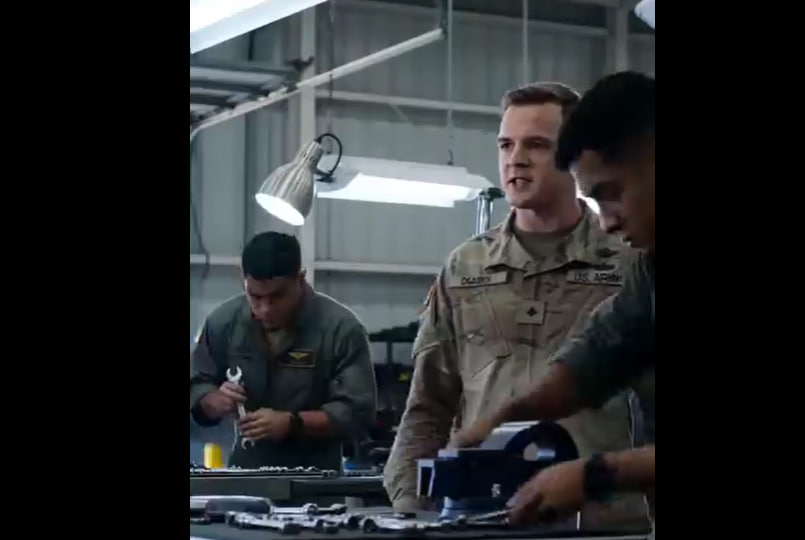

They Humiliated a Civilian Contractor Until One Hidden Mark Made a Colonel Forget How to Breathe
The morning after the security clearance review, the rain returned. It didn’t pour; it just drifted across the flight line in a gray, persistent mist that turned the concrete into a mirror.
I arrived at Hangar 7 before six. The building was quiet, smelling of damp wool, aviation fuel, and the faint, sweet trace of my fresh coffee. I set my clipboard on the workbench, pulled a diagnostic tablet from the rack, and walked past the open access panels of the Black Hawk.
The primary return valve was dry. The seal we had spent yesterday afternoon inspecting showed no trace of weeping fluid.
“You’re early again,” a voice said from behind the tail rotor.
Ruiz stepped out from the shadow of the fuselage, a mug of black coffee in one hand and a torque wrench in the other. He looked tired, the shadows under his eyes darker than they had been before the incident with Brennan.
“Early is better than late when you’re chasing a pressure drop,” I said, not turning around.
Ruiz leaned against the landing gear strut. He watched me for a second, blowing across the surface of his coffee. “Word is moving through the shift supervisors.”
“What word?”
“About Brennan.” He paused, weighing his words. “Legal pulled his duty roster last night. He’s reassigned to supply inventory in warehouse four. Indefinitely.”
I tapped the screen of the diagnostic tablet. The numbers remained green. “That sounds administrative.”
“It’s a graveyard shift behind a desk counting bolts,” Ruiz said, his tone flat. “For a guy who spent three years strutting around the flight line like he owned the base, it’s worse than a court-martial. The guys are talking. Nobody’s crying for him.”
“Good.”
“You don’t sound surprised.”
“I’m not.” I turned to face him. “People who look for power where they shouldn’t usually find it in the wrong places.”
Ruiz held my gaze, then looked down at his boots. “I should have stepped in earlier, Erin. Before he made you take off the shirt.”
We had not talked about the mechanics of that moment since the day it happened. The word Erin still sounded slightly strange coming from someone on the base, but Ruiz said it without hesitation now.
“You stepped in when it mattered,” I said.
“It only mattered because Colonel Cross dropped a folder and recognized a ghost,” Ruiz muttered, shaking his head. “If he hadn’t been walking by—”
“Cross didn’t save me, Ruiz. The twenty men in this hangar who raised their hands when he asked who saw the order—that’s what stopped it.” I crossed my arms. “Don’t rob yourself of that. You all made a choice.”
Before Ruiz could answer, the heavy double doors at the front of the hangar groaned on their tracks. A low-slung civilian sedan with military base decals on the bumper rolled inside, stopping twenty feet from the dry bay.
The engine cut out. The driver’s door opened, and Captain Ellis stepped out into the damp air, holding a thick manila envelope sealed with red wax tape.
Ruiz set his mug down on the edge of the workbench. “That’s not maintenance.”
“No,” I said, my pulse ticking upward in a familiar, steady rhythm. “It isn’t.”
Ellis walked across the polished concrete, his boots clicking sharply against the floor. He didn’t look at the helicopter, and he didn’t look at Ruiz. His eyes fixed entirely on me as he approached the workbench.
“Ms. Mercer,” Ellis said, coming to a halt.
“Captain.”
He held out the envelope. “Courier drop from Washington ten minutes ago. Direct routing through the installation commander’s office.”
“Am I being reassigned?”
“I don’t know what’s inside,” Ellis said honestly. His expression was tight, guarded in the way officers get when they are handling paperwork that sits several paygrades above their security clearance. “Colonel Cross is currently in a secure comms briefing with the Pentagon. He instructed me to deliver this directly to you the moment it arrived.”
I looked at the envelope. There was no return address. Just a string of typed digits in the top left corner: OASD-SEC-09-2026.
“Thank you, Captain,” I said, taking it from his hand.
Ellis lingered for a fraction of a second, as if he wanted to say something else—perhaps offer a warning, or ask a question his career wasn’t ready to answer. Instead, he simply nodded once. “If you need civilian counsel present before you open it, I can—”
“I don’t need counsel to read mail,” I interrupted.
“Understood.” He turned on his heel and walked back toward his sedan. The doors hummed, the engine turned over, and he drove out into the gray morning mist.
Ruiz looked at the manila envelope in my hands. His face was pale. “Do you want me to clear the floor?”
“No,” I said, slipping my thumb under the red wax seal. “The hydraulic test isn’t finished. Run the secondary pump at four thousand PSI and check the return line for micro-fractures.”
“Erin—”
“Do it, Ruiz.”
He swallowed hard, picked up his wrench, and walked back toward the tail rotor without another word.
I pulled the flap open. Inside sat a single sheet of heavy, unwatermarked bond paper. Typewritten text covered the upper half, crisp and black against the stark white surface. There was no signature at the bottom—only a small, embossed stamp bearing the seal of the Office of the Secretary of Defense.
I read the lines slowly, letting each word settle against the background of my mind.
SUBJECT: Operational Status Verification and Contractor Oversight.
1. Reference the incident occurring in Hangar 7 on the current installation involving civilian contractor E. Mercer (Designation: V-3147).
2. All local records concerning the subject’s primary designation have been reviewed by the Oversight Committee. The civilian contract remains valid, authorized, and fully protected under secondary compartmented provisions.
3. The subject is hereby advised that local inquiries regarding her historical profile have been permanently sealed under Directive 88-Alpha. Any future attempts by base personnel to compromise this compartmentalization will result in immediate court-martial and permanent revocation of installation access.
4. Colonel Nathan Cross is designated as the sole local liaison for operational continuity.
I stared at the last line.
Colonel Nathan Cross.
Not the base commander. Not a regional procurement officer. Nathan Cross, who fourteen years ago had been a young captain ordered to read and destroy a briefing packet containing my name, had just been appointed as my keeper.
A shadow fell across the workbench.
I didn’t need to look up to know who it was. The steady, heavy tread of boots belonged to someone who didn’t bother trying to move quietly.
“You read it,” Cross said.
I folded the paper neatly and slid it back inside the manila envelope. “Directive 88-Alpha. That’s an impressive piece of administrative armor.”
Cross walked around the workbench, resting his hands on the edge beside my clipboard. He looked older this morning, the lines around his eyes etched deeper by a night spent dealing with secure lines and distant superiors in Washington.
“It’s not armor,” Cross said quietly. “It’s a cage.”
“Whose? Mine or yours?”
“Both.” He glanced toward the open hangar doors, where the rain was beginning to clear, letting a pale, watery light spill across the tarmac. “When I spoke to the committee at midnight, they weren’t angry about Brennan. They were angry that an enlisted idiot almost exposed a node that was supposed to have dissolved into the ether fourteen years ago.”
“I’m not a node, Colonel. I’m a civilian contractor reviewing hydraulic valves.”
“To you, yes,” Cross said, turning his gaze back to me. “To Washington, you’re an active asset that refuses to stay buried. Every time you sign a government contract, every time your credentials get scanned at a gate, there’s a wire that twitches in a server room under the Pentagon.”
“Then why let me take the job here?”
“Because,” Cross said, his voice dropping an octave, “when they scrubbed Evelyn Vale in 2012, they didn’t just change your name. They tested your file against three hundred simulated logistics networks to see where a person with your exact skill set would naturally drift if she ever decided to work again.”
The hangar seemed to shrink around us. The sound of Ruiz’s wrench clicking against metal felt miles away.
“Are you telling me this assignment wasn’t an accident?” I asked, my voice dangerously low.
“I’m telling you that systems like the ones you built don’t just forget how you think,” Cross replied evenly. “You thought you were hiding in plain sight as a civilian aviation contractor. But the algorithm didn’t put you here by chance, Erin. It routed you back to a flight line because people who spent their lives fixing broken machines always end up where the heavy iron is.”
I stared at him. For fourteen years, I had believed that my new life was my own creation—that every brick in the wall of Erin Mercer had been laid by my own hands, choice by choice, day by day. To learn that even the walls might have been sketched by the same architects who tore down my past felt like a physical blow.
“And you?” I asked, my throat tight. “Were you routed here too?”
Cross gave a bitter, humorless smile. “I was a captain who followed orders and watched a file disappear. They kept me moving through logistics commands for a decade and a half. Every five years, I get a new posting. And every posting happens to be on an installation where a specialized aviation contractor with a clean, perfectly blank background happens to be bidding on high-value refits.”
He reached out and tapped the manila envelope with his index finger.
“I didn’t find you by accident yesterday, Erin. I’ve been reading your evaluation reports for three years, wondering when you were finally going to look in the mirror and realize the ghost wasn’t dead—she was just waiting for someone to call her name.”
Silence stretched between us, heavy and absolute.
Across the bay, the hydraulic pump whined as Ruiz completed the test cycle. The needle on the digital pressure gauge climbed smoothly, hit four thousand pounds per square inch, and locked into place. Green. Steady. Normal.
I looked down at my hands. They weren’t shaking. They never shook when the pressure held.
“Does Brennan know?” I asked.
“Brennan knows he’s spending the next two years counting cargo crates in a concrete box in the desert,” Cross said. “He will never know why. If he speaks of you, if he mentions the mark on your back to a single soul on this base, military intelligence will pick him apart before he reaches the motor pool.”
“That’s harsh.”
“It’s necessary,” Cross said. “In our world, the moment a secret stops being a secret, people start dying to keep it quiet. You know that better than anyone.”
I thought about the rain falling on the metal roof fourteen years ago. I thought about the smoke, the burned wiring, and the orders whispered in a room with no windows—orders that told me the only way to survive was to stop existing.
“I didn’t ask to be remembered, Nathan,” I said, using his first name for the first time.
Cross flinched slightly at the sound, then nodded. “I know. But some things aren’t up to us.” He straightened up, stepping back from the workbench. “The committee wants you transferred off this installation within forty-eight hours. They’re offering a civilian logistics post in Germany. Quiet, secure, completely isolated from active flight lines.”
I looked at the Black Hawk. I looked at the grease on my sleeve. I looked at Ruiz, who was standing twenty feet away, pretending not to listen while he wiped his hands on a rag.
“No,” I said.
Cross stopped. “Erin, that wasn’t a suggestion from me. That was an order wrapped in velvet from Washington.”
“Tell them no.”
“They will revoke your clearance.”
“Let them try.” I picked up my clipboard, my fingers curling tightly around the aluminum edge. “I spent fourteen years running from rooms with no windows, Colonel. I spent fourteen years letting invisible men in Washington decide where I could live, who I could talk to, and what name I was allowed to use.”
I stepped around the workbench, closing the distance between us until I was looking straight up into his eyes.
“I fixed the valve on this aircraft yesterday. I helped Ruiz diagnose a primary return failure this morning. And tomorrow, I’m going to sign off on the flight readiness report for thirty civilian specialists who depend on my competence to stay alive.”
I tapped the manila envelope against his chest.
“If Washington wants to pull my contract, they can send an officer down here to look me in the eye and tell me why. But I am not packing a bag, and I am not moving to Germany.”
Cross stared at me for a long, agonizing moment. His jaw muscles clenched, working under his skin. For a second, I thought he was going to pull rank, invoke the full weight of Directive 88-Alpha, and order me off the base himself.
Instead, a slow, grim smile touched the corners of his mouth.
“You really haven’t changed at all, have you, Evelyn?” he whispered.
“My name is Erin,” I said.
“Right. Erin.” Cross took the envelope from my hand, slipped it inside his tunic pocket, and turned toward the exit. He paused at the edge of the hangar doors, looking back over his shoulder.
“The committee conference call is at fourteen hundred hours,” Cross said. “I’ll tell them you’re staying put.”
“And what will you tell them about the risk?”
Cross adjusted his cap, the gray light catching the silver oak leaves on the brim.
“I’ll tell them that if anyone tries to break the fence around Hangar 7, they’ll have to get past a civilian contractor who knows how to hold pressure better than any colonel in the United States military.”
He turned and walked out into the morning sun, his boots fading into the distance as the hangar doors swallowed his silhouette.
Ruiz walked over from the tail rotor, wiping his hands on a clean shop rag. He looked toward the empty doorway, then back at me.
“Was that bad news?” he asked cautiously.
I looked down at the diagnostic tablet. The pressure reading was still holding at a perfect, unchanging green.
“No, Ruiz,” I said, picking up my coffee and taking a warm, steady sip. “Just standard maintenance.”
