
Chapter 1: The Cafeteria Floor
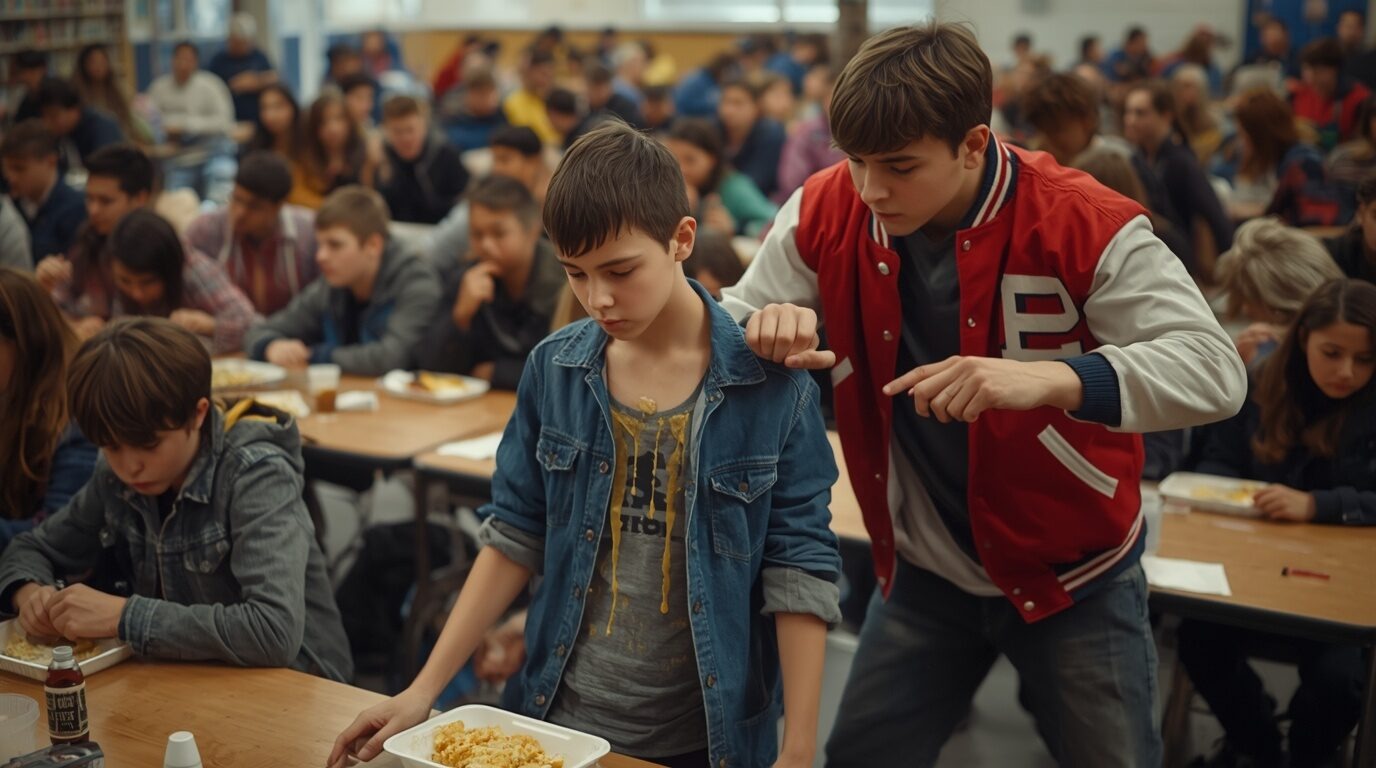
The yellow mustard dripped slowly down the front of my favorite blue denim shirt, cold and heavy against my skin. Trent stood over me in his pristine red letterman jacket, his jaw set in a mocking sneer. He had intentionally stepped right into my path, tipping his hard plastic food tray just enough to send a sloppy pile of hot dogs, baked beans, and yellow mustard cascading down my chest before letting the tray clatter to the tiled floor.
“Clean it up,” Trent commanded, his voice carrying effortlessly over the sudden, suffocating quiet of the room. “You ruined my lunch. Now you’re going to pick it all up.”
I hadn’t ruined anything. I had merely been walking back to my table, keeping my head down, trying to survive another Tuesday. It was a calculated move, designed for maximum public humiliation. He was the star quarterback, the untouchable golden boy of Oak Creek High, and I was just the quiet teenager who worked fourth period in the school’s IT office. To him, I wasn’t a person; I was a prop for his daily entertainment.
The noisy high school cafeteria, usually a chaotic symphony of overlapping conversations and clinking silverware, had fallen completely silent. Dozens of seated students stopped eating. Forks hovered in mid-air. Eyes darted between Trent’s imposing frame and my stained shirt. Nobody moved. The social hierarchy of high school was absolute, and everyone knew the penalty for intervening when Trent selected his target.
The heavy weight of public shame crept up my neck. I could hear a few stifled giggles from the front tables, followed by the heavy, expectant silence of a crowd waiting to see if the target would run or beg.
For three years, I had watched Trent do this. I had watched him intimidate classmates, mock teachers, and walk away without a single consequence because he could throw a football sixty yards. He operated under the arrogant assumption that the rules simply didn’t apply to him. He thought his letterman jacket was an absolute shield.
I looked at the mess on the floor. Smeared beans, an overturned milk carton, the plastic tray at my feet. Then, I looked back up at Trent. He was shifting his weight, crossing his arms over his chest, waiting for me to scramble to the floor and wipe up his mess with thin paper napkins while the school watched.
Instead, I reached up and calmly wiped the thick yellow stain off my collar with my thumb.
I felt a strange, icy calm wash over me. The anxiety evaporated, replaced by a razor-sharp clarity. I squared my shoulders, drawing myself up to my full height. I locked eyes with him. I saw a flicker of genuine confusion cross his face—just for a microsecond—when he realized I wasn’t backing down.
At my side, I slowly tightened my right hand into a fist. My heart hammered against my ribs. The urge to shout, to push him back and demand respect in front of everyone, was overwhelming. But engaging in a shouting match was a game he knew how to win. I needed to play a game he didn’t even know he was in.
I held his gaze for five agonizing seconds. The silence in the cafeteria stretched out, thick and dangerous. He took a half-step forward, his chest puffing out. I didn’t say a word. I just kept my posture rigid, letting him wonder what I was going to do next.
Then, I simply turned my back on him. I heard him laugh behind me—a loud, barking, arrogant sound that echoed off the cinderblock walls, a sound that told me he thought he had won. But as I walked out of the cafeteria, the mustard drying on my shirt, I realized this public spectacle was exactly the motivation I needed to finally expose him.
Chapter 2: The Server Room
The B-wing corridor was entirely deserted, a long stretch of scuffed linoleum and pale green lockers that felt miles away from the roaring chaos of the cafeteria. The silence here was thick and industrial, broken only by the distant, rhythmic thumping of my own heartbeat in my ears. With every step I took, the heavy, sour smell of yellow mustard wafted up, a suffocating reminder of what had just happened.
I pushed through the heavy wooden door of the IT office. The familiar hum of the cooling fans and the blinking blue lights of the server racks immediately grounded me. This was my domain. Out there, Trent was the king of the turf. In here, I controlled the digital pulse of the entire school.
I grabbed a towel from the supply closet, scrubbing the worst of the mess from my shirt before sitting down at my dual-monitor workstation. My hands were shaking, but not from fear.
Trent was passing his senior year by the skin of his teeth, maintaining just enough academic eligibility to keep his football scholarship offers alive. Everyone knew he barely studied, yet his grades in AP History and Calculus were miraculously pristine. As the student assistant, I didn’t have the authority to change grades, but I had something far more dangerous: read-access to the network proxy logs.
I cracked my knuckles and typed in my credentials. The black terminal screen illuminated my face. If Trent thought he was untouchable, he was about to learn that every action leaves a digital footprint.
Chapter 3: The Digital Trail
Finding the thread took less than twenty minutes.
I started by running a simple query for login attempts on the faculty grading portal that originated from student Wi-Fi IP addresses rather than the secured teacher network. A massive list of blocked attempts scrolled past, mostly kids trying and failing to guess passwords.
But then, a successful login caught my eye.
It was logged at 11:45 PM on a Tuesday. The credentials used belonged to Mr. Harrison, the head football coach and Trent’s biggest defender. I traced the MAC address of the device used for the login. It didn’t belong to a school-issued laptop. I cross-referenced the address with the school’s guest Wi-Fi registry from earlier in the week.
There it was. Trent_iPhone13.
Trent wasn’t just intimidating people; he was logging into the administrative portal using the coach’s credentials to manually inflate his own test scores. He had changed a failing grade in Calculus to a solid B+. He had bumped his History mid-term by twenty points. He was committing academic fraud on a weekly basis, completely unaware that the server logged every single keystroke, timestamp, and device identifier.
I leaned back in my chair, staring at the glowing data. The football star had handed me the exact evidence I needed.
Chapter 4: The Checkmate
I didn’t print the logs. Walking into the principal’s office with a stack of papers would only turn it into a messy dispute where the administration might try to sweep it under the rug to protect the team’s playoff chances.
Instead, I compiled the server logs, the MAC address cross-references, and the grade modification history into a clean, undeniable PDF report.
I drafted an email, attaching the file. I put Principal Davis in the “To” field. But the real power was in the “Cc” line. I added the district superintendent, the state athletic association’s compliance officer, and the admissions office of the university that had just offered Trent a full-ride scholarship.
Once the data was in the hands of external authorities, the school wouldn’t be able to protect him. The cover-up would cost the administrators their jobs.
I set a delay-send on the email for 2:45 PM, exactly fifteen minutes before the final bell, ensuring it would hit their inboxes right as football practice was scheduled to begin.
Chapter 5: The Final Whistle
At 3:00 PM, I was walking across the grassy quad toward the student parking lot. The afternoon sun was warm, and the air smelled of freshly cut grass. From the distant athletic fields, I could hear the sharp blows of Coach Harrison’s whistle.
Suddenly, the whistling stopped.
I paused, looking through the chain-link fence. Principal Davis, looking remarkably pale, was marching briskly across the turf, flanked by two district officials. They walked straight up to the coach. Trent was called over from the scrimmage line. Even from a hundred yards away, I could see the exact moment the arrogant posture melted right off Trent’s shoulders. He looked small. He looked terrified.
He had lost his academic eligibility, his spot on the team, and likely his college offers, all in the span of a three-minute conversation.
As Trent was escorted off the field, he looked toward the fence and locked eyes with me. He didn’t know how it had happened yet, but looking at my calm, steady posture, the realization began to dawn on him.
I didn’t smile. I didn’t gloat. I simply adjusted my backpack over my faintly stained denim shirt, turned away, and walked to my car. The loud, untouchable quarterback had been taken down entirely in silence, and the cafeteria floor was finally clean.
