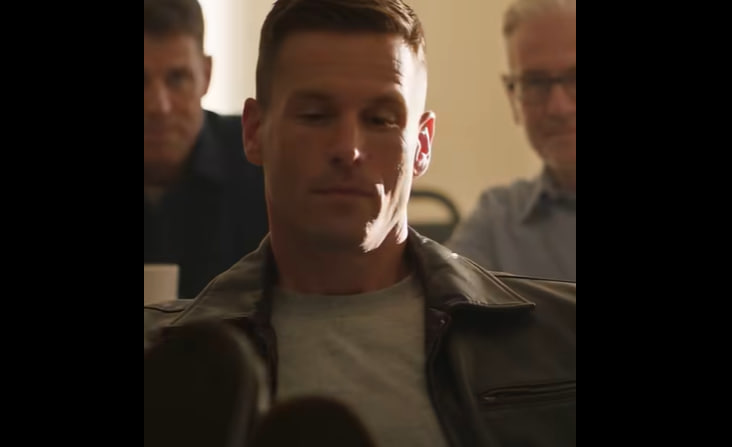

Chapter 1: The Aisle
“Pull your boots back,” Shannon Davis said, stopping beside the young serviceman’s chair.
Mercer stretched his legs farther across the aisle. “What makes you think I should move for you?”
Three men at his table laughed into their coffee cups. Their amusement traveled farther than Mercer expected inside the bright veterans’ hall.
Shannon did not retreat. Her polished support cane remained planted beside his chair, its curved metal handle steady beneath her hand.
“You are blocking the walkway,” she said.
Mercer looked at the cane before studying her immaculate service uniform. A small grin slowly crossed his face.
“There’s another table in back,” he said. “Take the long way.”
Nobody nearby spoke. Forks stopped above plates, and conversations dissolved beneath the humming fluorescent lights.
Shannon’s fingers closed more firmly around the handle. “Move your feet.”
Mercer glanced toward his friends. Their eager expressions encouraged him more than her warning restrained him.
“The aisle is public,” he said. “I got here first.”
A cup met its saucer with a sharp clink. The nervous sound came from an older veteran seated several feet away.
Shannon turned her eyes toward Mercer’s polished boots. Then she looked directly into his face again.
“Your behavior may cost you more than you understand,” she said.
Mercer leaned back. “That sounds like a threat without any weight behind it.”
His friends laughed again, but the sound lacked its earlier confidence. Several guests now watched them openly.
Shannon advanced one measured step. Her cane struck the polished floor with a crisp metallic note. The sound seemed to divide the room.
Mercer straightened before catching himself. He restored his smile after noticing that his friends had seen the reaction.
“Well?” he asked. “Are you waiting for someone to carry you around me?”
A few people lowered their eyes. One elderly man tightened both hands around a folded ceremony program.
Shannon’s expression remained controlled. Only a slight movement near her jaw revealed the pressure beneath her composure.
“No,” she said. “I am waiting for you to remember what that uniform requires.”
Mercer’s smile narrowed.
Beyond them, sunlight poured through tall windows overlooking a parking lot in Columbus, Ohio. American flags outside pulled sharply against the September wind.
The Franklin County Veterans Recognition Hall had hosted retirement dinners, memorial services, and reunions for nearly four decades. That afternoon, every table was occupied. Veterans from different generations sat beneath framed photographs of service members. Families gathered among volunteers, local officials, and uniformed guests.
At the front stood a modest stage with a lectern, five chairs, and a folded American flag beneath glass. The annual program honored service beyond the battlefield. Its theme concerned responsibility after returning home.
Mercer had joked about that theme when he arrived. He was twenty-nine, recently returned from his second overseas deployment, and still carried himself like someone expecting attention. His dress uniform fit perfectly. Every ribbon sat straight, and his shoes reflected the overhead lights.
His three companions had deployed with other units. Together, they occupied a center table and treated the gathering like their private reunion. They had been loud during coffee. Nobody had corrected them because their stories sounded impressive from a distance.
Shannon had entered alone ten minutes earlier. She was fifty-two, though the guarded lines around her eyes sometimes made her appear older. Her dark hair was secured neatly beneath her service cap. The cane supported damage concealed beneath tailored trousers. She never apologized for its presence or explained it to curious strangers.
A volunteer had directed her toward the front tables. Mercer’s chair blocked the only clear route between the crowded rows.
Shannon could have turned around. She could have moved between tables, asked seated guests to rise, or accepted help from the volunteer near the entrance. Instead, she had stopped.
The decision was not about convenience. Mercer’s careless posture had become deliberate the moment he saw her cane.
Shannon recognized that choice immediately. She had encountered arrogance in training rooms, command tents, transport aircraft, and hospital corridors. Usually, it disguised uncertainty. This felt different. Mercer wanted an audience.
“You heard her,” an older veteran finally said. The speaker wore a faded Marine Corps tie beneath a brown jacket. A tremor moved through his left hand.
Mercer turned toward him. “We’re handling it.”
The veteran’s mouth tightened. His wife touched his wrist, quietly asking him not to stand.
Shannon noticed the exchange. She also noticed the embarrassment spreading across the room.
“This does not concern anyone else,” Mercer said.
“It concerned everyone when you made it public,” Shannon replied.
One of Mercer’s friends, Tyler Reed, shifted uncomfortably. “Come on, Luke. Just move your feet.”
Mercer looked at him with disbelief. “You were laughing ten seconds ago.”
“I’m saying the joke is finished.”
“That depends on whether anyone was joking.”
The answer darkened the space between them. Tyler looked down at his untouched coffee.
Shannon remained beside Mercer’s chair. Her shoulders stayed level despite the pressure building through her damaged leg. Pain traveled upward with every second she stood motionless. She had learned to hide that pain during eighteen months of rehabilitation.
Mercer saw the cane but not the discipline surrounding it.
“You can still go around,” he said.
Shannon studied him carefully. Something about his eyes troubled her more than his words. The shape of his face seemed faintly familiar. His surname stirred a memory she could not immediately place. She searched through years of personnel rosters, casualty briefings, and hospital lists. Nothing settled.
Mercer mistook her silence for uncertainty. “That’s what I thought,” he said.
His nearest friend, Kevin Marsh, whispered, “Let it go.”
Mercer ignored him. “Some people think a uniform means everyone must clear a path.”
Shannon’s gaze hardened. “That uniform means you should clear the path without being asked.”
A low murmur moved through nearby tables. Mercer heard it and flushed. His humiliation sharpened his need to regain control.
“You don’t know anything about me,” he said.
“I know what you are showing this room.”
“You walked over here looking for special treatment.”
“I asked you to move your boots.”
“That cane probably gets you whatever you want.”
The sentence landed harder than his friends expected. Tyler’s chair creaked as he leaned away. Kevin stared at Mercer with open discomfort.
Shannon’s face did not change. Her breathing did. She drew one slow breath and held it until the pain inside her chest settled behind discipline.
The cane was not a symbol she displayed for sympathy. It was the remaining evidence of a morning she rarely discussed. On difficult nights, she still heard metal tearing beneath a desert sky. She still remembered smoke entering her lungs.
However, none of those memories belonged to Mercer yet.
“Luke,” Tyler said quietly, “stop.”
Mercer turned. “Whose side are you on?”
“There shouldn’t be sides.”
“That’s easy to say after laughing.”
Tyler’s expression tightened. Mercer had trapped him with the truth, and everyone close enough had heard it.
Shannon looked across the table. “You can choose differently now.”
Tyler’s eyes rose toward her. Shame moved through them.
Before he could answer, the main doors opened.
Chapter 2: The General
The mechanical latch produced a hard click. Cold air swept through the entrance and stirred the ceremony programs. A tall man stepped inside wearing a pristine formal service uniform. Silver hair framed a lined, composed face.
Robert Hale removed his gloves as the doors closed behind him. He paused beneath the flags and surveyed the hall.
Conversations stopped without any announcement. Hale had spent thirty-four years in uniform. His reputation had traveled through commands long before his name appeared on that afternoon’s program. He had been delayed at a nearby hospital dedication. Most guests expected him to enter through the stage door.
Instead, he arrived behind Mercer.
Hale saw the crowded tables, Shannon’s rigid posture, and the cane pressed into the floor. Then he noticed Mercer’s boots occupying her path.
His expression changed almost imperceptibly.
“Move them, Mercer,” Hale said.
Mercer’s feet disappeared beneath his chair. The movement was so abrupt that his heel struck a table leg. His chair scraped backward. Tyler, Kevin, and the third friend, Brandon Cole, stood automatically. Their earlier confidence vanished.
“Sir,” Mercer said. “We were just messing around.”
Hale approached at an even pace. “Was everyone enjoying it?”
Mercer looked toward his companions. Tyler stared at the floor. Kevin folded his arms, while Brandon stepped away from the table.
Hale stopped several feet from Mercer. “I asked whether everyone found your behavior amusing.”
“No, sir.”
“Then explain the entertainment.”
Mercer swallowed. “There was a misunderstanding.”
Shannon shifted slightly. Her cane tapped the floor as she relieved pressure from her left leg.
Hale’s gaze moved toward her face. Recognition transformed him. For one brief second, the formal distance left his expression. What replaced it was respect, relief, and an old burden he had never forgotten.
“Colonel Davis,” he said softly.
The title moved through the room.
Shannon gave him a restrained nod. “General Hale.”
Mercer’s face changed. He had noticed Shannon’s uniform, yet he had not examined it closely. He had seen a cane first. Everything afterward had passed through that assumption.
Hale stepped beside Shannon and lowered his voice. “Are you all right?”
“I am standing.”
“That was not my question.”
“It is the answer I can give here.”
Hale understood. His eyes briefly dropped toward the cane before returning to Mercer.
“Look at her,” Hale said.
Mercer raised his eyes reluctantly. “I am looking, sir.”
“No. You are finally facing her. That is different.”
Mercer’s jaw tightened.
Hale gestured toward Shannon without touching her. “You have encountered this officer before.”
Mercer stared at her. The room became silent enough for the wall clock to sound unusually loud. Each movement of its second hand sharpened the pause.
Shannon watched Mercer search her face. His uncertainty disturbed her. Then an image surfaced behind her guarded expression. A younger face streaked with dust had looked upward through emergency lights. Blood had darkened one side of that soldier’s uniform. She remembered a medic calling a surname.
Mercer.
Shannon’s grip tightened around the cane.
Mercer saw the movement. His gaze dropped toward the curved handle, then rose toward her ribbons. Recognition did not arrive all at once. His shoulders became rigid first. His lips parted. The remaining color slowly left his face.
“No,” he whispered. “That cannot be her.”
Shannon’s discipline faltered for less than a second. Pain crossed her eyes before she concealed it again.
Hale heard him. “Say her name.”
Mercer’s throat moved. Nothing emerged. His friends exchanged alarmed glances. They understood that their laughter had pulled them into a history they did not know.
“Say it,” Hale repeated.
The cane made another soft sound as Shannon adjusted her weight.
Mercer flinched. “Shannon Davis,” he said.
Her name passed from table to table in low whispers. Several older veterans straightened. A woman near the coffee station slowly lowered the glass pot in her hand. A retired Army physician removed his glasses and studied Shannon. Recognition appeared across his face.
Hale never looked away from Mercer. “Where did you learn that name?”
Mercer lowered his gaze.
“Answer him,” Shannon said. Her voice contained no anger. Its restraint made obedience feel unavoidable.
“During my last deployment,” Mercer answered.
The guests remained still.
Hale took another step forward. “Be more specific.”
Mercer’s pride resisted the room even as his memory weakened it. “I heard the name at Bagram,” he said.
Shannon’s free hand briefly closed against the seam of her trousers. The answer opened a sealed corridor inside her mind. She saw a flight line under emergency lamps. She smelled fuel, scorched fabric, disinfectant, and wet concrete. She remembered Hale standing beside a medical transport. His sleeves had been rolled above his forearms. She remembered a young soldier refusing to release another wounded man’s vest. That soldier had been Mercer.
Hale saw the memory settle across Shannon’s face. “So you remember Bagram,” he said.
Mercer nodded.
“Do you remember arriving there?”
Mercer’s mouth tightened. “Parts of it.”
“Which parts?”
“This isn’t necessary, sir.”
Hale’s voice remained level. “You made it necessary when you decided her disability was material for your friends.”
A visible tremor crossed Mercer’s jaw. Nearby guests shifted, but nobody looked away.
Shannon turned slightly toward Hale. “Robert.”
He met her eyes. The use of his first name revealed a familiarity greater than rank. It also carried a warning.
Hale lowered his voice. “He needs to understand.”
“He may understand more than he admits.”
Mercer looked between them. “I honestly didn’t recognize her.”
The sentence sounded smaller than he intended.
Shannon faced him fully. “Would recognition have changed your behavior?”
Mercer hesitated. That pause answered for him.
“If I knew who you were, yes,” he said.
A disappointed murmur crossed the hall.
Shannon’s eyes remained fixed on him. “Then you still do not understand.”
Mercer’s face flushed. “I mean I would have shown proper respect.”
“You were already required to show proper respect.”
“I made a mistake.”
“You made several choices.”
Mercer glanced toward the audience. Public shame tightened around him, and defensiveness returned. “You don’t know what deployment did to me,” he said.
Shannon absorbed the statement without moving.
Hale’s expression cooled. “Be careful.”
“No, sir. Everyone is acting like I woke up wanting to humiliate somebody.”
“You extended your boots after she asked you to move.”
Mercer looked at Shannon’s cane. “I didn’t think it was serious.”
“That is precisely what you thought,” Hale said. “You decided her pain was unimportant.”
Mercer drew a breath. “I came home different.”
“So did she.”
The words struck the room with more force than shouting could have carried. Mercer looked again at the cane. For the first time, he seemed to wonder why Shannon needed it.
Shannon saw that question and hated how much power it held. She had spent years refusing to become one damaged morning. She did not want the room to respect her because metal had entered her leg. She wanted them to understand what happened before it did.
Hale turned toward the stage. “This program was created to honor responsibility,” he said. “We planned speeches about what service asks after the uniform comes off.”
Nobody shifted.
“Instead, this room witnessed a decorated serviceman confuse attention with character.”
Mercer stared forward.
Hale continued. “It also witnessed good people choosing silence because confrontation felt uncomfortable.”
Several guests lowered their eyes. The retired Marine who had spoken earlier looked toward Shannon. His wife released his wrist.
Hale’s criticism did not spare Mercer’s friends. “You laughed,” he told them.
Tyler nodded miserably. “Yes, sir.”
“Why?”
Tyler swallowed. “Because Luke expected us to.”
“That is not an answer.”
“I wanted to belong.”
Hale turned toward Kevin.
Kevin looked pale. “I laughed because everyone else did.”
“And you?” Hale asked Brandon.
Brandon pressed his lips together. “I knew it was wrong.”
“Yet you participated.”
“Yes, sir.”
Mercer looked at his friends with growing resentment. “Don’t act like this was only me.”
Shannon spoke before Hale could respond. “They are answering for themselves. You should try it.”
Mercer’s eyes returned to her. “I said I made a mistake.”
“You are describing an accident.”
“What do you want me to call it?”
“A decision.”
His shoulders rose with a defensive breath. “Fine. I decided to make a joke.”
“You decided that my difficulty walking lowered my standing in this room.”
Mercer said nothing.
“You decided your friends’ approval mattered more than basic decency.”
His silence continued.
“You decided the uniform protected you from accountability.”
“That is not true.”
Shannon’s voice remained calm. “Then tell us what is true.”
Chapter 3: The Memory
Mercer looked around the hall. The American flag near the stage moved slightly beneath the ventilation system. Sunlight brightened its red stripes across the floor. He seemed to search for a version of events that would rescue his pride. None existed.
“I saw the cane,” he finally said. “I thought you were expecting people to treat you differently.”
Shannon nodded once. “That is honest.”
Mercer looked surprised.
“It is also ugly,” she added.
His face hardened.
Hale watched both of them. “Tell her why her name frightened you.”
Mercer stared at the floor again.
Shannon’s breathing became shallower. The room seemed to recede behind a distant mechanical roar. She had not entered the hall expecting Bagram to follow her inside.
Hale noticed the change. “We can stop.”
Shannon looked at him. “No.” The answer came immediately.
Mercer raised his head.
Shannon’s eyes held his now. “If he remembers, he should finish remembering.”
Hale nodded.
Mercer gripped the back of his chair. “Her name was part of an after-action briefing.”
“What did the briefing concern?” Hale asked.
“A convoy attack.”
The retired physician closed his eyes briefly.
Hale continued. “Which convoy?”
Mercer’s voice weakened. “Ours.”
Shannon heard a helicopter somewhere beyond the walls, though none crossed the Ohio sky. Memory supplied the sound. Years earlier, her convoy had been moving medical supplies between isolated positions. The morning had begun beneath a pale, colorless horizon. Her vehicle had been two positions behind Mercer’s transport. The first blast had lifted dust across the road. The second struck before anyone could see through it.
Shannon had not been Mercer’s direct commander. She had been the senior officer still able to coordinate the response. Her radio operator had lost consciousness. Two vehicles were disabled, and the remaining soldiers had scattered behind insufficient cover.
Shannon had moved forward. She had crossed open ground because Mercer’s vehicle had begun burning near the rear compartment. Those facts entered the official report. They had also been repeated during Mercer’s recovery. He knew her name because other people had spoken it whenever he asked why he was alive.
However, he had seen her face only through smoke, emergency lights, medication, and pain.
Hale drew him toward that memory carefully. “What happened to your vehicle?” he asked.
Mercer’s hands tightened on the chair. “It was hit.”
“Were you able to exit?”
“No.”
“Why not?”
“My leg was trapped.”
The words created a new silence. Shannon’s gaze dropped briefly toward Mercer’s polished shoes. Both legs appeared strong beneath him. Mercer followed her eyes and understood the contrast.
Hale asked, “Who reached you?”
Mercer did not answer.
Shannon’s posture remained upright. The cane bore more of her weight now.
“Who reached you?” Hale repeated.
“A team,” Mercer said.
“Name the person leading it.”
Mercer’s face tightened. “I couldn’t see.”
“You heard her voice.”
His eyes closed. For an instant, he was no longer standing in a veterans’ hall. He was pinned beneath twisted equipment while smoke filled the transport. Every breath had burned. Someone outside had ordered him to follow her voice. He had shouted that another soldier remained behind him. The voice had answered that nobody was being abandoned.
Mercer opened his eyes. Shannon stood before him, older than the figure inside his fragmented memory. Silver now touched the hair near her temples. The same composure lived in her voice.
“You told me to keep talking,” he said.
Nobody moved.
Shannon’s expression remained guarded. “Yes.”
“You kept asking my hometown.”
“You said Dayton.”
“My mother had moved there.”
“You corrected me three times.”
Mercer blinked rapidly.
Shannon continued. “You said you were from Springfield, but your mother lived in Dayton.”
His mouth opened.
“That bothered you despite everything else,” Shannon said. “You insisted those were different answers.”
A short, broken breath escaped him. The detail could not have come from a report. His friends stared at Shannon.
Hale watched Mercer’s certainty collapse beneath memory. “You were there,” Mercer whispered.
Shannon gave no answer. She did not need one.
Mercer looked down at the cane again. Understanding approached, and he resisted it.
Hale saw that resistance. “Ask the question.”
Mercer’s voice barely carried. “What happened to your leg?”
Shannon’s eyes remained on him. “You already know.”
“I don’t.”
“You have avoided knowing.”
“That isn’t fair.”
“Neither was the morning that gave us this conversation.”
Mercer recoiled as though she had raised her voice. She had not.
The retired physician stood slowly near the stage. His name was Dr. Samuel Porter, and he had supervised the receiving medical team.
“General Hale,” Porter said, “may I speak?”
Hale looked toward Shannon. She nodded once.
Porter removed his glasses. “I treated Colonel Davis after that convoy arrived.”
Mercer turned toward him.
Porter’s hands trembled slightly, though his voice did not. “She refused treatment until every soldier from the disabled vehicles was accounted for,” he said.
Shannon’s jaw tightened. “Sam.”
He understood the warning but continued carefully. “She had severe trauma to her left leg. She remained conscious long enough to report every casualty and every evacuation priority.”
Mercer’s grip slipped from the chair.
Porter looked directly at him. “You were one of those priorities.”
The hall seemed to shrink around Mercer. He shook his head once. “I was told a rescue team pulled us out.”
“A rescue team did,” Shannon said. “Many people risked themselves that morning.”
Hale added, “She led them.”
Mercer looked between them. Shannon’s expression revealed no satisfaction. The absence of triumph made the truth harder to escape.
“You were inside the vehicle?” he asked.
“I reached the rear opening.”
“You pulled me out?”
“Sergeant Alvarez released your trapped leg. Two others carried your weight.”
“That wasn’t my question.”
Shannon paused. “I kept you conscious,” she said. “I helped move you beyond the burning vehicle.”
Mercer’s lips trembled. “And then?”
Shannon glanced toward the windows. September sunlight lay peacefully across the floor. “Another blast struck while we were moving the last casualty.”
Mercer stared at the cane. Hale allowed the implication to settle.
Shannon turned back. “My injury does not belong to you.”
Mercer looked confused.
“You did not cause that attack,” she continued. “You do not owe me your life.”
His eyes filled despite his effort to control them.
“But you owed the woman in this aisle ordinary human decency,” Shannon said. “You failed before knowing her name.”
That sentence removed his final defense. Mercer lowered himself into the chair. The movement lacked his earlier swagger. His friends remained standing, uncertain whether sitting would appear disrespectful.
Shannon looked at them. “Take your seats.”
They obeyed quietly.
Chapter 4: Accountability
Mercer remained bent forward, his hands clasped between his knees.
“I heard stories about you,” he said.
Shannon waited.
“They said you stayed until the helicopters arrived.”
“I stayed because leaving was not possible.”
“They said you refused evacuation.”
“I delayed it.”
“They said you saved nine people.”
“Many people saved nine people.”
Hale looked toward Mercer. “Notice what she refuses to claim.”
Mercer nodded faintly.
Shannon’s discomfort became visible. She had never enjoyed ceremonies that transformed collective survival into one person’s legend. That afternoon’s program had already worried her. Hale had asked her to attend without explaining why. She had suspected some form of recognition. Now the entire hall knew a story she had spent years reducing to a few clinical sentences.
“You knew she would be here,” Mercer said to Hale.
“Yes.”
“Why didn’t anyone tell us?”
Hale’s expression sharpened. “Would a guest list have supplied the character you lacked?”
Mercer looked away.
Shannon studied Hale. “You invited me for something more than lunch.”
He exhaled slowly. “Yes.”
The room sensed another shift.
Hale gestured toward the front. “Your seat is on the stage.”
Shannon looked at the five chairs. A brass nameplate had been turned downward on the center chair. From the floor, its inscription remained hidden.
“I told you I would not accept a personal award,” she said.
“It is not an award.”
“Robert.”
“It concerns the recovery program.”
Shannon’s guarded expression changed. For three years, she had worked quietly with clinicians, veterans, and county officials. They had designed a rehabilitation network for injured service members returning to Ohio. The project connected physical therapy, trauma counseling, transportation, and employment assistance. Shannon had refused to attach her name to it. Funding had remained uncertain.
Hale reached inside his jacket and removed a sealed envelope. “The state partnership was approved this morning,” he said.
A murmur moved through the room.
Shannon stared at the envelope. “All counties?”
“All participating counties, including the rural clinics.”
“And transportation?”
“Fully funded for the first three years.”
Her fingers loosened around the cane. For the first time since entering the hall, genuine emotion reached her face without being immediately concealed.
Porter smiled from across the room. “We received confirmation before noon.”
Shannon looked toward him. “You knew.”
“I was ordered to keep quiet.”
“You have never followed that order successfully.”
Quiet laughter passed through the hall. It carried warmth rather than cruelty. Mercer heard the difference.
Hale offered Shannon the envelope. “The program launches in January.”
She took it with her free hand. The paper trembled slightly between her fingers. Whether pain or emotion caused the movement remained unclear. Mercer watched her study the seal. He finally understood why Hale had wanted the afternoon centered on responsibility after service. Shannon had continued serving after injury. She had built the support that others would need when applause disappeared. Mercer had returned home and converted his survival into permission. The contrast stood plainly before him.
Hale turned toward the audience. “Colonel Davis came here expecting a planning meeting.”
Shannon gave him a narrow look. “That was what your invitation said.”
“It was accurate, though incomplete.”
“You manipulated an officer.”
“I surprised a stubborn colleague.”
“You remain dangerously pleased with yourself.”
Another restrained laugh moved through the room. The tension eased briefly, but Mercer did not join it.
He stood again. Every face turned toward him.
Shannon folded the envelope carefully. “What are you doing?”
“I need to apologize.”
“You already named your conduct a mistake.”
“That was not an apology.”
Hale stepped back, leaving the space between them open. Mercer faced Shannon without the shelter of his friends. His hands remained stiff at his sides.
“I saw your cane before I saw you,” he said.
Shannon waited.
“I decided you wanted attention. Then I used your disability to entertain my table.” His voice caught, but he continued. “When you challenged me, I cared more about winning than behaving honorably.”
The room remained silent.
“I laughed at the person who helped bring me home,” he said. “That makes this worse, but it does not create the wrong.”
Shannon’s eyes narrowed slightly. Mercer understood that she was listening now.
“I should have moved for anyone,” he continued. “I should never have forced you to defend your right to pass.”
Tyler lowered his head.
Mercer looked directly at Shannon. “I am sorry, Colonel Davis.”
The apology did not erase what had happened. Nothing in Shannon’s expression suggested immediate forgiveness.
“That is the first responsible thing you have said,” she replied.
Mercer absorbed the measured answer.
“I don’t expect you to forgive me.”
“Good.”
The blunt word surprised several guests.
Shannon shifted her cane and faced him squarely. “Forgiveness requested in public can become another performance,” she said. “Real accountability begins after the audience leaves.”
Mercer nodded. “What should I do?”
“That is not mine to decide for you.”
“I want to make this right.”
“You cannot reverse the last hour.”
His face tightened, but he accepted the statement.
Shannon continued. “You can decide whether it remains an isolated humiliation or becomes evidence of your character.”
Mercer glanced toward the envelope in her hand. “Your program needs volunteers.”
Hale’s expression became guarded.
Shannon noticed. “Do not offer service as payment for absolution.”
“I’m not.”
“You reached that answer quickly.”
“Because I spent nine months learning to walk normally again,” Mercer said. “I know what transportation failures and missed appointments can do.”
Shannon studied him. The room waited, but she refused to let the audience hurry her judgment.
“Volunteers receive training,” she said. “They also undergo review.”
“I understand.”
“You would not work with patients initially.”
“I understand.”
“You would answer to people who know nothing about today.”
“That is probably better.”
A faint change touched Shannon’s expression. It was not a smile, but its severity softened.
Hale spoke quietly. “The program can decide through its normal process.”
Shannon nodded. “Exactly.”
Mercer looked relieved, though no promise had been made.
Tyler rose beside him. “I owe you an apology too,” he said.
Shannon turned toward him.
“I told him to stop only after I became uncomfortable,” Tyler said. “Before that, I encouraged him.”
Kevin and Brandon stood as well.
Kevin spoke next. “I followed the table because I didn’t want them turning on me.”
Brandon looked toward the guests. “I knew it was wrong before anyone said anything.”
Shannon listened without rescuing them from the discomfort.
When they finished, she said, “Remember how easy laughter felt before responsibility arrived.”
All three nodded.
The older Marine near the aisle pushed himself upright. His wife did not restrain him this time.
“I should have spoken sooner,” he said. “I waited because I thought someone with more authority would handle it.”
Shannon looked around the hall. Many faces carried the same admission.
“That is how public humiliation survives,” she said. “Everyone waits for the person with permission to object.”
The Marine nodded slowly.
Chapter 5: The Address
Hale moved toward the stage but stopped before climbing the steps. “The scheduled program no longer fits this afternoon,” he said.
A few guests exchanged uncertain looks.
Hale glanced toward Shannon. “Will you speak?”
She looked at the lectern, then at Mercer. “I did not prepare remarks.”
“I suspect prepared remarks would be less useful.”
Shannon disliked the logic because it was sound. She walked toward the stage. This time, the aisle opened before her. Chairs moved carefully. Guests created more space than she needed, each person suddenly attentive to the cane’s measured rhythm.
Shannon noticed their exaggerated concern. “Please remain seated,” she said. “I can cross a room.”
Several people looked embarrassed and settled back. Mercer moved his chair beneath the table. His boots disappeared entirely from the aisle. Shannon passed him without stopping.
At the stage steps, Hale indicated a side ramp hidden behind the curtain.
She looked at him. “You remembered.”
“I remember some things.”
The ramp had been installed after Shannon criticized the building during an earlier planning meeting. She ascended slowly, refusing Hale’s offered arm.
When she reached the lectern, the hall rose. The standing ovation began unevenly. Within seconds, every chair had emptied.
Shannon looked across the applauding room. Her expression became distant. She had heard applause after promotions, retirements, and memorial speeches. It had never sounded as simple as people believed.
Mercer stood among them, but he did not clap immediately. He watched Shannon as though trying to reconcile the officer before him with the voice inside a burning vehicle. Then he brought his hands together once.
The applause continued until Shannon raised her hand. Silence returned.
“You may sit,” she said.
Chairs moved across the floor.
Shannon placed Hale’s envelope on the lectern. She removed her service cap and set it beside the seal.
“I intended to discuss clinic schedules today,” she began. “Instead, we are discussing an aisle.”
Nobody smiled.
“That aisle exposed more than discourtesy,” she continued. “It exposed the stories we create when another person’s weakness becomes visible.”
Mercer held her gaze from the center table.
“My cane told one story to Mercer,” Shannon said. “My uniform should have told another, but neither story was complete.”
She allowed the point to settle.
“When General Hale used my rank, the room changed. When my deployment became known, it changed again.”
Several guests shifted.
“That should trouble us.”
Hale watched her from beside the stage.
“If dignity depends upon discovering someone’s importance, then it is not dignity,” Shannon said. “It is calculation.”
The older Marine nodded.
“The person blocking that aisle believed I lacked power. Once he learned otherwise, respect became easier.”
Mercer’s face tightened beneath the truth.
Shannon’s tone remained measured.
“However, power also creates dangerous temptations for the person who receives it.” She looked toward Hale. “I could humiliate Mercer now. This room would permit it.”
Hale did not react.
“Some might even call that justice,” Shannon continued. “It would not be.”
Mercer looked up sharply.
“Accountability requires truth, consequences, and change,” she said. “Revenge requires only an audience.”
The hall remained completely still.
Shannon rested both hands along the lectern. “I will not pretend his conduct caused no harm. Public contempt reaches beyond its target.”
Her eyes moved across Mercer’s friends and the silent tables.
“It teaches witnesses that cruelty is acceptable. It teaches vulnerable people that belonging depends upon secrecy.”
Dr. Porter lowered his gaze.
“It also teaches the aggressor to mistake silence for approval,” Shannon said.
Mercer’s earlier laughter seemed to linger inside the room.
Shannon glanced at the cane beside her. “This device helps me walk. It does not summarize my service, my pain, my rank, or my worth.”
Her voice softened. “Many people carry injuries without visible evidence. Some become impatient, withdrawn, frightened, or reckless.”
Mercer stared at his clasped hands.
“Trauma can explain behavior,” Shannon said. “It cannot excuse deliberate humiliation.”
Hale looked toward Mercer. Mercer nodded faintly.
Shannon lifted the sealed envelope. “This program will help veterans rebuild lives after injury. It will not require them to perform gratitude or heroism.”
A quiet emotion moved through the audience.
“It will offer rides, counseling, rehabilitation, and employment support,” she continued. “It will also ask participants to recover responsibility.”
She set the envelope down again. “Coming home alive is not the end of service. Sometimes, it is the beginning of a harder obligation.”
Mercer’s eyes filled once more.
Shannon finished without raising her voice. “We must become people worth returning to.”
Nobody moved after her final words. Then Dr. Porter stood. Others followed slowly, but no applause came immediately. The silence felt more respectful than noise.
Hale stepped onto the stage and placed one hand on the back of the center chair. “Thank you, Colonel,” he said.
Shannon nodded.
The program resumed in altered form. Porter explained the rehabilitation network. A county coordinator described transportation partnerships with local hospitals and community colleges.
Shannon remained seated at center stage. The nameplate before her now faced the audience. It identified her only as program director.
Mercer listened without checking his phone or whispering to his friends. When speakers discussed mobility barriers, he looked at the aisle. When they discussed survivor guilt, his shoulders lowered. When they described volunteer screening, he wrote the website address inside his ceremony program.
Shannon noticed. She also noticed that Tyler, Kevin, and Brandon wrote it down.
Chapter 6: After the Audience Leaves
The event ended near sunset. Guests formed a line near the stage, though Shannon had asked them not to. Some wanted to thank her. Others wanted to describe relatives who needed help.
She listened until pain began burning through her left hip. Porter noticed first.
“That is enough standing,” he said.
“I am seated.”
“You have been answering questions for forty minutes.”
“You were always dramatic.”
“I treated you. That gives me permanent permission.”
“It gives you an inflated sense of authority.”
Despite herself, Shannon smiled.
Hale approached carrying her coat. “The car is waiting.”
“I drove.”
“You are not driving after this.”
“I have driven after worse.”
“That argument stopped being persuasive years ago.”
Shannon accepted the coat but did not put it on.
Across the hall, Mercer remained beside his table. His friends had left after helping volunteers gather cups and programs. He appeared to be waiting.
Hale followed her gaze. “Do you want him removed?”
“No.”
“You do not owe him another conversation.”
“I know.”
Porter looked between them. “I can stay.”
Shannon shook her head. “Give us a moment.”
Hale hesitated. She raised one eyebrow. He surrendered. “Five minutes.”
“You stopped commanding me long ago.”
“Some habits survive retirement.”
Hale and Porter moved toward the entrance.
Mercer approached slowly, carrying two untouched coffee cups. He stopped several feet away.
“I thought you might want one,” he said.
Shannon looked at the cups. “That depends on how long they have been sitting.”
“Fresh pot.”
“No sugar?”
“I didn’t know.”
“Good answer.”
Mercer set one cup on the table near her chair. He did not sit until she gestured toward the opposite seat.
For several seconds, neither spoke. Volunteers worked quietly near the stage. Chairs scraped in distant rows, and dishes clattered inside the kitchen. Mercer looked older than he had two hours earlier.
“I remember more now,” he said.
Shannon wrapped both hands around the warm cup. “What do you remember?”
“Your voice.”
She waited.
“You kept telling me where the helicopter would land.”
“It gave you something ahead of you.”
“I thought you were lying.”
“I was.”
Mercer looked surprised.
“The landing zone changed twice,” she explained. “I needed you focused on a fixed point.”
“You said I would be home before Thanksgiving.”
“I had no authority over that.”
“I made it.”
Shannon nodded. “I know.”
“How?”
“Casualty reports.”
“You followed them?”
“For everyone from that convoy.”
Mercer stared into his coffee. “I never knew what happened to you,” he said.
“You could have learned.”
The statement contained no accusation beyond its truth.
Mercer nodded. “I was afraid.”
“Of what?”
“That the person who saved me had died.”
Shannon studied him.
“Then people said Colonel Davis survived,” he continued. “They said you had been transferred stateside.”
“So you stopped asking.”
“Yes.”
“Why?”
“Because survival was easier if the story ended with everyone alive.”
Shannon looked toward the folded flag beneath glass. “Survival rarely ends that cleanly,” she said.
Mercer’s fingers tightened around his cup. “I had nightmares for years,” he said. “Sometimes I still smell smoke in parking garages.”
Shannon remained quiet.
“I started acting like nothing could touch me,” he continued. “People liked that version better.”
“Did you?”
“At first.”
“And now?”
“I think I have been punishing everyone who reminds me that I was helpless.”
Shannon did not absolve him. “That is something to tell a counselor,” she said.
“I stopped going.”
“Start again.”
Mercer nodded. He looked at her cane once more, but now the glance contained no contempt.
“Does it hurt every day?”
“Yes.”
“Because you came back for us?”
“Because an explosive detonated nearby.”
His expression tightened.
Shannon leaned slightly forward. “Do not turn my injury into a debt you can never repay,” she said. “That will only create another prison.”
“Then what do I do with it?”
“Live responsibly.”
The answer frustrated him because it offered no dramatic repayment. Shannon understood that frustration.
“Responsibility is usually ordinary,” she said. “Move your boots. Notice discomfort. Interrupt cruelty before an important person enters.”
Mercer closed his eyes briefly. “I wish Hale had arrived later.”
Shannon’s eyebrow lifted.
“Not because I wanted to continue,” he explained. “I wish I had corrected myself before authority forced me.”
“So do I.”
He accepted that.
“I submitted my information to the volunteer coordinator,” Mercer said. “I listed the incident under conduct disclosures.”
Shannon looked genuinely surprised.
“It happened quickly because the form was online,” he added.
“You included today?”
“All of it.”
“That may affect approval.”
“I know.”
“Why disclose something nobody formally reported?”
Mercer looked toward the aisle. “Because hiding it would repeat the same problem.”
Shannon considered him for several seconds. “That does not repair the harm,” she said.
“No.”
“But it is a beginning.”
His shoulders lowered.
Hale appeared near the entrance and checked his watch. Shannon ignored him.
Mercer followed her gaze. “He is protective of you.”
“He blames himself.”
“For the convoy?”
“He approved the route.”
Mercer looked toward Hale with new understanding.
“The route was necessary,” Shannon said. “The attack was not his fault, but guilt does not always respect facts.”
“That explains how he looked at you.”
“Yes.”
“And why he looked at me like that.”
“Partly.”
Mercer almost smiled, but the expression faded before forming.
“Will you tell him what you told me about debt?”
“I have been telling him for years.”
“He doesn’t listen?”
“Generals rarely develop that skill.”
Hale called from across the room, “I can hear you.”
Shannon raised her coffee cup toward him. “Then improve.”
A quiet laugh escaped Mercer before he stopped himself. Shannon did not object. The moment softened without erasing what preceded it.
Mercer stood. “Thank you for speaking with me.”
“Do not thank me yet.”
He paused.
“Call the counseling office tomorrow,” she said.
“I will.”
“Do not promise me. Make the appointment.”
“I understand.”
“And apologize privately to the volunteer you dismissed near the entrance.”
Mercer blinked. “You saw that?”
“I see aisles.”
Shame crossed his face. “I’ll find her.”
“She is stacking programs near the kitchen.”
Mercer nodded and turned. After several steps, he stopped.
“Colonel Davis?”
“Yes?”
“I am glad you came home.”
Shannon looked at him across the emptying hall. “So am I,” she said.
Mercer continued toward the kitchen.
Hale approached after he left. “That exceeded five minutes.”
“You survived.”
“Barely.”
He took the chair Mercer had vacated. Outside, sunset colored the parking lot in muted orange. The American flags moved more gently as the wind weakened.
Hale looked at Shannon’s untouched envelope. “You should open it.”
“I know what it contains.”
“You know the funding decision. There is something else.”
She gave him a suspicious look. “This is not another ceremony,” he said.
“That denial sounds dangerously specific.”
“Open it.”
Shannon broke the seal. Inside rested the formal approval documents, several handwritten notes, and a photograph taken at Bagram.
She removed the photograph carefully. It showed a medical transport beneath floodlights. Hale stood near the ramp, exhausted and covered in dust. Porter was visible beside him. A stretcher crossed the foreground, carried by four medical personnel.
Shannon lay upon it, conscious but pale. Her hand was raised toward a second stretcher entering the aircraft behind her. Mercer occupied that stretcher. The photograph had captured the instant she checked that he was still following.
Shannon stared at it. “I have never seen this,” she said.
“A flight medic found it in an archived deployment collection.”
She traced the photograph’s edge with one finger. On the back, someone had written two surnames and the date.
Davis. Mercer.
Her breathing changed. Hale watched quietly. “That is why I asked whether you were all right.”
“You knew he would attend?”
“I saw his name on the registration list.”
“You arranged our meeting?”
“No.”
Shannon looked sharply at him.
“I knew he was one survivor from the convoy,” Hale said. “I did not know whether either of you would recognize the other.”
“You could have warned me.”
“Yes.”
“Why didn’t you?”
“Because you would have stayed home.”
She could not deny it.
Hale looked toward Mercer near the kitchen. He was speaking with the young volunteer he had dismissed earlier.
“She appears to be making him start over,” Hale said.
The volunteer folded her arms. Mercer listened without interrupting.
“He may deserve that,” Shannon replied.
“He does.”
They watched until the volunteer finally accepted his apology with a reserved nod. Mercer then took the stack of programs from her arms and carried them toward storage. No audience followed him.
Shannon looked down at the photograph again. “He remembered my voice,” she said.
Hale’s expression softened. “You brought nine people home with that voice.”
“Many people did.”
“There you are again.”
“Accuracy matters.”
“So does accepting what you did.”
Shannon slipped the photograph back into the envelope. “I accept the cost.”
“That was not what I said.”
She looked toward him. Hale’s eyes carried years of gratitude and regret.
“You built a life beyond that road,” he said. “Today proves it.”
Shannon glanced at the program documents. The rehabilitation network would open within months. Veterans across Ohio would receive help without navigating disconnected agencies alone. The victory was substantial. It did not return strength to her leg. It did not erase smoke from Mercer’s memory or guilt from Hale’s. It created something useful from what remained.
“That is enough ceremony for one afternoon,” Shannon said.
Hale stood and offered her coat again. This time, she accepted his help putting it on. They crossed the hall together.
When they reached Mercer’s table, Shannon stopped. His chair had been pushed completely beneath the table. The aisle stood open from the stage to the doors. A single ceremony program rested where his boots had been. On its cover appeared the afternoon’s theme: responsibility after service.
Shannon bent slightly, but Hale reached for the program first. “Leave it,” she said.
He straightened.
Mercer returned from the storage room and saw them beside the table. “I dropped that,” he said.
He approached, picked up the program, and folded it carefully. “I’m keeping it.”
Shannon nodded.
No applause followed. No cameras recorded the moment. Mercer stepped aside, leaving the center of the aisle clear.
Shannon passed him at her natural pace. Her cane touched the floor once, then again, each sound quiet beneath the fading activity.
At the doors, she looked back. Mercer was still standing beside the chair, holding the folded program against his chest. For a moment, he resembled the frightened young soldier who had once followed her voice through smoke. Then he turned toward the remaining volunteers and asked where they needed him.
Shannon watched until someone handed him a box. Only then did she face the open doors.
Cold September air moved across her face. Beyond the entrance, the flags settled beneath the darkening Ohio sky. Hale waited without rushing her. Shannon stepped outside under her own strength, carrying the envelope beneath one arm.
Behind her, the aisle remained open.
