
Chapter 1: The Boiling Point
The heat radiating off the asphalt at noon was enough to warp the horizon, turning the supermarket parking lot into a baking sheet. I was just trying to get through my shift pushing carts, keeping my head down, letting my hat cast a shadow over the jagged scars on my cheek. People usually looked away when they saw me anyway.
That’s why I was the only one actually looking at the silver sedan parked directly in the sun.
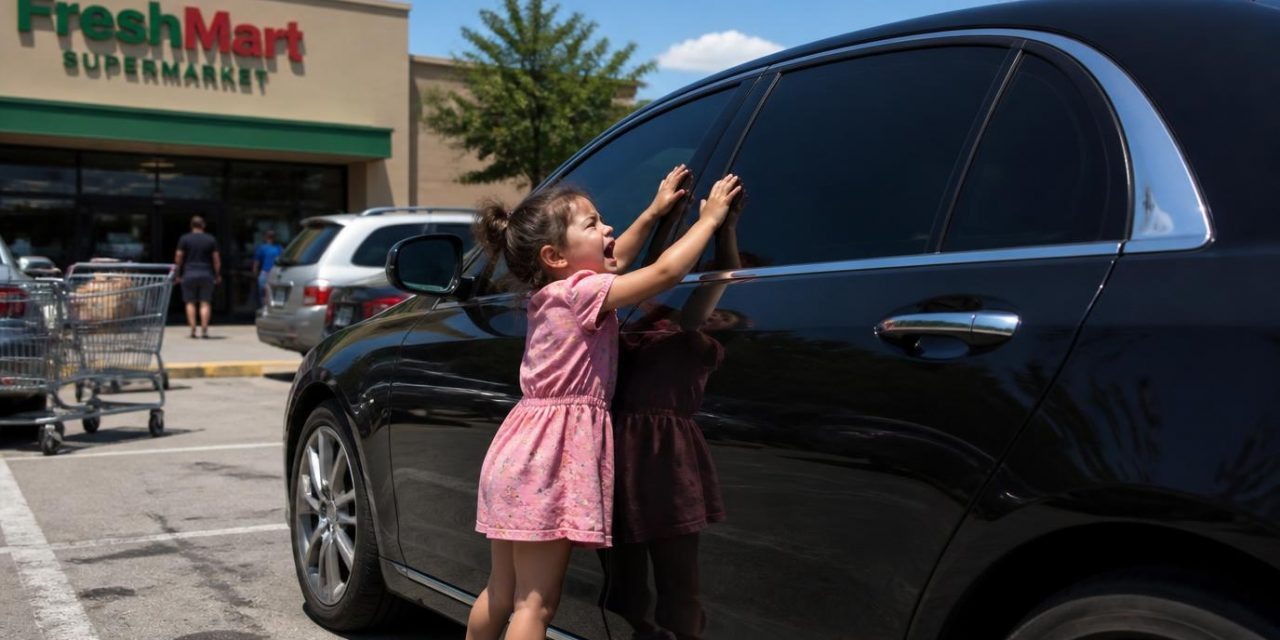
Shoppers were walking right past it. A woman with a loaded cart barely glanced at the tinted back window, shaking her head as if annoyed by a disruption. Inside, a little girl, maybe three years old, was pressed against the glass. Her small hands were frantically slapping the window. She was screaming, but the thick glass and the heavy doors sealed the sound inside. To everyone else, she was just a brat throwing a tantrum while her mom was inside grabbing groceries.
But I saw her face. It wasn’t flushed with anger; it was a terrifying, unnatural crimson. Her eyes were rolling back, and her frantic slapping was losing rhythm, slowing down into weak, uncoordinated thuds.
I dropped the line of carts I was pushing. “Hey!” I yelled at a man walking to his SUV. “There’s a kid in there, the car isn’t running!”
He waved me off without looking. “Parents probably just ran in for a second, kid. Mind your business.”
I ran to the sedan and yanked the handle. Locked. I pressed my face to the glass, shading my eyes. The heat radiating from the metal actually burned my palms. Inside, the little girl had stopped crying. She slid down the seat, her head lolling to the side, her eyes half-closed. She wasn’t throwing a tantrum anymore. She was dying.
Panic spiked cold in my chest. I looked around wildly. No one was coming. No parents rushing out with apologies. Just rows of shimmering, empty cars.
I didn’t think about my job. I didn’t think about the fact that I was a high school dropout on probation, the kind of kid the cops never believed. I grabbed the nearest empty shopping cart, backed up three steps, and drove it as hard as I could into the back window.
The glass didn’t break on the first hit. It spider-webbed, a loud crack echoing across the lot. Finally, a few heads turned.
“Hey, what are you doing?!” someone shouted.
I ignored them, grabbed a heavy metal anti-theft steering wheel lock that someone had discarded near a cart corral, and swung it with everything I had. The tinted glass shattered outward in a shower of dark cubes.
The blast of heat that hit my face was like opening an industrial oven. It smelled like melting plastic and stale air. I reached through the jagged frame, ignoring the glass biting into my forearm, and blindly scrambled for the lock. I hauled the door open and practically dove inside.
The little girl was limp. Her skin was scorching to the touch, and her breathing was shallow, rapid, and raspy. I fumbled with the complex buckles of her car seat, my hands shaking so badly I couldn’t get the plastic to yield.
“Come on, come on,” I muttered, finally pressing the release button hard enough to pop the harness. I gathered her up; she felt terrifyingly light and completely unresponsive.
I pulled her out of the oven-like interior just as a crowd finally decided to form. A woman shrieked, covering her mouth.
“Call 911!” I roared at the sea of suddenly concerned faces, laying the girl down in the scant shade of the open car door, desperately trying to fan her with my hat. “Someone get water!”
As the distant wail of sirens began to cut through the heavy summer air, I looked back into the sweltering car to see if I had missed a phone or an ID. On the front passenger seat, sitting casually next to a half-empty diaper bag, was a bright pink, sequined purse. And sticking out of the top, right next to a set of car keys, was a crumpled receipt from the tavern across the street.
Chapter 2: The Alibi
The wail of the sirens hit the parking lot before the ambulance did, a piercing mechanical scream that finally shattered the stagnant, suffocating air. Red and white lights washed over the shimmering asphalt, reflecting off the jagged teeth of safety glass still clinging to the sedan’s rear window frame.
I was still kneeling on the boiling pavement, the little girl’s head cradled in my lap. I was using my faded work hat to frantically fan her face, but the air I was pushing around was like the breath of a furnace. She hadn’t moved. Her skin was a terrifying, dry crimson, radiating a heat that felt completely unnatural for a human body.
“Over here!” I screamed, my voice cracking, tearing at my throat. “She’s not waking up!”
The heavy square doors of the ambulance burst open before the vehicle had even come to a complete stop. Two paramedics hit the ground running. One was a broad-shouldered woman carrying a massive orange trauma bag; the other was a younger guy who was already barking into his shoulder radio.
“Move, move, let us in,” the woman commanded, her voice dropping an anchor of authority into the chaotic scene.
I scrambled backward on my hands and knees, the rough asphalt tearing into my jeans, and let them take over. The moment my hands left the little girl, a profound sense of helplessness washed over me. The sun was a physical weight on my shoulders. Every breath I took tasted like car exhaust and melting tar. Watching the paramedic squeeze a tiny oxygen bag over the girl’s face, I felt a phantom tightness in my own chest. I had spent my whole life being invisible, slipping through the cracks of a system that didn’t want me, but in that moment, all I wanted was for this little girl to take one deep, visible breath.
“Pediatric heatstroke, severe,” the woman said, her hands moving in a blur as she checked the girl’s airway and pressed two fingers against the side of her tiny neck. “Pulse is thready and racing. Skin is bone dry. She’s cooked. Get the ice packs, rapid cooling protocols, now!”
The younger paramedic was already ripping open chemical cold packs with his teeth, slapping them against the child’s neck, armpits, and groin. The sheer violence of their urgency terrified me. This wasn’t a precaution. They were fighting a ghost that was already halfway out the door.
“Come on, sweetie, stay with us,” the woman murmured, securing the mask.
I stood up, my legs trembling so violently I had to lean against the side of the smashed sedan. My right forearm was stinging. I looked down and realized for the first time that a two-inch shard of tinted glass was protruding from my skin, right below the elbow. A thick, dark ribbon of blood was tracking down my wrist, dripping steadily onto the white painted lines of the parking space. I hadn’t felt it going in. I didn’t care. All my focus was tethered to the tiny, limp body on the stretcher as they hoisted her up and slammed the ambulance doors shut, enclosing her in a sterile, air-conditioned fight for her life.
“Step away from the vehicle. Keep your hands where I can see them.”
The voice was deep, flat, and uncompromising. I turned my head. A police cruiser had silently pulled up behind the ambulance, boxing in the scene. A heavy-set officer with salt-and-pepper hair and mirrored aviator sunglasses was walking toward me. His hand was resting casually, yet deliberately, on the butt of his sidearm.
“I… I wasn’t doing anything to the car,” I stammered, wiping a mixture of sweat and blood off my forehead with the back of my hand. “The little girl, she was trapped in there.”
Officer Miller—his silver nameplate caught the harsh midday sun—stopped about five feet away, taking in the scene. He looked at the smashed window, the heavy metal steering wheel lock resting on the pavement amidst a sea of shattered glass, and then, finally, he looked at me.
I knew what he saw. He didn’t see a hero. He saw a nineteen-year-old kid in a sweat-stained, oversized grey t-shirt and dirty work boots. He saw the jagged, puckered scars that ran from my left ear down to my jawline—souvenirs from a foster home dog attack years ago that made people cross the street when they saw me coming. He saw a kid who looked like trouble, standing next to a vandalized vehicle.
“Whose car is this?” Officer Miller asked, his tone devoid of warmth.
“I don’t know,” I said, my heart starting to hammer against my ribs. “I was just pushing carts. I saw her in the back seat. She was passing out.”
“He smashed it with that metal bar!” a voice called out.
I whipped my head around. The crowd of shoppers that had completely ignored the dying child five minutes ago had now morphed into a captive audience. The older man in the polo shirt—the same guy who had told me to mind my own business—was pointing a fleshy finger at me.
“I was walking to my SUV,” the man told the officer, stepping forward with unearned confidence. “I heard a massive crash. I look over, and this punk is smashing the window in. Just wailing on it. Scared my wife half to death.”
“She was dying in the heat!” I yelled at the man, a sudden, hot surge of anger flooding my veins. “You walked right past her!”
“Hey! Lower your voice and don’t address the bystanders,” Officer Miller snapped, stepping into my line of sight, using his physical presence to block me. “Are you the registered owner of this vehicle?”
“No! I just told you—”
“Then why did you break into it?”
“Because it’s a hundred degrees outside and the car was off!” I was hyperventilating now, the stress of the rescue colliding with the sudden, terrifying realization that I was becoming a suspect. It’s a specific kind of nightmare when a crowd decides you are the villain. It doesn’t matter what the truth is. It only matters what the consensus becomes. And the consensus in that parking lot, led by a man in a country-club polo and backed by a chorus of whispering shoppers, was that a kid with a scarred face and dirty hands was a predator.
“Officer, I had to get her out,” I pleaded, my voice dropping.
Miller pulled a small notebook from his breast pocket. “You got ID on you, son?”
“It’s in my locker inside the store,” I muttered, suddenly feeling very small, the adrenaline crashing and leaving me hollow.
Before I could explain my situation, before I could beg him to just ask the paramedics what they found, a sharp, piercing shriek tore through the parking lot.
“What did you do to my car?!”
The crowd parted. Striding toward us, her face contorted in exaggerated horror, was a young woman in her early twenties. She was wearing designer sunglasses, a pristine white sundress, and strappy sandals. She had a massive iced coffee cup in one hand, the plastic sweating in the heat, and a shopping bag from a high-end boutique in the other.
She didn’t look like a frantic mother who had just rushed out of the grocery store. She looked like she had just come from a brunch date. And as she got closer, the heavy, sweet scent of cheap perfume couldn’t entirely mask the sharp, fermented undertone of alcohol radiating off her breath.
She completely ignored the flashing lights of the ambulance. She ignored the puddles of blood from my arm. She zeroed in entirely on the shattered back window of the silver sedan.
“My window! My interior! There is glass everywhere!” she shrieked, dropping her shopping bag and rushing toward the car.
Officer Miller held up a hand to stop her. “Ma’am, is this your vehicle?”
“Yes, it’s my car! I’m Ashley! What happened?!” She finally seemed to register my presence, her eyes racking up and down my dirty clothes, locking onto my scarred face with visible disgust. “Did he do this? Oh my god, did you try to steal my car?”
“Where is the child, Ashley?” Officer Miller asked, his voice tightening a fraction.
Ashley froze. The iced coffee in her hand tilted, a few drops of brown liquid spilling onto the hot pavement. A look of pure, unadulterated panic flashed across her face, quickly replaced by a mask of manufactured hysteria.
“Mia!” she gasped, dropping the coffee entirely. It splattered against my boots, but I didn’t move. “Where is my niece?! Where is Mia?!”
“She’s in the ambulance,” I said, my voice shaking with a mixture of rage and exhaustion. “She nearly cooked to death because of you.”
Ashley spun on me, her acrylic nails flashing in the sun. “You shut your mouth! You delinquent! You attacked my car!” She turned back to Officer Miller, grabbing his forearm with both hands, tears welling up instantly beneath her designer sunglasses. “Officer, you have to arrest him! He must have been trying to steal my purse, and he attacked my niece!”
I stared at her, utterly bewildered by the audacity. “Are you insane? I pulled her out!”
“He’s lying!” Ashley sobbed, her voice trembling with practiced fragility. She leaned into the officer, playing the role of the terrified, defenseless woman flawlessly. “I was only gone for two minutes! Two minutes, I swear! Mia was fussing, her teeth are coming in, and I just ran into the pharmacy section of the supermarket to grab infant Tylenol. I left the AC running, I swear I did! The engine must have stalled!”
“The keys weren’t even in the ignition,” I interrupted, my hands clenching into fists at my sides. “The car was dead silent.”
“Because you turned it off!” Ashley screamed, pointing a trembling finger at me. “You broke in, you turned it off, you tried to steal my purse from the front seat! Officer, look at him! Look at his face! Does he look like a hero to you?!”
The crowd was eating it up. A collective murmur of sympathy rippled through the onlookers.
“I knew it,” the older man muttered loudly to his wife. “Disgusting. Breaking into a car with a baby inside.”
“He should be locked up,” a woman added, shaking her head.
I felt the blood drain from my face. The narrative was shifting, twisting violently in real-time. Ashley didn’t just lie; she orchestrated a performance. She used her expensive clothes, her perfectly blown-out hair, and her delicate tears as weapons. She understood the inherent biases of the uniform standing in front of us. She knew that Officer Miller, whether he realized it or not, was wired to protect a weeping, attractive young woman from a rough-looking teenager. She leveraged her privilege with a terrifying, practiced ease.
Officer Miller gently detached Ashley’s hands from his arm. “Okay, ma’am, calm down. If you were only gone for two minutes, we can verify that with the store’s security cameras at the entrance.”
Ashley didn’t miss a beat. “I didn’t go through the main entrance,” she lied smoothly, wiping a tear from her cheek. “I used the side doors by the pharmacy. They don’t have cameras there, the manager told me last week when my car was bumped. I just ran in, couldn’t find the Tylenol, and ran right back out! And I find this… this thug destroying my property!”
Miller turned back to me, his stance wider now, more defensive. His hand was resting firmly on his belt again. The benefit of the doubt he hadn’t even extended to me was now completely evaporating.
“Son, I’m going to need you to turn around and place your hands flat on the trunk of the cruiser,” Miller instructed, his voice dropping into that chilling, official cadence that meant an arrest was imminent.
“Officer, please,” I begged, the panic finally breaking through my stoic facade. Probation wasn’t just a legal status; it was a leash. I had spent two years walking on eggshells, working double shifts at the supermarket, keeping my head down, swallowing every insult and unfair accusation just to avoid drawing attention. One arrest—even a false one—meant a violation. It meant going back to a cell. It meant losing the tiny, fragile life I had managed to scrape together out of the dirt. “If you arrest me for this, I go straight to county. You can’t just take her word for it. Smell her breath! She smells like a distillery!”
Ashley gasped, pressing a hand to her chest. “How dare you! I use mouthwash with alcohol in it! Officer, he’s threatening me now!”
“Turn around. Now,” Miller barked, taking a step toward me, pulling a pair of steel handcuffs from his belt. The metallic click-clack of the cuffs swinging loose sent a jolt of pure terror straight down my spine.
I took a step back, raising my hands in surrender. My mind was racing, desperately clawing for a lifeline, for any shred of evidence that could stop this runaway train.
I looked at the silver sedan. I looked at the shattered window. I looked at the open driver’s side door.
The keys weren’t in the ignition.
When I had reached through the broken glass and blindly unlocked the heavy door, I had practically thrown myself into the front seat to get leverage on the back. My knee had slammed into the passenger seat. I remembered knocking over the half-empty diaper bag. I remembered the pink, sequined purse spilling sideways.
And I remembered grabbing something.
In my frantic, panicked scramble to find a water bottle or anything to help the dying child, my hand had brushed against the spilled contents of the purse. To clear a path to the back seat, I had reflexively swiped a loose piece of paper off the center console and shoved it into my pocket without a second thought.
I stood frozen as Officer Miller approached, his handcuffs ready.
“Last warning,” Miller said, his jaw tight. “Turn around.”
Ashley stood behind him, no longer crying. A faint, triumphant smirk played on her lips. She had won. She knew how the world worked. She knew who the police would believe. She knew she was going to walk away from nearly cooking her niece to death, and I was going to take the fall for the broken glass.
“Okay,” I whispered, my voice barely audible over the hum of the police cruiser’s engine. “Okay, I’ll turn around.”
But as I lowered my arms, I didn’t reach behind my back. Slowly, deliberately, keeping my eyes locked on Ashley’s smug face, I slid my right hand into the front pocket of my dirt-stained jeans.
“Hey! Keep your hands where I can see them!” Miller shouted, his other hand flying to his holster.
“I have something,” I said quickly, pulling my hand out just as fast.
My fingers were tightly clenched around a small, crumpled ball of thermal paper. I unspooled it carefully, my bloody arm trembling, smoothing out the creases against my thigh. It was a receipt.
Not from the grocery store pharmacy.
From O’Malley’s Tavern, the dark, windowless dive bar directly across the four-lane highway from the supermarket.
I looked down at the faded black ink. My eyes scanned past the list of items—three margaritas, two tequila shots, and a plate of loaded nachos—and landed squarely on the bolded timestamp printed at the very bottom.
Chapter 3: The Receipt
The timestamp at the very bottom of the crumpled, grease-stained thermal paper was printed in a faint, purplish ink, but in the glaring midday sun, it might as well have been written in neon.
1:12 PM.
I glanced up at the digital clock glowing faintly on the dashboard of Officer Miller’s idling cruiser behind me. The bright green numbers read 2:38 PM.
She hadn’t been gone for two minutes. She had been gone for an hour and twenty-six minutes. An hour and twenty-six minutes inside a dark, air-conditioned dive bar across the highway, knocking back tequila while a three-year-old child slowly cooked to death in a sealed metal box in a hundred-degree parking lot.
“I said, keep your hands where I can see them!” Officer Miller barked, his voice sharp enough to cut through my racing thoughts. He took another step forward, the heavy leather of his utility belt creaking, his hand fully gripping the handle of his sidearm now.
“I have proof,” I said, my voice shaking. I didn’t raise my arms back in surrender, but I held my right hand out flat, palm up, offering the crumpled ball of paper like a peace offering. “Just look at this. Please. Before you put those cuffs on me, just read what’s on this paper.”
Miller stopped. He was a veteran cop; I could see it in the way he assessed the situation. He was looking at my eyes, looking for the frantic, erratic shiftiness of someone high or lying, but all he found was desperate, terrifying sincerity.
“Put it on the hood of the cruiser,” he ordered, his tone dialing back just a fraction from lethal to merely commanding. “Slowly. Then step back three paces.”
I did exactly as I was told. I smoothed the receipt out on the blazing hot white metal of the police car, the blood from my forearm dripping a single, dark red spot onto the white paint right next to the paper. Then I backed away, raising my hands to my shoulders.
Ashley let out an exaggerated, theatrical sigh, crossing her arms over her pristine white sundress. “This is ridiculous! He’s stalling! He probably pulled some trash out of his pocket to distract you. Are you really going to let this delinquent waste your time while my car is destroyed?”
Miller didn’t answer her. He kept his eyes on me for a long three seconds, establishing control, before he reached out and picked up the receipt.
I watched his face. I watched the reflection of the parking lot in his mirrored aviator sunglasses. I watched the slight furrow form between his graying eyebrows as he read the logo at the top. I watched his lips part slightly as he read the list of items. And then, I watched his jaw muscles clench tight as his eyes hit the timestamp at the bottom.
The silence in the parking lot suddenly felt extremely heavy. The only sound was the low, rumbling idle of the ambulance engine twenty feet away, where the paramedics were still fighting to keep the little girl’s heart beating.
Miller slowly lowered the receipt. He didn’t look at me. He turned his head and looked at Ashley.
The shift in his posture was microscopic, but to someone who had spent his whole life avoiding the attention of cops, it was as loud as a siren. The defensive, protective stance he had taken to shield her from me vanished. He squared his shoulders, planting his feet evenly, facing her head-on.
“Ma’am,” Miller said, his voice completely stripped of the gentle, accommodating tone he had used just a minute ago. “You stated you went into the pharmacy section of the supermarket.”
“Yes,” Ashley said, her smug smile faltering just a fraction at the sudden coldness in his voice. “I went to get infant Tylenol.”
“And you were gone for how long?”
“Two minutes! Five, absolute tops. There was a line, and the cashier was moving so slow, I just left it and came back out. Like I told you.” She shifted her weight, suddenly looking uncomfortable under his mirrored gaze.
“Did you buy anything else today? Go anywhere else before coming to the supermarket?”
“No,” Ashley lied, her voice pitching up a half-octave. “We came straight from my sister’s house. Why? What does that piece of trash say?”
Miller held the receipt up, pinching it between his thumb and forefinger so she could see the purple ink.
“This is a receipt from O’Malley’s Tavern,” Miller said slowly, deliberately letting every word hang in the suffocating heat. “Located directly across the highway from where we are standing. It’s for three margaritas, two shots of Patron, and an order of nachos. The tab was closed out at 1:12 PM.”
Ashley’s face drained of color. The deep, expensive tan she was sporting suddenly looked sallow and sickly. Her mouth opened, but no sound came out.
“The young man here,” Miller continued, gesturing toward me without taking his eyes off her, “claims he pulled this out of a pink sequined purse sitting on the front passenger seat of your vehicle. The purse sitting right next to your car keys.”
“That… that’s a lie,” she stammered, taking a literal step backward. “He planted that! I don’t know where he got that!”
“He planted a receipt from an hour and a half ago, detailing drinks that coincidentally match the smell of alcohol currently radiating off your breath from three feet away?” Miller asked, his voice dripping with absolute, lethal skepticism.
“I told you, I use alcohol-based mouthwash!” she shrieked, the panic finally shattering her carefully constructed facade. “He’s trying to frame me! He broke my window!”
“Let’s go look at the purse,” Miller said flatly.
“No!” Ashley lunged forward, not toward the car, but toward Miller, trying to snatch the receipt out of his hand.
It was the dumbest thing she could have done. Miller stepped back, smoothly evading her manicured claws, and raised his left arm to block her.
“Ma’am, step back immediately,” he barked.
The crowd of onlookers, the same people who had been muttering about throwing me in jail five minutes ago, collectively gasped. The narrative had violently flipped, and the whiplash was visible on their faces. The older man in the polo shirt, the one who had accused me of vandalism, took his sunglasses off and stared at Ashley in absolute horror.
“You left a baby in a car for an hour and a half to go get drunk?” a woman in the crowd yelled, her voice thick with disgust.
“Shut up! Mind your own business!” Ashley screamed at the crowd, her face contorting into an ugly, feral snarl. The pretty, helpless victim was gone. The monster underneath had finally broken through the surface. She turned back to Miller, pointing a trembling, accusing finger at me. “He’s a thug! Look at his face! Look at those scars! You’re going to believe some ghetto trash over me?!”
“I’m going to believe the physical evidence,” Miller said. He reached up and unclipped his shoulder radio. “Dispatch, this is Unit 4. I need an additional unit for a suspect transport at the Main Street Supermarket. And get me an ETA on a forensics photographer.”
“Suspect?!” Ashley shrieked, her voice echoing off the brick facade of the grocery store. “I didn’t do anything! It was a mistake! I left the AC on, the car must have died! It’s a faulty alternator, I swear!”
“The keys weren’t in the ignition, Ashley,” I said quietly, speaking for the first time since I handed over the receipt. “You took them with you. You locked the doors. You walked across a highway and sat in a bar for eighty-six minutes. She was scratching at the glass. She was dying while you were eating nachos.”
Ashley spun toward me, her eyes bulging with pure hatred. For a second, I thought she was going to rush me, but she looked at my bloody arm, looked at the heavy steel steering wheel lock on the ground, and thought better of it.
Before she could spit another venomous lie, the heavy back doors of the ambulance swung open with a loud metallic clatter.
The broad-shouldered female paramedic stepped out backwards, pulling a yellow biohazard bag out and tossing it into a receptacle. She turned around, wiping her forehead with the back of her wrist, her uniform shirt soaked through with sweat. The expression on her face was grim, exhausted, and furious.
Officer Miller took a step toward her. “What’s the status, EMT?”
The paramedic looked at Miller, then glared directly at Ashley.
“We got a rhythm stabilized, but she’s critical,” the paramedic said, her voice carrying easily across the silent parking lot. “Her core temperature when we got the probe in was 106.4 degrees. Her internal organs were literally beginning to shut down. We’ve got her packed in ice and we’re pushing chilled saline IVs, but she’s entirely unresponsive. We are transporting to County General, straight to the pediatric ICU. They have a neurology team standing by.”
A collective murmur of shock rippled through the crowd. A woman near the front covered her face and started to cry.
Miller grimaced. “Can you determine how long she was in the vehicle?”
The paramedic didn’t hesitate. “In a metal vehicle, engine off, windows rolled up, in direct sunlight with an ambient outdoor temperature of ninety-eight degrees? To reach a core temp of 106.4, that child had to have been trapped inside that oven for an absolute minimum of seventy-five to ninety minutes. Probably longer.”
The medical verification fell over the parking lot like a judge’s gavel. It aligned perfectly with the timestamp on the O’Malley’s receipt. There was no room left for lies. There was no room left for manipulation.
Ashley seemed to realize this at the exact same moment. The fight went completely out of her. Her shoulders slumped, and the iced coffee cup she had dropped earlier suddenly seemed fascinating to her as she stared down at the puddle of brown liquid near her sandals.
“It wasn’t supposed to be this hot,” she mumbled to the pavement, a pathetic, childish excuse slipping past her lips. “She was asleep. I just wanted a drink. My sister is always riding my ass, I just needed a break.”
Miller didn’t offer an ounce of sympathy. He reached back to his belt, unhooking the steel handcuffs with a sharp, decisive snap.
“Ashley Montgomery,” Miller said, stepping up behind her and grabbing her right wrist with a firm, inescapable grip.
“Wait, what are you doing?” she gasped, trying to pull away. “You can’t arrest me! I’m in nursing school!”
“You have the right to remain silent,” Miller recited, his voice an unfeeling monotone as he twisted her arm behind her back.
“Get off me! You’re hurting me!” she wailed, struggling against his grip. She dug the heels of her strappy sandals into the melting asphalt, thrashing her shoulders, but Miller handled her with practiced ease.
“Anything you say can and will be used against you in a court of law,” he continued, snapping the first steel bracelet around her wrist.
The click of the locking mechanism was the most beautiful sound I had ever heard. It was the sound of truth prevailing. It was the sound of the system actually working, for once in my life, exactly the way it was supposed to.
“Help! Someone help me!” Ashley screamed to the crowd as Miller locked the second cuff in place. “He’s hurting me! Film this! Police brutality!”
No one pulled out a phone to help her. No one yelled at the cop. The older man in the polo shirt actually turned his back to her in disgust. The crowd, realizing the show was over and the true villain had been caught, began to disperse, muttering amongst themselves, heads shaking in disbelief.
Miller began patting her down, ignoring her continued shrieks and curses.
I leaned back against the hood of the police cruiser, my knees suddenly feeling like they were made of water. The adrenaline that had been keeping me upright for the last twenty minutes suddenly evaporated, leaving behind a profound, aching exhaustion. My arm was throbbing furiously now, the blood drying tight and itchy against my skin.
The young male paramedic hopped out of the front seat of the ambulance and jogged over to me, carrying a small white first-aid kit.
“Hey man,” he said, his voice quiet and respectful. “Let me take a look at that arm before we roll.”
I nodded, holding my arm out. He popped the plastic latch on his kit, pulled out a pair of blue nitrile gloves, and snapped them on. He took a bottle of saline and flushed the wound, washing away the blood so he could see the shard of tinted glass embedded in the muscle.
“It’s not too deep, but it needs a couple of stitches,” the paramedic said. He reached in with a pair of metal tweezers. “This is going to pinch. One, two, three.”
He yanked. A sharp bolt of fire shot up my arm to my shoulder, and I hissed through my teeth, looking away.
“Got it,” he said, dropping the bloody shard of glass onto the pavement. He quickly wrapped my forearm in a tight layer of white gauze and secured it with medical tape. “You did good today, man. Seriously. You hesitated for another five minutes, and we’d be calling the coroner instead of the ICU.”
“Is she going to make it?” I asked, my voice barely a whisper.
The paramedic paused, packing up his kit. He looked at me, seeing the desperation in my eyes, the need for this whole nightmare to mean something. “Kids are resilient,” he said softly. “She’s got a fighting chance. And she only has that chance because of you.”
He clapped me on the uninjured shoulder and jogged back to the ambulance. The sirens spun up, a deafening wail that shook my chest, and the heavy rig peeled out of the parking lot, taking the little girl toward salvation.
As the ambulance disappeared down the highway, I watched Officer Miller walk a sobbing, ruined Ashley over to the back of his cruiser. He pressed his hand down on the top of her head, forcing her into the cramped, cage-like back seat, and slammed the heavy door shut.
Miller walked back over to me. He pulled his notepad out again, clicking his pen. The mirrored sunglasses were off now, hanging from his shirt pocket. He looked tired.
“I need your name for the report, son,” he said. There was no hostility in his voice anymore. Just professional courtesy, tinged with what sounded like genuine regret.
“Marcus,” I said. “Marcus Vance.”
“Well, Marcus,” Miller said, writing it down. “I owe you an apology. I came into this situation hot, and I read it completely wrong. If you hadn’t grabbed that receipt, I probably would have taken her at her word. You saved that little girl’s life, and you stopped a criminal from walking away.”
I looked at my dirty boots. “People usually believe the person in the clean white dress.”
Miller sighed, a heavy, tired sound. “Yeah. Sometimes we do. And sometimes we need a kid with a shopping cart to remind us to look closer.”
Before he could ask for my address, the screech of tires tearing across the parking lot made us both jump.
A dark blue Volvo SUV came careening around the corner of the supermarket, driving far too fast for the lot. It slammed on the brakes, the anti-lock system stuttering violently, and slid into the empty space next to the smashed silver sedan.
The doors flew open before the vehicle was even in park.
A woman in her early thirties practically fell out of the passenger side. Her hair was a mess, her eyes were wide with a terror so absolute it made my chest hurt to look at her. A man, wearing a suit jacket but no tie, scrambled out of the driver’s side, his face pale as a ghost.
“Mia!” the woman screamed, her voice cracking, scanning the empty parking lot, looking past the police car, looking past me, searching frantically for a child who wasn’t there. “Where is she?! Where is my baby?!”
She ran toward the silver sedan, seeing the shattered glass, the open doors, the empty, overheating car seat inside. She let out a sound that wasn’t quite a scream—it was a visceral, animalistic wail of pure agony.
“No, no, no, God, no!” she sobbed, dropping to her knees right there in the glass and the spilled iced coffee.
Officer Miller stepped forward quickly, holding his hands up to calm them. “Ma’am! Sir! Are you the parents of Mia?”
The father rushed forward, wrapping his arms around his hysterical wife, hauling her up from the pavement. “Yes! The police called me at work, they said there was an incident with my sister-in-law’s car—where is my daughter? Where is Mia?!”
“She’s en route to County General Hospital,” Miller said clearly, trying to cut through their panic. “She suffered a heat-related emergency, but the paramedics had her stabilized before transport. You need to head to the pediatric ICU right now.”
The mother gasped, burying her face in her husband’s chest. “Is she… is she…”
“She’s alive,” Miller said firmly.
The father let out a shuddering breath, nodding rapidly. “Okay. Okay. County General.” He turned to drag his wife back toward the SUV, but then he stopped. He looked at the shattered back window of the sedan. He looked at the heavy steel lock on the ground. Then, he looked at the police cruiser, where Ashley was currently screaming and beating her head against the partition window in the back seat.
“Why is Ashley in handcuffs?” the father demanded, his voice thick with confusion and rising anger. “What happened here?”
Miller pointed a thumb toward the back of his cruiser. “Your sister-in-law abandoned your child in that vehicle for over an hour and twenty minutes while she was across the street at a bar. She is being charged with felony child endangerment.”
The mother’s head snapped up. The grief in her eyes was instantly replaced by a blinding, terrifying fury. She took a step toward the police car, her hands curling into claws, but her husband held her back.
“She did what?” the mother hissed, her voice vibrating with rage.
“I’ll handle her, ma’am,” Miller said, stepping into her path. “You need to get to the hospital.”
The mother stopped. She looked at Miller. She looked at the smashed car again. And then, for the first time, her eyes landed on me.
She saw the dirt and the grease on my clothes. She saw the ugly, jagged scars crisscrossing my cheek. She saw the white gauze wrapped around my forearm, a fresh circle of red blood already blooming through the center of the bandages.
She looked at the shattered window, and she looked back at my bleeding arm.
The realization hit her like a physical blow. The frantic, chaotic energy of the parking lot seemed to completely freeze as she stared at me. The police radio chattered in the background, Ashley continued to shriek from the back of the cruiser, but the mother didn’t hear any of it.
She took a slow, trembling step toward me.
Chapter 4: Breath and Scars
She took a slow, trembling step toward me.
My immediate instinct, hammered into my brain by years of harsh experience, was to shrink back. I pulled my shoulders down and instinctively tipped my chin, a reflexive attempt to hide the worst of the jagged, raised tissue on my left cheek. I was fully braced for the flinch. I was waiting for the moment her grief-stricken eyes registered my dirty clothes, my heavy work boots, and the brutal roadmap of scars on my face, and decided I was a threat. It was the reaction I received from ninety percent of the strangers I interacted with.
But she didn’t stop, and she didn’t flinch.
She stepped right into my personal space, her eyes bypassing my face entirely to lock onto the white gauze wrapped around my forearm, where the fresh circle of my own blood was steadily blooming. She raised a shaking hand, her fingers hovering just an inch over the bandage without actually touching the wound.
“You,” she whispered, her voice a raw, ragged rasp that sounded like it physically hurt to use. “You got her out.”
I swallowed hard, suddenly finding it incredibly difficult to speak. The crushing exhaustion of the afternoon was settling deep into my bones. “I… yes, ma’am. The doors were locked. I had to break the window. I’m sorry about the glass.”
She let out a sound that was half-sob, half-laugh, a broken exhalation of pure disbelief. Before I could process what was happening, she closed the remaining distance between us and threw her arms around my neck.
I froze, my arms pinned awkwardly at my sides. She was burying her face in the shoulder of my sweat-soaked, grease-stained grey t-shirt, crying so hard her entire body shook against mine. She smelled like clean laundry detergent and vanilla—a stark, comforting contrast to the suffocating, alcohol-laced perfume her sister had been projecting across the parking lot.
“Thank you,” she sobbed into my shoulder, her fingers gripping the fabric of my shirt like she was drowning and I was the only piece of driftwood left in the ocean. “Thank you, thank you, thank you. You saved my baby. Oh my god, you saved her.”
Her husband, still pale and breathing heavily, stepped up beside her. He didn’t pull her away. He reached out and wrapped his large, trembling hand over my uninjured shoulder, squeezing it with a fierce, grounding strength.
“What’s your name, son?” he asked, his voice thick with unshed tears.
“Marcus,” I managed to say, finally lifting my good arm to awkwardly pat the mother’s back. “Marcus Vance.”
“Marcus,” the father repeated, committing it to memory. He looked at my face. He looked right at the scars, and for the first time in as long as I could remember, I didn’t see pity, fear, or suspicion looking back at me. I just saw overwhelming, bottomless gratitude. “I don’t know how we are ever going to repay you. If there is anything—and I mean anything—you ever need, you call us. We owe you our daughter’s life.”
“You don’t owe me anything,” I said quietly. “You just need to get to the hospital.”
The mother pulled back, wiping her wet face with the back of her hands, smudging her makeup. She nodded rapidly, her eyes wild with the desperate need to be beside her child. “Yes. We have to go. We have to go now.”
The father turned to Officer Miller, who was standing quietly a few feet away, giving us space. “Officer, are we cleared to leave?”
“Go,” Miller said gently, pointing toward their idling SUV. “Drive safe. I’ll have a cruiser meet you at the hospital to take your official statements once she’s settled.”
They didn’t waste another second. They practically sprinted back to their vehicle, the tires squealing as they threw it into reverse and tore out of the parking lot, chasing the invisible trail of the ambulance.
I stood there for a moment, the hot asphalt radiating through the soles of my boots, feeling incredibly hollowed out. The chaotic, screaming epicenter of the crisis had completely vanished, leaving behind nothing but an empty, shattered silver sedan and a police cruiser with a ruined, weeping woman locked in the back seat.
Officer Miller walked over to me. He reached into his breast pocket and pulled out a plain white business card, holding it out.
“Take this, Marcus,” Miller said.
I took the card. It had his name, rank, and a direct phone number printed on it.
“I know you mentioned you’re on probation,” Miller continued, his mirrored sunglasses still hanging off his shirt, looking me directly in the eye. “I’m going to file a full incident report before my shift ends. It will explicitly state that your actions today were heroic, justified, and lifesaving. But if your PO gives you even a sideways glance about the police contact or the damaged property, you have them call that number. I will personally explain the situation to them.”
A massive, suffocating weight that I hadn’t fully realized I was carrying suddenly lifted off my chest. The paralyzing fear of being violated, of being thrown back into a cell for doing the right thing, evaporated into the heavy summer air.
“Thank you, Officer,” I said, my voice barely above a whisper.
“Go home, kid,” Miller said, turning back toward his cruiser. “Get some rest. You earned it.”
I didn’t go straight home. I turned around and walked across the sweltering parking lot, back toward the automatic sliding glass doors of the supermarket. The blast of industrial air conditioning that hit my face as I stepped inside felt like a physical shock.
My manager, Mr. Henderson—a man who had spent the last eight months treating me like a liability waiting to happen, constantly checking my timecard and watching me on the security feeds—was standing near the customer service desk. He was staring at me. He had clearly watched the entire confrontation through the massive front windows.
I walked over to the time clock on the wall, reaching for my punch card.
“Vance,” Henderson said, stepping forward.
I stopped, waiting for him to yell at me for abandoning the carts in the lot, or for tracking blood onto the polished linoleum floor.
“Leave the card,” Henderson said, his voice stripped of its usual abrasive bark. He looked at my bandaged arm, then looked out the window at the flashing lights of the police cruiser. “Go back to your locker, get your stuff, and go home. I’m putting you down for a full forty hours this week, paid. Take the next four days off. Let that arm heal.”
I stared at him, utterly stunned. “Are you sure? We have the truck delivery on Thursday—”
“I’ll handle the truck,” Henderson interrupted, his tone leaving no room for argument. He offered a small, stiff nod—the closest thing to respect I had ever seen him give anyone. “You did a good thing out there today, Marcus. Go home.”
The walk back to my tiny, one-bedroom apartment on the edge of town felt like a blur. The adrenaline crash hit me halfway there, turning my legs into lead and making the throbbing in my stitched forearm pound in time with my heartbeat. When I finally unlocked my door and stepped inside, the oppressive silence of the empty rooms was deafening. I sat down on the edge of my sagging mattress, stared at the peeling paint on the opposite wall, and for the first time since I smashed that window, I let myself cry. I didn’t cry from the pain. I cried from the sheer, overwhelming relief that I hadn’t been too late.
Over the next three days, the silence in my apartment was filled by the buzzing of my cheap television.
The story exploded on the local news. You couldn’t turn to a channel without seeing a tight, zooming shot of the shattered sedan window in the supermarket parking lot. They didn’t release my name—Miller had kept it out of the immediate press briefings to protect my privacy—but they released everything else.
Ashley Montgomery’s mugshot was broadcast at the top of every hour. Without her designer sunglasses, her expensive blowout, and her manufactured victimhood, she looked exactly like what she was: a selfish, reckless criminal who had been caught red-handed.
The news anchors detailed the brutal reality of her actions. The timeline provided by the O’Malley’s Tavern receipt had been corroborated by the bar’s security footage, which showed her laughing and downing tequila shots while her niece was suffocating a few hundred yards away. Her blood alcohol content at the time of her arrest was double the legal limit for driving.
The consequences crashed down on her with a swift, merciless finality.
On Tuesday, the local university issued a terse public statement confirming that a student matching her description had been immediately and permanently expelled from their nursing program, citing a zero-tolerance policy for felony endangerment charges.
On Wednesday, a reporter standing outside the county courthouse revealed that Ashley had been denied bail. The judge, clearly disgusted by the details of the police report and the medical records, deemed her a flight risk and a danger to the community. The reporter also noted that her own family—her sister and brother-in-law—had officially filed for a restraining order against her, cutting off all communication and financial support. She was sitting in a county holding cell, completely isolated, facing up to ten years in state prison.
She had tried to manipulate the system to destroy me, and in the end, her own arrogance had locked the cage around her.
But the news that mattered to me, the only update I actually cared about, didn’t come from the television. It came from a phone call on Thursday morning.
I didn’t recognize the number, but I answered anyway.
“Marcus?”
It was David, the father. His voice sounded infinitely lighter than it had in the parking lot. It sounded like a man who had just woken up from a nightmare.
“Yeah, this is Marcus.”
“She’s awake,” David said, the smile audible through the speaker. “Her fever broke yesterday afternoon. The neurology team ran their scans, and… she’s going to be okay, Marcus. No permanent organ damage. No brain swelling. They’re moving her out of the ICU this afternoon. We wanted to know if… well, if you’d like to come see her.”
I swallowed the lump forming in my throat. “I’d really like that.”
I spent an hour getting ready. It was a strange sensation, preparing to go somewhere where I knew I was actually wanted. I showered, carefully keeping my bandaged arm out of the spray. I put on the only clean button-down shirt I owned, a faded blue plaid that hid the grease stains of my usual work clothes.
When I looked in the bathroom mirror, I reached for my faded baseball cap, fully intending to pull the brim down low over my left eye to hide the raised, puckered scars. It was a routine I had practiced every day since the dog attack in the foster home when I was twelve. Hide the damage. Make yourself invisible. Don’t give people a reason to stare.
My hand hovered over the hat. I looked at the reflection of my face. I looked at the white bandage on my arm.
I slowly lowered my hand, leaving the hat on the bathroom counter.
The bus ride to County General Hospital took forty-five minutes. The sprawling medical complex smelled heavily of industrial bleach and institutional food, a sterile, clinical scent that usually made my skin crawl. But today, walking through the sliding glass doors, it just smelled like a safe place.
I checked in at the front desk and took the elevator up to the pediatric recovery wing. The hallways here were different. The walls were painted with bright, cheerful murals of animals and trees. The nurses smiled as I walked past.
I found room 412 at the end of the hall. The door was half-open.
I stood in the doorway for a second, just taking it in. The room was bathed in warm, natural light from a large window. David was sitting in a plastic chair near the wall, looking exhausted but deeply content. Elena, the mother, was standing beside the hospital bed.
And sitting up in the center of the bed, propped up against a mountain of white pillows, was Mia.
She looked small, surrounded by the bulky medical equipment. A thin clear tube was taped to the back of her hand, feeding fluids into her tiny veins. Her skin was still a little pale, but the terrifying, unnatural crimson flush from the parking lot was completely gone. She was holding a stuffed brown bear, quietly pressing its paws together.
Elena looked up and saw me in the doorway. Her face broke into a radiant, tearful smile.
“Marcus,” she said, stepping away from the bed and ushering me into the room. “Come in. Please.”
David stood up immediately, crossing the room to shake my hand again, his grip just as firm and grateful as it had been three days ago. “It’s good to see you, man. Really good to see you.”
I stepped closer to the bed, my heart hammering a nervous rhythm against my ribs. I hadn’t really thought about what I was going to say to a three-year-old. I stopped by the metal railing, suddenly feeling very large and clumsy in the pristine room.
Mia stopped playing with the bear. She turned her head and looked at me.
Her eyes were bright, clear, and focused. She didn’t look at my clean shirt. She didn’t look at the bandage on my arm. Her eyes tracked straight up to my face.
I held my breath. I waited for the inevitable reaction. I waited for her to shrink back, to bury her face in her mother’s side, to cry at the sight of the ruined, scarred skin on my cheek. Children were usually the most brutally honest when they saw me. They didn’t possess the social filter to hide their fear.
Mia tilted her head slightly to the side, studying my face with intense, innocent curiosity.
She didn’t cry. She didn’t pull away.
Instead, she shifted forward on the mattress, pushing the stuffed bear aside. She reached out toward me, her tiny, pale arm extending through the gap in the metal bed railing.
I hesitated for a fraction of a second, glancing at Elena. The mother just nodded, her eyes shining with tears, silently encouraging me.
I slowly reached my uninjured hand out, moving carefully so I wouldn’t startle her.
Mia didn’t hesitate. She opened her small hand and wrapped her tiny, warm fingers firmly around my index finger. Her grip was surprisingly strong. It was the absolute opposite of the limp, terrifying fragility I had felt when I pulled her from the boiling interior of that car. There was life in that grip. There was a pulse.
She looked up into my eyes, completely unbothered by the jagged lines on my cheek, and offered me a small, tired, but incredibly bright smile.
I stood there in the quiet hospital room, the distant beeping of the heart monitor keeping a steady, beautiful rhythm in the background. I looked down at the little girl holding onto my hand.
For the first time in my life, I didn’t want to pull my hat down. I didn’t want to look away. I didn’t want to fade into the background and disappear. Standing there, tethered to this tiny, resilient life that I had helped save, the heavy, suffocating shame I had carried for years finally broke apart. I didn’t feel like a delinquent, or a suspect, or a scarred kid pushing carts.
I just felt seen.
