
Chapter 1: The Shadow of Lake Como
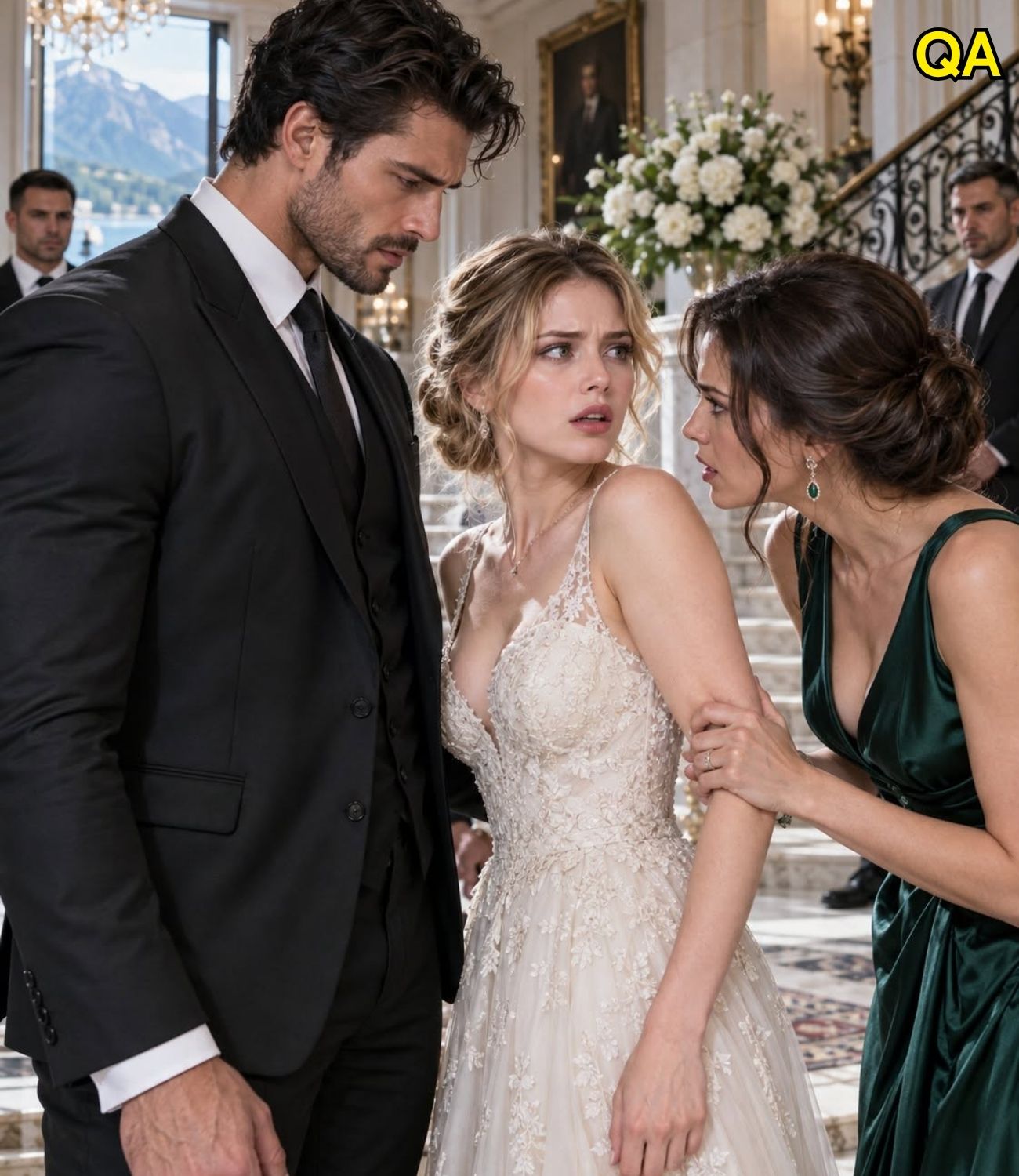
The cold silver of her fingers remained wrapped around my wrist. Across the vast, marble-floored room, Luca had gone completely still. He could not possibly have heard her whisper, but judging by the sharp narrow of his eyes, he knew his sister had just revealed something forbidden.
“Elena,” he said. His voice was not loud. It did not need to be.
She released my arm. Luca crossed the floor slowly, his gaze fixed on her. “What did you tell her?”
Elena lifted her chin. “Enough.”
“Enough for what?”
“Enough so she doesn’t walk into a marriage blind to the fact that there is far more happening here than Father Bennett ever told her.”
I turned sharply toward Luca. “You knew?”
Something shifted in his expression. It was not guilt, exactly, but a heavy resignation. “I knew your father was not being entirely honest.”
My stomach tightened into a hard knot. “And you were still going to marry me?”
“No,” he answered instantly.
Luca stepped closer, halting just outside my personal space. “I was going to ask whether you actually wanted to marry me.”
“The priest is already here,” I pointed out.
“The priest lives fifteen minutes away and has known my family for thirty years.”
“That does not make this feel spontaneous.”
“No,” Luca admitted quietly. “It does not.”
Elena folded her arms. “You two should talk privately.”
I glanced toward the armed guards stationed near the doorway. “Privately would be a new experience.”
For the first time, the corner of Elena’s mouth twitched. Luca looked over his shoulder. “Everyone out.”
The guards vanished without a word. Elena lingered for a moment, then reached out to touch my arm. “You do not owe anyone a wedding tonight.” She looked directly at her brother as she spoke.
Luca gave a single, slow nod. “I know.”
Chapter 2: Coffee and Confessions
When Elena left us alone, the enormous entrance hall felt twice its size. Neither of us seemed to know what protocol required in such a bizarre situation, so naturally, I said the first thing that drifted into my mind.
“Do you have coffee?”
Luca blinked. “Coffee?”
“I am jet-lagged, my father apparently lied to me, your sister just implied I am part of some elaborate family conspiracy, and twenty minutes ago I nearly strangled you with your own shirt.”
His gaze dropped to the front of his perfectly pressed black shirt. “You did not strangle me.”
“Give me time.”
A faint, near-invisible smile touched his lips. “Come with me.”
He led me through a maze of museum-like rooms: carved ceilings, antique furniture, and tall windows framing mountains that dropped toward the blue-gray waters of Lake Como. Yet, the deeper we walked, the less intimidating the estate felt. Family photographs lined the side tables—a young Elena missing her front teeth, a twelve-year-old Luca holding a massive fish with a look of pure horror, and a woman with kind eyes standing between them. Their mother, I assumed.
The kitchen surprised me most. Instead of industrial stainless steel, it was warm and inviting, filled with cream-colored cabinets, copper pans, and a sunny window lined with fresh herbs.
“This does not look like the kitchen of a terrifying criminal mastermind,” I noted.
Luca paused by the coffee machine. “Should there be more skulls?”
“At least one.”
“I will speak to the decorator.”
A genuine laugh escaped me. He turned, and in that instant, Luca Moretti smiled. The severity dissolved entirely from his face, leaving behind the warmth of the boy in the photograph. Then, just as quickly, the smile vanished, and he began pouring coffee.
“Milk?” he asked.
“Please.”
“Sugar?”
“Two.”
“You decorate cakes for a living and take two sugars?”
“I believe in professional consistency.”
He set the cup before me, and I wrapped both hands around it. “Now. Tell me what my father lied about.”
Luca pulled out the chair opposite mine and studied his cup for a long moment. “Your father contacted me six months ago.”
“About money?“
“Initially.” He leaned back, his expression turning serious. “Our business interests crossed paths. Commercial properties, shipping, investments. Last year, I began reviewing older accounts and found inconsistencies. Transfers to companies that existed only on paper. Payments authorized by people who had never signed the documents.”
I knew next to nothing about my father’s business, having always accepted his excuse that it was too complicated. “What does that have to do with me?”
“I do not know yet.”
“That is not comforting.”
“I do not intend it to be.” He leaned forward. “Your father’s name appeared repeatedly. When I requested explanations, he tried to settle the matter financially.”
“By paying you to stop asking questions?”
“Essentially.”
“And you refused.”
“Yes.”
“So then he offered you his daughter?”
Luca’s jaw tightened with sudden force. “No. He did not offer me his daughter.”
“But the marriage—”
“Was his suggestion. And I told him no. Three times.”
That completely shattered my father’s version of events, which claimed the Moretti family had demanded the union for protection. My cheeks burned with sudden humiliation. “What changed?”
Luca glanced toward the window. “Your father sent me a photograph.”
Chapter 3: The Photograph on the Back
“A photograph of me?” I asked, staring at him.
He looked almost embarrassed. “You were standing outside a bakery. Your hair was frizzy from the rain, there was flour on your cheek, and you were holding an OPEN sign while laughing because a letter had fallen off.”
“That was a terrible photograph.”
“I disagreed.” Heat climbed further up my neck. Luca cleared his throat. “But the photograph was not why I changed my mind. There was writing on the back.”
The smile vanished from my face. “What writing?”
“Your father’s handwriting.” He stood abruptly. “Wait here.”
I followed him anyway into a dark, wood-paneled study. Luca opened a desk drawer, retrieved an envelope, and handed me the photograph. Seeing it here, thousands of miles from home, felt surreal.
I turned it over. Four words were scrawled across the back: ASK SOPHIA ABOUT ROSE.
My throat went dry. “Who is Rose?” Luca asked.
“No one.”
“You are a terrible liar, Sophia.”
“I decorate cakes. Lying is not in the job description.” I set the photograph down. Rose. I had not heard that name since I was a little girl. “Rose was my mother’s middle name.”
“What happened to her?”
“She died when I was seven. In a car accident on a mountain road during a storm.” I paused, a sudden chill creeping over me. “Except… my mother hated being called Rose.”
Luca’s eyes sharpened. “Why?”
“Because it was not her middle name. Her name was Catherine Bennett. But when I was small, she used to tell me bedtime stories about an adventurer named Rose who traveled the world, solved mysteries, and outsmarted people.” I let out a soft breath. “After she died, the stories stopped.”
“And your father wrote her name on that photograph,” Luca murmured. “Why?”
“Because of a box,” I whispered, memories flooding back. “My mother gave me something a few weeks before she died. A key. She told me some things are important because they look ordinary. I kept it in a little wooden jewelry box back home in my apartment.”
Luca’s expression hardened instantly. “Your father knows about that key.”
“Maybe.”
“He must. Which means—”
“If I am in Italy, I am not in my apartment,” I finished, the realization hitting me like a physical blow.
I reached for my phone. No signal. Luca pulled out his, but I was already stepping into the hallway, searching for a bar. It connected just as my neighbor, Mrs. Alvarez, answered on the fifth ring.
“Sophia? Honey, is everything alright?”
“Can you do me a favor, Mrs. Alvarez? Would you go upstairs and check my apartment?”
A pause. “Now?”
“Please.”
I waited, my heart hammering against my ribs, while Luca stood close by, offering silent support. I heard Mrs. Alvarez’s door open, her footsteps climb the stairs, and then absolute silence.
“Sophia?” Her voice trembled.
“What is it?”
“Your door is unlocked.”
“I locked it!”
“I know you did, but—oh, sweetheart. Someone has been in here.”
The room seemed to tilt. “The wooden jewelry box in my bedroom closet—is it there?”
More footsteps, a door creaking, and then a quiet sigh. “It is gone.”
I closed my eyes as Luca stepped closer. “What happened?” he asked.
I lowered the phone. “The box is gone.”
Chapter 4: Unraveling the Past
I instructed Mrs. Alvarez to call the police and lock her door, then ended the call. For several seconds, neither Luca nor I spoke.
“My father,” I finally breathed.
“We do not know that,” Luca cautioned.
“You told me he is hiding something.”
“Hiding something and breaking into an apartment are entirely different matters.”
“You are defending him?”
“I am refusing to accuse a man without proof.” His measured response caught me off guard, showing a level of fairness I had not expected from a mafia boss.
“Why are you being so fair to him?” I asked.
Luca considered the question. “Because someone once decided who I was before they ever met me.”
His words struck a deep chord. I looked down, ashamed. “I did that too. I was terrified of you before I arrived.”
“Fear is not cruelty.”
“I had an idea of who you were. Spoiled, demanding, cold.”
“That was your father’s description of you,” Luca countered smoothly. “He said you were accustomed to getting what you wanted.”
“I run a bakery where the oven door has to be kicked twice to shut.”
A genuine laugh escaped him, easing the tension in the room. Luca’s expression softened. “You do not have to marry me. The priest can go home, and I can arrange a hotel or a flight back tomorrow.”
“Even if my father arranged this to keep you from discovering the truth?”
“Especially then.”
I studied him, realizing that trust had to begin somewhere, even in a kitchen with a man who looked terrifying yet kept offering me an escape route. “Then I want to stay.”
Luca frowned slightly. “Stay?”
“Not marry you tonight, but stay here. Because someone broke into my home looking for my mother’s key, because my father lied, and because someone wrote Ask Sophia about Rose on my photograph. I am done being a pawn.”
He nodded slowly. “Very well.”
“Also,” I added, “I want food. I have not eaten since the airport.”
Dinner was served on a terrace overlooking the lake. Elena joined us alongside a silver-haired adviser named Matteo, who fiercely debated Luca on whether basil should ever be refrigerated. It was surreal yet grounding.
Halfway through the meal, Elena set down her fork. “What exactly did your father tell you about Luca?”
“He told me the Moretti family called in an old debt,” I replied, “and that refusing the marriage would put my father in danger.”
Luca went entirely rigid. “I never threatened your father.”
“I know that now. But he used those exact words—that people would suffer.”
Luca and Elena exchanged a heavy glance. “Our mother used to say almost the same thing,” Elena murmured.
“Before she died eleven years ago,” Luca added, “she became obsessed with old business records, believing past decisions would cause innocent people to suffer if uncovered.”
The realization hit me cold. “Your mother and my father knew each other.”
Chapter 5: Florence and the Stone Angel
Later that night, Luca led us to his study and unlocked a cabinet containing old ledgers and files. From a weathered folder, he pulled out a photograph and handed it to me.
My mother stood beneath a striped awning outside a café, smiling beside a younger version of Luca’s mother. On the back was a single date from twenty-two years ago, accompanied by one word: Florence.
“My mother knew yours,” I whispered.
“Yes,” Luca replied.
Anger flared anew. “You knew this when I arrived?”
“I found the photograph shortly before you got here. But I did not want to overwhelm a stranger with tales of a financial investigation linking our parents.”
Elena flipped through an old notebook resting on the desk until she found a hand-drawn sketch of a bridge featuring a small stone angel. Beneath it, Luca’s mother had written: Rose knows where the beginning is.
My hands trembled. “My mother used to tell me stories about a stone angel in Florence where Rose found a hidden secret.”
The priest did not marry us that night, opting instead to stay for dessert and lemon tart before leaving us to our midnight investigation. By two in the morning, our search of the library yielded an old address book with torn pages. One remaining entry displayed my father’s initials: D. Bennett.
Right beside it slipped a fragile, handwritten note from Luca’s mother:
Daniel, If Catherine contacts you, tell her the Florence account has been closed. Do not use Rose’s name again. The child must never be connected to this.
Elena whispered, “The child…”
Luca took the letter from my trembling fingers. “Sophia…”
“They mean me,” I said, a hollow numbness spreading through my chest.
“We are going to find out why,” Luca promised quietly.
I retreated to my guest room—the very room that had once belonged to Luca’s mother—but sleep refused to come. Hours later, as the first pale light of dawn crept across Lake Como, a forgotten memory clicked into place.
The jewelry box was never the point of protection. The key itself held an engraved number.
I threw off the blankets, my heart racing with sudden clarity. I knew where the key belonged, and I knew I had to find the truth before anyone else could silence it.
