
Chapter 1: The Unexpected Arrival
The rancher had waited alone in a brown coat, his hat held awkwardly between his hands. For four months, he had exchanged letters with the widow now walking toward him. She had buried a husband, crossed half the country, and agreed to begin again beside a rancher she barely knew.
But he hadn’t expected the woman following her.
Her name was Hulda. White hair showed beneath a gray felt hat. A walking stick supported her steps, while her other hand gripped a battered tin box. At sixty-six, she had only partial sight in one eye and apparently nowhere left to call home.
The rancher stared. The widow noticed immediately.
“She was my neighbor,” she explained quietly. “Her name is Hulda.” Then she gave him the truth that could have ended their arrangement before it began: “She has nowhere else to go.”
Hulda didn’t beg. She didn’t promise to earn her keep or insist she wouldn’t become a burden. She simply stood beside the widow and waited.
After a long silence, the rancher bent down, picked up both women’s bags, and carried them to his wagon.
Chapter 2: The Troubled Ranch
During the hour-long ride to the ranch, the widow said little, instead studying the land. The grass had been grazed dangerously short, several fence posts leaned toward the earth, and the property looked exhausted.
When the ranch house finally appeared, something else bothered her: the barn was in better condition than the home. This wasn’t a ruined ranch, but something was slowly going wrong.
Before she had even finished unpacking, she asked, “Where does your water come from?”
The question surprised him. He explained that there was a creek nearby and a stock tank beside the barn. The pipe feeding the tank had been troublesome since August, but the cattle had drunk from it for eight years.
“Show me.”
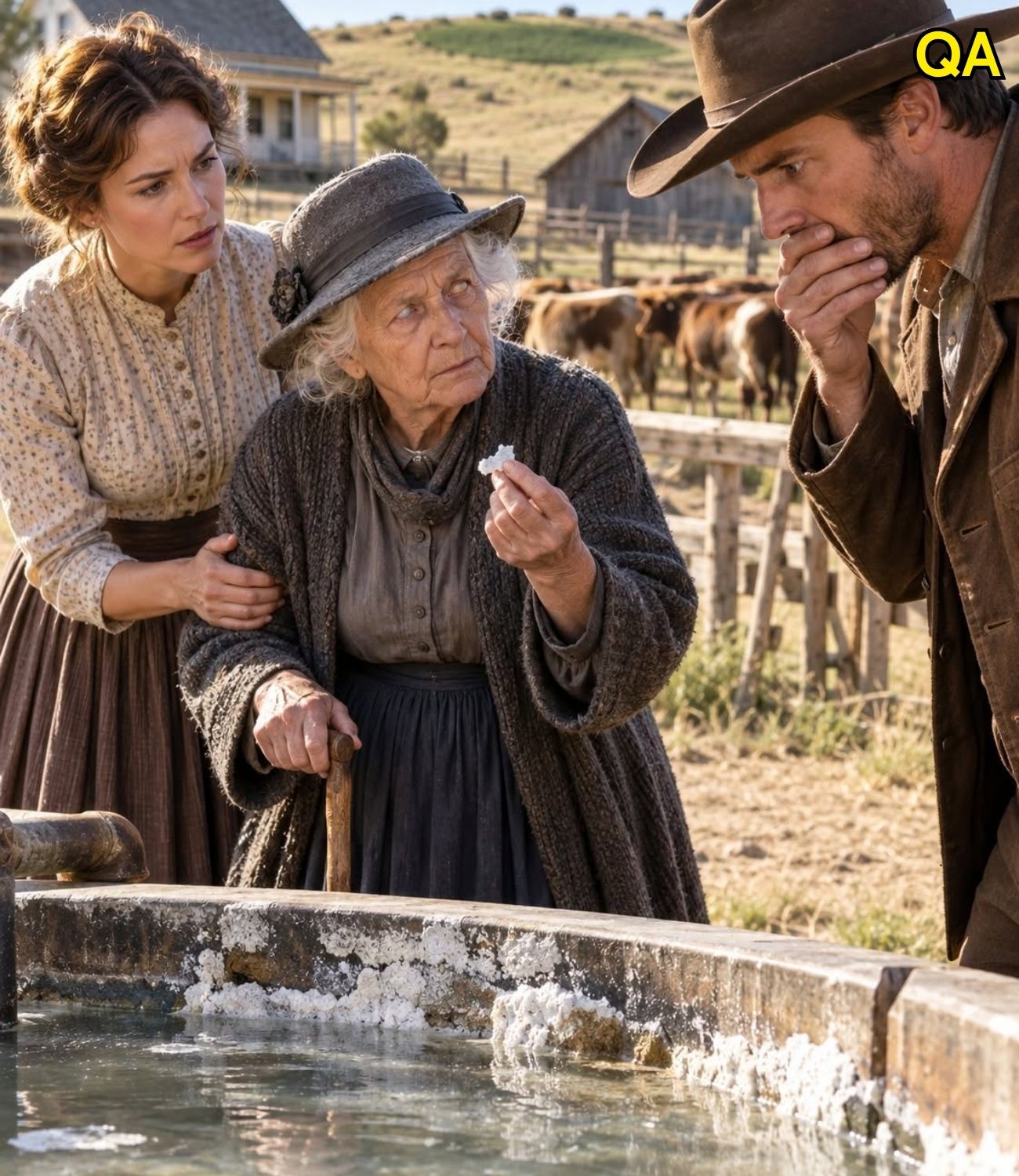
At the tank, she crouched beside the overflow. A strange white residue coated some of the rocks. She rubbed it between her fingers, then leaned closer and smelled the water.
The rancher saw her expression change. “How long have they been drinking this?”
“Eight years.”
“Have the cattle been different lately? Slower? Thinner? Not eating like they used to?”
He hesitated. Two young steers had been losing weight since July. He had blamed the dry summer.
The widow looked across the property. South of the ranch, beyond a slight rise, one patch of grass appeared noticeably greener than everything surrounding it. “You should dig a new well,” she said.
He stared at the hard earth as though she had suggested moving a mountain, then looked back at her. Neither of them knew yet whether she was right.
Chapter 3: Hulda’s Discovery
The following morning, Hulda asked to examine the tank herself.
With the widow supporting her elbow, the old woman slowly lowered herself beside the water. She studied the white crust coating the rocks and touched the soil surrounding the intake pipe. Then she opened her battered tin box and examined the residue more carefully.
The rancher watched from behind them. Yesterday, he had wondered whether bringing Hulda home would mean another person to feed when his ranch was already struggling. Now he found himself waiting for her judgment.
Hulda remained silent for a long moment. Finally, she pushed herself upright with her walking stick. Her weathered face had changed.
The widow noticed it too. “What is it?” the rancher asked.
Hulda turned toward him. Then the old woman said one word.
And every bit of color seemed to leave the rancher’s face.
Chapter 4: The Poison Beneath the Soil
“Arsenic.”
The single word fell into the crisp morning air like a dropped stone, sending ripples of dread through the silence.
The rancher stumbled half a step backward, his boots crushing a dry twig underfoot. For a second, the vast, sunlit plains around them seemed to tilt on their axis. His chest tightened, a cold knot forming in the pit of his stomach.
“Arsenic?” he repeated, his voice dropping to a rough, disbelieving whisper. “That’s impossible. This is open range, deep underground water. There are no mines for fifty miles in any direction. No industrial waste. Nothing.”
“Nature doesn’t always need a factory to poison a well, young man,” Hulda said, her voice steady despite the frailness of her frame. She tapped the side of her battered tin box with a trembling, arthritic finger. “My father spent forty years as an assayer in the territory up north. I spent my childhood watching him test ore and soil samples. I know the look of an alkali flat, and I know the crust left behind when groundwater leaches through ancient mineral veins buried deep beneath the shale.”
The widow stepped closer to the rancher, her eyes sharp with sudden realization. “That patch of grass south of here—the one that looked unnaturally green yesterday?”
“What about it?” the rancher asked, his throat dry.
“That’s where an old pocket of mineral runoff is seeping up closer to the surface,” she explained, her voice urgent. “It means the main aquifer feeding your lower pasture and this stock tank isn’t just dry—it’s cutting through a toxic pocket of arsenic-laced rock. Your cattle aren’t starving because of a bad summer. They’re being slowly poisoned from the inside out.”
The pieces clicked together with terrifying clarity in the rancher’s mind. The listless steers, the sudden drop in milk yield from the dairy cows last spring, the inexplicable lethargy that had plagued his best breeding bull for months—he had blamed the heat, the drought, bad luck, and his own poor management. He had cursed the sky while the very earth beneath his boots was killing everything he owned.
“Eight years,” the rancher muttered, staring blankly at the murky water in the concrete tank. A wave of intense guilt washed over him. “I’ve watered every head of cattle, every horse, every chicken from this exact line for eight years. How are they even alive?”
“Dilution,” Hulda answered simply, leaning heavily on her walking stick. “During the spring rains, the concentration is low enough to make them sick, but not kill them outright. But come late summer, when the water table drops and the flow slows to a trickle, the poison concentrates. If we hadn’t caught it now, before the autumn freeze forced them to rely entirely on this tank… by next spring, you wouldn’t have a single head left standing.”
Chapter 5: The Hard Choice
The sun climbed higher into the cloudless sky, casting sharp shadows across the weathered timber of the barn. No one spoke for a long time. The gravity of Hulda’s revelation hung heavy between them, transforming what had started as an awkward domestic arrangement into a matter of survival.
Finally, the rancher dragged a calloused hand across his face, wiping away the shock. He looked at the widow, then down at elderly Hulda, whose single good eye burned with fierce, unwavering intelligence.
“If we dig a new well,” the rancher said, his voice hardening with sudden resolve, “we have to go deep. Past the upper shale, through the clay layer, right down into the deep limestone aquifer on the western ridge. But that takes heavy machinery, casing pipes, and days of hard labor. I don’t have the equipment, and my credit in town is… well, let’s just say the bank isn’t eager to lend money to a ranch with a dying herd.”
“Who said anything about borrowing from the bank?” the widow asked, stepping up beside him.
The rancher blinked. “With what money? Every coin I have is tied up in feed and fencing wire.”
The widow reached into the deep pocket of her woolen coat and pulled out a small, heavy leather pouch. She untied the leather string and emptied its contents into her palm: a collection of heavy gold coins and silver certificates, carefully hoarded from the sale of her late husband’s modest farm back East.
“When I decided to cross the country to start a new life, I didn’t come empty-handed,” she said quietly. “I knew what it meant to gamble on a new beginning. If we pool what we have, we can hire the drilling rig from the Miller brothers over in the next valley. But we have to move today.”
Hulda nodded in agreement, tapping her cane against the packed earth. “And while you arrange the rig, young man, we need to empty this stock tank, flush the lines with clean hauled water from the upper creek, and make sure not another drop of that poison touches your livestock.”
A strange, unfamiliar warmth bloomed in the rancher’s chest. For four months, he had fought this harsh land entirely alone, believing that endurance meant suffering in silence. He had worried that bringing a new wife—and an unexpected, elderly neighbor—would only double his burdens. Instead, within twenty-four hours of their arrival, they had uncovered a fatal threat he was completely blind to, and were already offering the means to fight it.
“Thank you,” he said, his voice thick with an emotion he hadn’t allowed himself to feel in years. He looked directly at Hulda, then at the widow. “Thank you both.”
“Don’t thank us yet,” the widow smiled faintly, slipping the coins back into her pouch. “Save your thanks for when the new water runs clear.”
Chapter 6: Turning the Tide
The next three days were a blur of backbreaking labor and frantic activity.
With the financial backing of the widow’s savings, the Miller brothers brought their heavy steam-powered drilling rig across the ridge by dawn on Thursday. The deafening roar of the engine and the rhythmic thump-thump of the steel drill bit chewing into the stubborn earth shattered the quiet of the valley.
The rancher worked shoulder to shoulder with the crew, hauling timber, clearing debris, and draining the old, contaminated stock tank. Hulda, despite her age and partial blindness, took charge of the domestic front. Using vinegar, lye, and endless buckets of hauled creek water, she scrubbed every inch of the watering troughs, troughs, and pipes, ensuring that no lingering residue remained to threaten the animals.
On the fourth afternoon, as the sun began to dip below the western horizon, painting the sky in brilliant strokes of orange and violet, a shout echoed from the drilling site.
“We hit it!” one of the Miller brothers yelled, waving his arms from atop the scaffolding.
The rancher dropped his shovel and sprinted across the dry grass, his heart pounding in his throat. The widow and Hulda stood near the edge of the pit, watching anxiously.
A jet of dark, muddy water surged up through the iron pipe, driven by immense underground pressure. For a few tense seconds, the water ran thick with gray silt and clay. But as the pumps kept chugging, the liquid began to clear, turning sparkling, crystal-clear, and ice-cold.
The rancher cupped his hands beneath the rushing spout, scooped up a handful, and brought it to his lips. It tasted clean, sweet, and rich with the mineral purity of the deep mountain stone—entirely free of the bitter, metallic tang of arsenic.
He turned toward the women, a triumphant smile breaking across his dust-covered face, and held up dripping hands.
“It’s clean,” he shouted over the noise of the engine. “It’s the best water this land has seen in a decade!”
Chapter 7: A True Home
A month later, the transformation across the ranch was nothing short of miraculous.
The young steers, once sluggish and failing, had regained their strength, their coats sleek and healthy under the autumn sun. The fence lines were repaired, the pastures were rotating properly, and the air around the ranch house carried a renewed sense of life and purpose.
The relationship between the rancher and his new wife had deepened beyond a mere arrangement of convenience, forged in the fires of crisis and mutual respect. And Hulda had long since ceased to be an unexpected burden; she was the anchor of the household, sitting on the front porch every evening with her tin box and her memories, watching the cattle graze peacefully on the lush, safe grass of the lower meadow.
One evening, as the sun cast long, golden shadows across the porch, the rancher sat down on the wooden bench beside Hulda.
She looked up from her knitting, her good eye catching the fading light. “You look deep in thought, boy.”
“I was just thinking about the day you stepped off that train,” the rancher admitted, a soft chuckle escaping his lips. “When I saw you with your walking stick and your tin box, I honestly thought to myself: What on earth am I going to do with her?”
Hulda let out a dry, crackling laugh that sounded like dry leaves scraping across a stone path. “And I thought to myself when I looked at you standing there in that oversized brown coat: This poor fellow looks like he needs someone to keep him from accidentally shooting his own boots off.”
The rancher smiled, looking out across the sprawling, vibrant fields that stretched toward the horizon. The ranch was saved. His future was secure. And the family he never knew he needed had turned a dusty, dying homestead into a true home.
He reached over, gently patting the top of Hulda’s battered tin box. “Well, I’m glad you both got off the train.”
