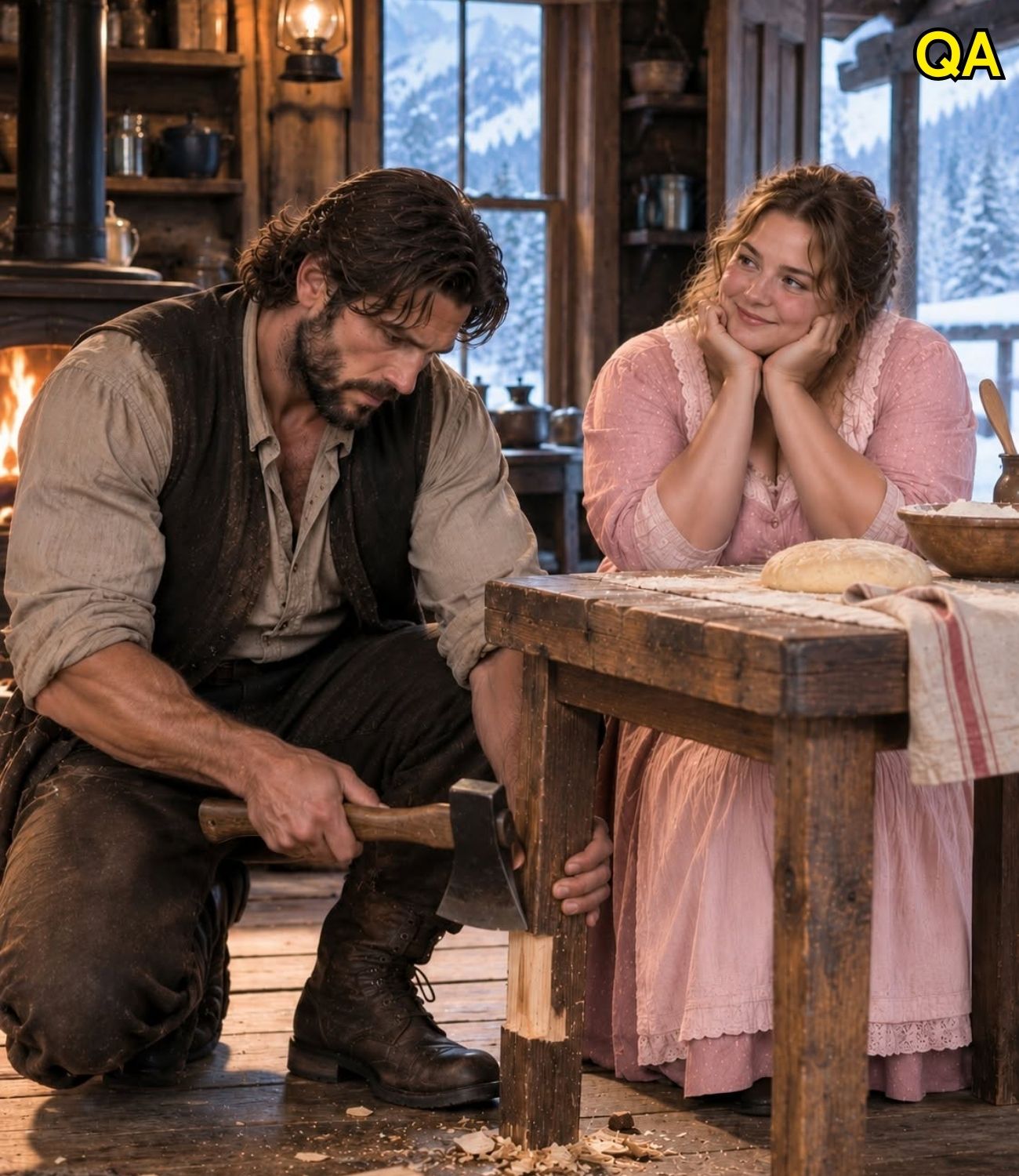

Chapter 1: The Bread and the Blizzard
By the nineteenth morning, Constance Bradley had stopped counting the days until she could leave Whispering Ridge. That frightened her more than the mountain ever had.
For the first week, she had scratched a tiny mark into the underside of Elias Boon’s kitchen table every morning—one mark for every sunrise survived, one mark closer to the day the trail would reopen so she could descend to Red Pine, reclaim whatever remained of her old life, and forget the humiliation of being sent into the mountains like unwanted cargo.
Seven marks became twelve. Twelve became sixteen. On the nineteenth morning, Constance reached beneath the table with the tip of a kitchen knife, felt the shallow grooves, and realized she had forgotten to make the eighteenth.
Outside, the world was blindingly white. The blizzard had passed three days earlier, but winter had buried Whispering Ridge beneath drifts so deep that the pines seemed to rise from an ocean of snow. The trail to Red Pine had vanished. The creek had frozen beneath a pale shell, and smoke curled lazily from the cabin chimney under a cloudless blue sky.
Constance looked toward the window. Elias was outside splitting wood. He raised the axe.
Crack. A log separated cleanly.
Crack.
There was a rhythm to him now that she had learned without meaning to. Three swings, then a pause to stack the pieces. He favored his left shoulder in cold weather. He rubbed the back of his neck when he was thinking. When he came inside, he always knocked snow from his boots twice, even though once would have been enough.
She knew these things. That was the problem.
“You’re staring again.”
Constance jumped. Elias had opened the door without her noticing.
“I was not.”
He glanced behind himself as though checking whether another man happened to be standing outside. “Then the tree must be handsome.”
“The tree is considerably more conversational.”
Elias shut the door, snow dusting his dark coat and beard. His expression remained solemn, but Constance caught the faintest movement at the corner of his mouth—a month earlier, she might have mistaken it for irritation. Now she knew it was almost a smile.
“Bread’s burning,” he said.
Constance spun toward the oven. “Oh!” She pulled the loaf free just before its crust could blacken and placed it on the table. Elias removed his gloves.
“You never burned bread in Red Pine?”
“I never had a mountain hermit distracting me.”
“I was outside.”
“You managed it anyway.”
This time the smile appeared—small, brief, real. Constance hated how much satisfaction it gave her. Their life had settled into something neither of them had named. Elias chopped wood, checked traps, repaired the roof, and traveled farther down the ridge whenever weather permitted. Constance baked bread, preserved meat, washed clothes, mended blankets, and rearranged his kitchen so thoroughly that Elias had once spent twenty minutes searching for a spoon.
At night they ate together. Sometimes they talked. Sometimes the wind talked for them. Neither mentioned Red Pine. Neither mentioned the arrangement that had brought her there, and neither asked what would happen once the trail reopened.
Chapter 2: The Sign from Below
That afternoon, Elias disappeared down the mountain. He returned shortly before sunset carrying something long beneath one arm. Constance was kneading dough when the door opened.
“You’re late.”
“So I’ve been told.”
“By whom?”
“Someone who apparently owns my kitchen now.”
She flicked flour at him. Elias leaned aside, and the flour struck the wall. Constance gasped. “You dodged.”
“I value my dignity.”
“You live alone on a mountain.”
“I value what remains of my dignity.” He stepped inside and placed the object against the wall.
Constance looked at it, and her hands stopped moving. It was a wooden sign. Paint peeled from its edges, one corner was broken away, snow had soaked into the grain, and a muddy boot print crossed the faded lettering. But she recognized the painted wheat stalk immediately.
Bradley’s Bakery.
Her bakery. Her father’s bakery before that. For several seconds, Constance could not breathe. “Where did you get that?”
“Near the lower road.”
She wiped her hands on her apron and crossed the room, her fingers hovering over the letters. “They threw it away.”
Elias said nothing.
Constance touched the damaged corner. “When the bank took the building, I thought they would at least leave the sign.”
“They didn’t.”
Her voice hardened. “Obviously.”
Elias removed his coat. She turned sharply. “Why did you bring it here?”
He looked at her as though the answer were simple. “Because you’re still a baker.”
Something inside her tightened. “No, Elias. I was a baker.”
“You baked six loaves today.”
“That isn’t what I mean.”
“I know.”
“Do you?”
He came closer. “You think losing the building means you lost the thing you were.”
Constance stared at him. Elias nodded toward the cooling loaf. “That says otherwise.”
She almost laughed. Instead, to her embarrassment, her eyes burned. She turned away quickly. “Bread does not make a bakery.”
“Then what does?”
“A shop. Customers. Shelves. Flour that doesn’t arrive on the back of a mule. A front door people can find without climbing a mountain.”
Elias considered this. “People climb mountains for stranger things.”
“Name one.”
“Gold.”
“That is gold.”
“Religion.”
“Debatable.”
“Women.”
Constance looked at him. Elias immediately reached for his coat. “I’m going outside.”
“Coward.”
“Survivor.”
Her laughter followed him through the door.
Chapter 3: The Whispering Ridge Bakery
Three mornings later, someone knocked. Constance and Elias looked at one another—nobody knocked at Elias Boon’s cabin.
The visitor was a trapper named Samuel Dorr, wrapped in fur and carrying enough snow on his shoulders to resemble a walking drift. “Boon,” Samuel greeted. “Dorr.”
Samuel sniffed, his eyes moving past Elias. “What’s that smell?”
Constance appeared behind him. “Apple pie.”
Samuel’s expression became almost spiritual. “You have apples?”
“Preserved.”
“Pie?”
“Yes.” He stared at Elias. “You’ve been hiding pie?”
Elias frowned. “I wasn’t aware mountain law required disclosure.”
Samuel pushed a small pouch of coins into Constance’s hand before she had even named a price. He ate two slices, then bought the rest. The following day, three trappers arrived. Two days later, a family crossing the ridge stopped after Samuel told them there was “a woman at Boon’s place who could make a man forget winter existed.” The children bought cinnamon biscuits, their mother bought bread, and their father bought two pies.
By the end of the week, Constance had begun waking before Elias. The kitchen glowed before sunrise, flour dusted every surface, and cooling loaves covered the table. Bundles of dried berries, jars of apple preserves, sacks of oats, and precious lumps of sugar filled shelves that had previously held almost nothing. Elias built her a second worktable.
Constance objected. “You need this wood.”
“So do you.”
“For baking?”
“For whatever this has become.”
She looked around. “What has it become?”
Elias shrugged. “Seems like a bakery.”
“It doesn’t have a sign.”
The following morning, she found Bradley’s Bakery hanging beside the cabin door. The broken corner had been repaired, the boot print had been scrubbed away, and beneath the original lettering, Elias had carved two smaller words: Whispering Ridge.
Constance stood outside staring at it until her fingers went numb, then found Elias near the woodpile. “You repaired it.”
“Yes.”
“You carved the ridge name.”
“Yes.”
“You could have asked me.”
“You would have argued.”
“I am arguing now.”
“So I saved time.”
She folded her arms as Elias continued stacking wood. Constance watched him for a moment. “Thank you.”
His hands stopped. He did not turn around. “You’re welcome.”
By early December, travelers were climbing Whispering Ridge specifically for Constance Bradley’s baking. Rumors traveled faster than horses—stories of pies filled with mountain berries, brown bread sweetened with molasses, and biscuits so soft an old miner claimed he had proposed marriage after eating three. Constance had replied that she would consider his proposal after he washed; he had not returned. Elias heard the story and laughed so unexpectedly that coffee came through his nose, earning him six days of teasing from Constance.
Business grew, and so did the changes inside the cabin. A shelf appeared beside the window, then another. Elias built a narrow counter near the entrance so customers would stop wandering into his sleeping area. Constance hung curtains; Elias complained, so she installed a second pair, and he stopped complaining. Somewhere between the first loaf and the fiftieth pie, Whispering Ridge stopped feeling like the place where Constance had been abandoned. It became hers.
Not entirely—Elias was still there. But that was becoming less of an objection every day.
Chapter 4: The Mayor’s Return
One evening, after the final travelers had left, they sat on the porch beneath a sky crowded with stars. Constance wrapped both hands around a tin cup of coffee. “Do you ever miss people?”
Elias looked toward the trees. “Some.”
“That is not an answer.”
“It’s the only one I have.”
“You lived somewhere before this.”
“Yes.”
“With family?”
His shoulders changed—only slightly, but Constance noticed. “You ask a lot of questions.”
“I’m a baker. We trade information.”
“I thought you traded bread.”
“Bread is how we get the information.”
Elias almost smiled. Constance waited, and finally he said, “I had family.”
“Had?”
His gaze remained on the dark ridge. The word sat between them, and Constance knew better than to push, having learned that Elias’s silences were doors requiring patience. So she looked at the stars instead.
“My father used to say bread could tell you whether a person had patience.”
Elias glanced toward her. “How?”
“You rush it, it fails.”
“Sounds obvious.”
“You say that because you have never tried waiting three hours for dough when hungry.”
“I’ve waited three days for elk.”
“That only proves my point. You’re unnaturally patient.”
“With animals.”
“Not people?”
“People lie more.”
Constance studied him. “Do you think I lie?”
“No.” The answer came too quickly. Her heartbeat changed. “Why?”
Elias looked directly at her. “Your face gives you away.”
“My face does no such thing.”
“You press your lips together when angry.”
“I do not.”
“You raise your left eyebrow when you don’t believe someone.”
“Nonsense.”
The eyebrow rose. Elias pointed. “That.”
Constance slapped his hand aside, and he laughed. For a moment, they were closer than they had ever been. The laughter faded, neither moved, and Elias’s gaze dropped toward her mouth. The frozen ridge, the stars, the wind, the entire world seemed to fall silent around them.
Then a distant horse whinnied somewhere below the cabin. Elias stepped away, the moment vanishing. Constance looked into her coffee. “You should check that.”
“Yes.”
Neither sounded grateful for the interruption.
The next afternoon brought six customers, and the afternoon after that brought nine. But on the first Thursday in December, a sleigh climbed the ridge carrying the last man Constance wanted to see.
Mayor Horace Pendleton stepped down wearing a fur-lined coat, polished boots, and the same expression he had worn when Constance lost her bakery, followed by two members of the Red Pine council and a driver. Constance saw the sleigh through the window, and the pie in her hands nearly slipped.
Elias was outside. Pendleton noticed him first. “Well,” the mayor called.
Elias lowered the bundle of wood he had been carrying. Pendleton smiled—a familiar smile Constance remembered from council meetings, from bank offices, and from the morning she had been told she could no longer afford the building her family had owned for twenty-seven years.
“Well,” Pendleton repeated, looking from Elias toward the cabin. “You actually kept her.”
The words landed like dirt thrown across clean linen. Constance stepped onto the porch as Elias slowly set the wood down. “I didn’t keep anybody.”
Pendleton chuckled. “Forgive me. Poor choice of words.”
“No,” Constance said. “It was exactly the choice you intended.”
The mayor removed his gloves. “My dear Mrs. Bradley, I’m delighted to see mountain life agrees with you.”
“You sent me here with one trunk and enough supplies for four days.”
“And yet you appear remarkably prosperous.” His eyes moved to the sign: Bradley’s Bakery — Whispering Ridge. Something unreadable passed across his face. “So the rumors are true.”
“What rumors?”
“That people are climbing half a day through snow for your pies.”
Constance lifted her chin. “They’re welcome to climb farther if you’re planning to buy one.”
One councilman coughed to hide a laugh, and Pendleton’s smile tightened. “I came for something more important.”
Elias moved toward the porch. “Say it.”
The mayor looked at him. “You never were fond of conversation.”
“Depends who’s talking.”
Pendleton turned back toward Constance. “The road is passable now. Not easily, but sufficiently. Red Pine can be reached before nightfall.”
Constance felt the words before understanding them. The road—open. For weeks, freedom had meant that road. She had imagined seeing it from the ridge, imagined packing immediately, imagined descending without looking back. Now the possibility stood in front of her, and instead of relief, she felt something disturbingly close to loss.
Pendleton gestured toward the sleigh. “We can take you home.”
Home. Constance looked behind herself. Through the open cabin door she could see her worktable, the curtains, the shelves, a loaf cooling beside the stove, and Elias’s coat hanging next to hers.
Pendleton followed her gaze. “I suppose you’ll need a few minutes to gather your things.”
Constance said nothing.
The mayor continued. “There may even be an opportunity to discuss your former bakery. The council has reconsidered certain matters.”
That caught her attention. “Reconsidered?”
Pendleton smiled. “Red Pine misses you.”
“Red Pine watched while the bank took everything.”
“That situation was complicated.”
“It seemed very simple from where I was standing.”
Pendleton sighed. “Constance—”
“I’m staying.”
Silence. Even the councilmen seemed uncertain they had heard correctly. Pendleton blinked. “What?”
“I said I’m staying.”
His amusement vanished. “You cannot seriously prefer this cabin to your life in town.”
Constance glanced toward Elias. He was watching her—not pleading, not hopeful, simply waiting, giving her the choice exactly as he always had.
Pendleton looked at Elias and laughed. “So that’s it.”
Elias’s jaw tightened. “What?”
The mayor gestured between them. “I should have guessed.”
Constance stepped forward. “You should choose your next words carefully.”
“Why? He actually kept you.”
Elias’s hand settled against the chopping block beside the axe—not on it, beside it. His voice remained quiet. “I told you once. I didn’t keep anybody.”
Pendleton ignored him. “Then I suppose she’ll be coming back with us.”
Before Constance could answer, Elias moved to stand beside her—not in front of her, but beside her. “She decides where she belongs.”
Something in Constance’s chest twisted. Mayor Pendleton laughed again, but Constance didn’t. “I already decided.”
Pendleton’s expression hardened. “You would surrender your place in Red Pine for this?”
“My place?” She almost smiled. “You made it clear I no longer had one.”
“You could have one again.”
“I have one here.”
Pendleton stared at her, then at Elias, and then at the flour dusting Constance’s apron. Something calculating entered his eyes. “Interesting.”
Constance disliked the way he said it, and Elias apparently did too. “What do you want, Pendleton?”
The mayor slowly slipped one hand inside his coat. Elias’s posture changed instantly, and Pendleton noticed. “Relax, Boon.” He removed an envelope—old, yellowed, its edges softened by age. “I came because Mrs. Bradley deserves to know the truth.”
Constance’s stomach tightened. “What truth?”
Pendleton stepped onto the porch as Elias moved closer to her. The mayor held out the envelope, but Constance did not take it. “Where did you get that?”
“Town archives.”
“What is it?”
“A letter.”
“From whom?”
Pendleton looked almost pleased. “That is where matters become complicated.”
Chapter 5: The Letter and the Stranger
Constance took the envelope. The handwriting across the front stole the warmth from her hands—she knew that handwriting from recipe cards, invoices, birthday letters, and notes left beside bowls of dough when she was a child.
Her father, Edward Bradley.
Constance’s blood seemed to turn cold. “That’s impossible.”
Elias looked at the envelope, his face changing—not to confusion, but recognition. Constance saw it. She turned toward him. “You know this?”
Elias said nothing.
Her voice dropped. “Elias.”
Pendleton answered for him. “Oh, he knows more than you think.”
Elias’s eyes snapped toward the mayor. “Enough.”
“Why?” Pendleton asked. “Afraid she might learn who you really are?”
Constance stared between them as the warmth of the bakery vanished. Every unanswered question from the past weeks suddenly crowded the porch: Elias’s family, his refusal to speak about Red Pine, his strange reaction whenever Constance mentioned her father, and the way he had known where to find the discarded bakery sign.
“Elias,” she whispered, “what is he talking about?”
Elias looked at her, and for the first time since she had met him, the mountain man seemed uncertain—not frightened, not angry, but trapped.
Pendleton nodded toward the envelope. “Open it.”
Constance’s fingers trembled as she broke the brittle seal. Inside was a folded sheet of paper and a photograph that slipped free. Elias caught it before it reached the snow, and the moment he saw the image, all color left his face.
Constance took it from him. The photograph showed three young men standing outside Bradley’s Bakery nearly twenty-five years earlier. One was her father; beside him stood Mayor Pendleton, younger but unmistakable. And beside Pendleton—
Constance looked at Elias, then back at the photograph. The third man had Elias’s eyes, the same broad shoulders, and the same severe mouth. But underneath the photograph, in her father’s handwriting, was a name: Jonathan Boon.
Constance’s breathing stopped. “Your father?”
Elias did not answer.
Pendleton did. “Yes.”
Constance unfolded the letter. Only a few lines were visible before her hands began trembling harder. Edward Bradley had written about money, a partnership, land on Whispering Ridge, and a promise that had been broken. Then came a sentence Constance read twice: Jonathan Boon knows what happened, but he must never tell Elias.
She looked up. “What happened?”
Pendleton’s expression became strangely grave. “That,” he said, “is why I came.”
Elias stepped forward. “No.”
Pendleton ignored him. “Your father did not lose Bradley’s Bakery because of debt.”
Constance stared. “What?”
“The debt was manufactured.”
The porch seemed to tilt beneath her feet.
Pendleton continued. “And the bank did not send you to Whispering Ridge because nobody else wanted responsibility for you.”
Constance’s fingers tightened around the letter. “Then why?”
Pendleton looked toward Elias. “Because someone wanted you here.”
Constance followed his gaze. Elias looked stunned. “I didn’t.”
“I know,” Pendleton said.
That answer disturbed her even more. “Then who?”
Pendleton smiled without warmth. “Keep reading.”
Constance lowered her eyes. The remaining paragraph had been written hurriedly, several words blurred, with one line underlined twice: If anything happens to me, find Jonathan. He knows what Pendleton did.
Constance slowly raised her head. Pendleton was still smiling, but now she understood—the letter was not evidence he wanted her to see; it was evidence against him.
“Why would you bring me this?”
Pendleton’s smile disappeared. Behind them came the sound of horses—not from the road leading toward Red Pine, but from the northern trail.
Elias turned. Three riders emerged through the pines, then five, then seven, all wearing dark winter coats.
Constance looked at Pendleton as he calmly replaced his gloves. “I didn’t bring you the letter,” he said. “I brought you the warning.”
The riders stopped beneath the Bradley’s Bakery sign. The man at their front removed his hat—he was older than Elias, gray-haired and scarred. When Elias saw him, he went completely still.
Constance looked from one man to the other. They had the same eyes.
The stranger smiled. “Hello, Elias.”
Elias whispered a name Constance had never heard before: “Father?”
Constance’s breath caught. Jonathan Boon was supposed to have died seventeen years ago, yet he was standing in the snow, alive, watching her, and hanging from a chain around his neck was a small brass key.
Constance recognized it immediately—it was the missing key from her father’s bakery.
Jonathan Boon looked at her and said quietly, “Edward Bradley told me you would eventually come.”
Constance could barely speak. “My father knew?”
Jonathan’s expression darkened. “He knew everything.” He reached inside his coat and produced another envelope. Unlike Pendleton’s, this one bore Constance’s own name, written in her father’s hand.
She took one step forward, then stopped. Because beneath her name were three words—words that made Elias stare at her as though the mountain had split open between them: Elias Boon’s son.
And suddenly Constance understood that the greatest secret on Whispering Ridge was not why she had been sent there. It was why her father had expected her to find Elias.
