
Chapter 1: The Contingency
Mr. Abernathy did not laugh. That was the first indication that the situation was far more severe than I had initially realized. He lowered himself into the chair across from me at the dining table and carefully adjusted his glasses. Outside, the autumn wind scraped bare branches against the windowpane, while the grandfather clock in the hall ticked with an unnerving, heavy rhythm.
“Mrs. Gable,” he said, his voice measured, “before you make any decisions regarding these properties, there is something you need to see.”
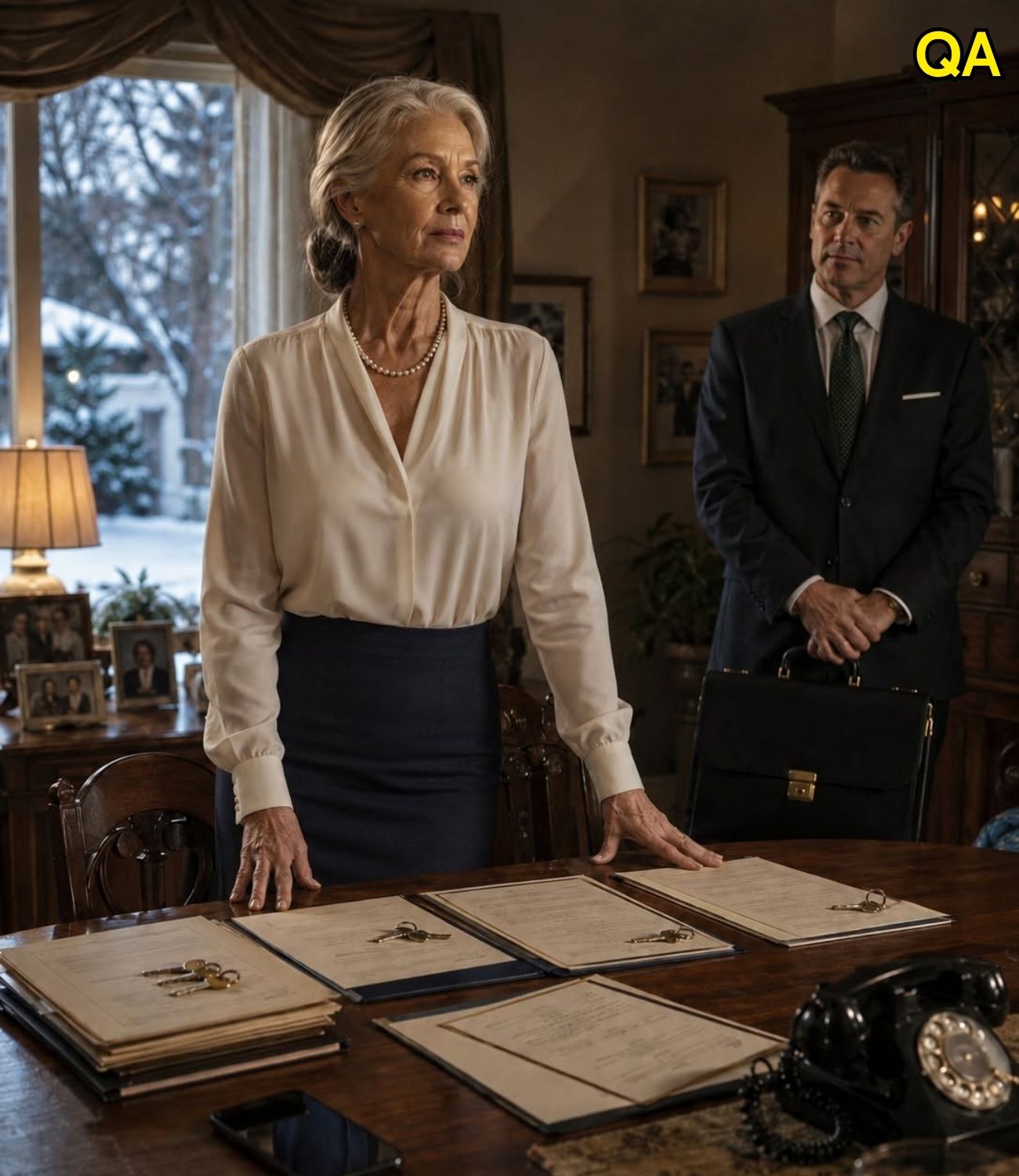
My hand froze halfway to the coffee pot. He opened his leather briefcase—not with dramatic flair, but with the solemnity of a man delivering a verdict. He withdrew a thick, cream-colored folder and placed it squarely on top of the property deeds. My late husband’s name was printed cleanly across the tab: Edward Gable — Estate and Corporate Holdings.
For a fleeting moment, I forgot about my son Kenneth. I forgot about my daughter-in-law Brenda. I even forgot about my phone, which was vibrating relentlessly against the wooden sideboard.
“Where did you get this?” I asked, my fingertips resting lightly on Edward’s name.
“From our firm’s private archive,” Mr. Abernathy replied. “Your husband instructed us never to present this portion of the estate plan unless one of two specific conditions was met. The first was if you became incapacitated. The second was if a member of your family attempted to remove you from the family structure while continuing to benefit financially from assets under your control.”
The walls of the dining room suddenly felt closer. “Edward planned for this?”
“He feared it,” the lawyer corrected gently.
Inside the folder was a letter written in Edward’s unmistakable handwriting, penned during the final, quiet months of his illness. He wrote that he knew I would spend the rest of my life trying to keep our children together. He knew I would lend money without calling it a loan, solve problems before anyone even asked, and confuse protecting our children with shielding them from the consequences of their own actions.
Then came the sentence that shattered the breath in my lungs: Margaret, if you are reading this, someone has finally mistaken your kindness for surrender.
Edward had deliberately left our three primary properties in a holding company controlled solely by me. Kenneth and Mason were permitted to occupy two of them under family-use agreements, but they did not own them. Furthermore, Edward had established a family trust holding a controlling block of Gable Manufacturing shares, naming me the sole voting trustee for life. He had never told me the full extent of this power because he wanted me to live as their mother, not their jailer.
“So what happens if I resign as trustee?” I whispered, staring at the faded ink.
“You shouldn’t,” Mr. Abernathy said instantly. He pulled a second document from his briefcase. “Because someone is already trying to make that happen.”
It was a proposed corporate resolution, dated three weeks prior. It stated my supposed intention to relinquish voting control of the trust due to my “declining capacity” and “emotional instability.” My name was typed at the bottom, waiting for a signature I had never given.
Kenneth had requested the preliminary paperwork. Brenda’s name was attached to the email chain. They had not merely been planning to exclude me from family dinners; they had been preparing to erase my authority entirely.
My phone vibrated again on the sideboard. It was Kenneth. I picked it up and answered.
“Mom,” his voice rushed through the speaker, tight and anxious. “Thank goodness. What are you doing?”
“Sitting at my dining-room table,” I replied evenly.
“With who?” he asked, the silence stretching. “Is Abernathy there?”
Not Mr. Abernathy. Just Abernathy. He knew.
“Come to my house at six,” I instructed, ignoring his frantic attempts to explain. “Bring Brenda. Bring Mason. And tell your Aunt Gertrude she is welcome too. We are going to have a family discussion.”
Chapter 2: The Reckoning
By six o’clock, the headlights of their cars swept across my front lawn. Kenneth arrived first, barging in without knocking. Brenda followed, her face pale inside her camel coat. Mason lingered near the doorway, looking entirely out of place in the home he had grown up in, while my sister Gertrude arrived last, refusing to meet my eyes.
Mr. Abernathy sat quietly by the fireplace, his briefcase resting at his feet.
“Yesterday,” I began, placing printed copies of their group chat on the coffee table, “I was informed that this family had collectively decided to cut ties with me.”
Mason whipped his head toward Kenneth. “Collectively? You didn’t tell me that. You said Brenda just needed some space because you two were fighting.”
“We weren’t cutting you off financially,” Brenda blurted out, stepping forward.
Even Kenneth flinched at her words. Mason took a slow, horrified step backward. “Oh my God,” he breathed.
“Yesterday,” I said, my voice cutting through the tension like glass, “I was someone who shouldn’t come to dinner. But you still expected the house. The beach property. Kenneth’s executive job. The trust.”
Mr. Abernathy smoothly withdrew three envelopes from his briefcase and set them on the table.
“Three weeks ago,” I continued, “Kenneth requested corporate documents describing me as elderly, confused, and unfit to control the family trust. Brenda provided ‘examples’ of my declining mental state—including a soccer game schedule change and a misplaced Christmas check. You were preparing to declare me incompetent behind my back.”
Kenneth’s face flushed dark red. “Someone had to plan ahead! You can’t control everything forever. Do you know what it is like waiting for your own life to begin while your mother controls every important asset?”
His words hung in the air, meant to wound, but they merely brought a wave of profound, sweeping clarity.
“Your own life?” I asked quietly. “Kenneth, you are forty-eight years old. The house you live in is mine. The beach property is mine. Your car was guaranteed with my credit, and your children’s tuition is funded by me. If your life has not begun, it is because I made the terrible mistake of ensuring you never had to build one.”
I pushed the envelopes across the mahogany table.
“Your family-use agreement on the house ends in ninety days,” I stated. Brenda let out a strangled sob. “Effective Monday, Kenneth will be placed on administrative leave pending an independent board review of this unauthorized succession request. Finally, the San Diego beach property will be sold. The proceeds will establish an independent education fund for the grandchildren. No parent will control it.”
Kenneth stared at me, his defiance crumbling into absolute shock. “You’re punishing everyone because of one text message?”
“No,” I replied, looking at the photograph of Edward and me on the mantel. “I am ending a toxic pattern because of what that text message revealed. Your father is the reason I am doing it.”
I handed Kenneth the letter Edward had left behind. He read it standing up, his hands beginning to tremble as he reached his father’s final instruction: If either of our boys ever believes your love is an entitlement rather than a gift, Margaret, give him the one thing we failed to give them enough of: the chance to stand without us.
Kenneth carefully set the paper down. He had no words left. He turned and walked out into the cold night, Brenda following closely behind. The soft click of the front door latch was the loudest sound I had ever heard.
Chapter 3: The Winter of Silence
Mason and Gertrude stayed behind. Mason stood in my kitchen while I washed cups at the sink, his eyes red and heavy with guilt. He confessed that he had known they were slowly excluding me from family events and had chosen to stay silent because it was easier. He didn’t ask for immediate forgiveness, which I respected. He simply promised to call every Sunday, and if I didn’t answer, he would try again the next week.
Gertrude was harder. She had believed Kenneth’s lies about my mental state because my profound grief had made me distant, and it was easier to write me off as unstable than to sit with me in my sadness. We sat at the kitchen table for a long time. Eventually, I reached across the wood and took her hand. It wasn’t full forgiveness yet, but it was a door left unlocked.
The corporate investigation lasted six weeks. Kenneth had not forged my signature, but he had knowingly supplied misleading statements and pressured employees to bypass me. The board removed him as Chief Operating Officer. For the first time in his life, I did not intervene to soften his landing.
He and Brenda moved into a modest rented townhouse. They sold their luxury vehicles. Brenda returned to work at an accounting firm, and Kenneth found a mid-level position with a regional supplier. There was no family name on the building, and no mother standing between him and the real world.
To my quiet amazement, he survived.
Chapter 4: The Christmas Knock
Christmas arrived with a quiet, snowy grace. I did not receive an invitation to Kenneth’s townhouse, and I was grateful. An invitation extended out of financial panic would have been another kind of insult entirely.
Mason came by on Christmas Eve, carrying groceries and a battered cardboard box of childhood ornaments. Gertrude brought a pie with slightly burnt edges. We ate at the old oak table, acknowledging the empty chairs without letting the absence swallow the room. Healing, I was learning, wasn’t pretending the empty chairs weren’t there; it was discovering you could still enjoy the meal anyway.
At a quarter past eight, the doorbell rang. I opened it to find Kenneth standing alone on the porch, snow gathering on his dark wool coat. He looked thinner, older, and stripped of the arrogant armor he had worn for decades. He held no gifts and carried no envelopes.
“I won’t stay,” he said, his breath pluming in the freezing air. “I just wanted to tell you something without asking for anything afterward.”
I waited.
“I blamed you,” he confessed, looking down at his boots. “For the job, the house, all of it. But then I was sitting in the parking lot of my new job, angry that nobody there cared who my father was. And I realized that was exactly what I had always claimed I wanted. My own life. It turns out I just didn’t know what that actually meant.”
He looked up, a single tear cutting through the cold on his cheek. “The worst thing I did wasn’t the text message. It was convincing myself that you were losing your mind, just because I needed a reason to take control without feeling like a thief.”
My throat burned. “I know.”
“I don’t expect you to forgive me,” he whispered, offering a small, broken smile. “Merry Christmas, Mom.”
He turned to walk back into the snow.
“Kenneth,” I called out. He stopped. I opened the door wider, letting the warmth of the hallway spill onto the frosted porch. “There is pie. It doesn’t mean tomorrow changes the investigation or the trust. But you can come in before you freeze.”
He stepped inside. When Mason saw him, the two brothers stood frozen for a moment. Then Mason held up a crumbling, homemade ornament. “You made this reindeer,” Mason said. Kenneth laughed, wiping his eyes, and argued about how many antlers a reindeer was supposed to have. Nothing was completely fixed, but something new had finally begun.
Chapter 5: The Final Bequest
In January, Mr. Abernathy requested one last meeting at his office. He handed me a final, sealed envelope from Edward.
“Why does that man keep writing to me from the grave?” I asked, though a fond smile tugged at my lips.
Inside was a single page explaining the true reason Edward had made me the sole trustee. It wasn’t just because he trusted my judgment. Decades earlier, when Gable Manufacturing was one missed payroll away from total bankruptcy, I had quietly sold a small parcel of land my mother had left me and funneled every dollar into the company to keep the workers paid. I had completely forgotten about it.
The company everyone calls mine survived because of something that was yours, Edward wrote.
I drove home with blurred vision. He hadn’t just left me in control to protect the family; he had left me in control because the legacy was always half mine.
That spring, the San Diego house sold. Part of the money went to the grandchildren’s education, as promised. The rest was used to establish the Edward and Margaret Gable Employee Emergency Fund, providing interest-free assistance to workers facing medical or housing crises. Money, I decided, should always remember where it came from.
Chapter 6: The Open Door
Rebuilding took time. Mason visited every other Sunday. Gertrude and I slowly repaired our sisterhood. Brenda took nearly a year, finally coming to my porch to hand me the original, uncropped photograph from the beach house—the one where I was standing beside them, laughing. She apologized for cropping me out, admitting that my presence always reminded her that the lavish life she enjoyed wasn’t truly hers. It was an ugly truth, but it was honest, and from that honesty, a genuine relationship finally began to grow.
Two Christmases after the text message that changed everything, the family gathered at my house again. They were not there because tradition demanded it, or because I was financing their lifestyles. They were there because I had invited them, and they had chosen to say yes.
I stood in the kitchen doorway, watching Kenneth explain his slightly burnt potatoes to his children, while Mason and Gertrude bickered cheerfully over napkins.
“Mom?” Kenneth appeared at my side. “We need another chair in the dining room. But… would you sit down first? You always feed everyone and then eat standing at the counter. You shouldn’t have to.”
He pulled out my chair at the head of the oak table. I sat, looking around at the glowing faces of my family. Edward’s photograph rested proudly on the mantel.
For years, I had believed that keeping a family together meant never letting anyone fall. I knew differently now. Sometimes, love is the hand that catches you. But sometimes, love is the hand that lets you go. The most loving thing a mother can do is say no to entitlement, and yes to the hard, painful growth that follows.
Kenneth raised his glass, bringing a hush over the room.
“To Mom,” he said, his voice thick with emotion. “Who taught us the difference between being supported, and learning how to stand up. And who was kind enough to let us learn it before it was too late.”
I smiled, raising my own glass toward the mantel. “To your father. Who knew us all better than we knew ourselves.”
Later that night, after the house had emptied and quieted, I stood on the back porch watching the snow fall. My phone buzzed with a simple text from Kenneth: Home safe. Thank you for tonight. Love you, Mom. No need to reply.
There was no demand. No panic. Just love, offered freely, without an invoice attached. I locked the door, turned off the lights, and walked upstairs, knowing that my family hadn’t ended. We had simply survived the fire, and what we built from the ashes finally belonged to all of us.
