
Chapter 1: The Stranger at Evermere Hall
The first time I saw Thomas Bennett in twenty years, he was standing beneath a wall of wedding photographs at Evermere Hall, staring at a picture of my son as though he had forgotten how to breathe.
At first, I did not recognize him. Why would I? The Thomas I remembered was twenty-four. Too handsome for his own good. Dark hair always falling over his forehead. Restless hands. A smile that could make an apology sound almost believable.
The man standing in the corridor outside Noah’s wedding reception was thinner. Gray at the temples. Older than fifty somehow, although I knew he wasn’t. His jacket hung loosely from his shoulders, and there was a small medical bracelet around his wrist.
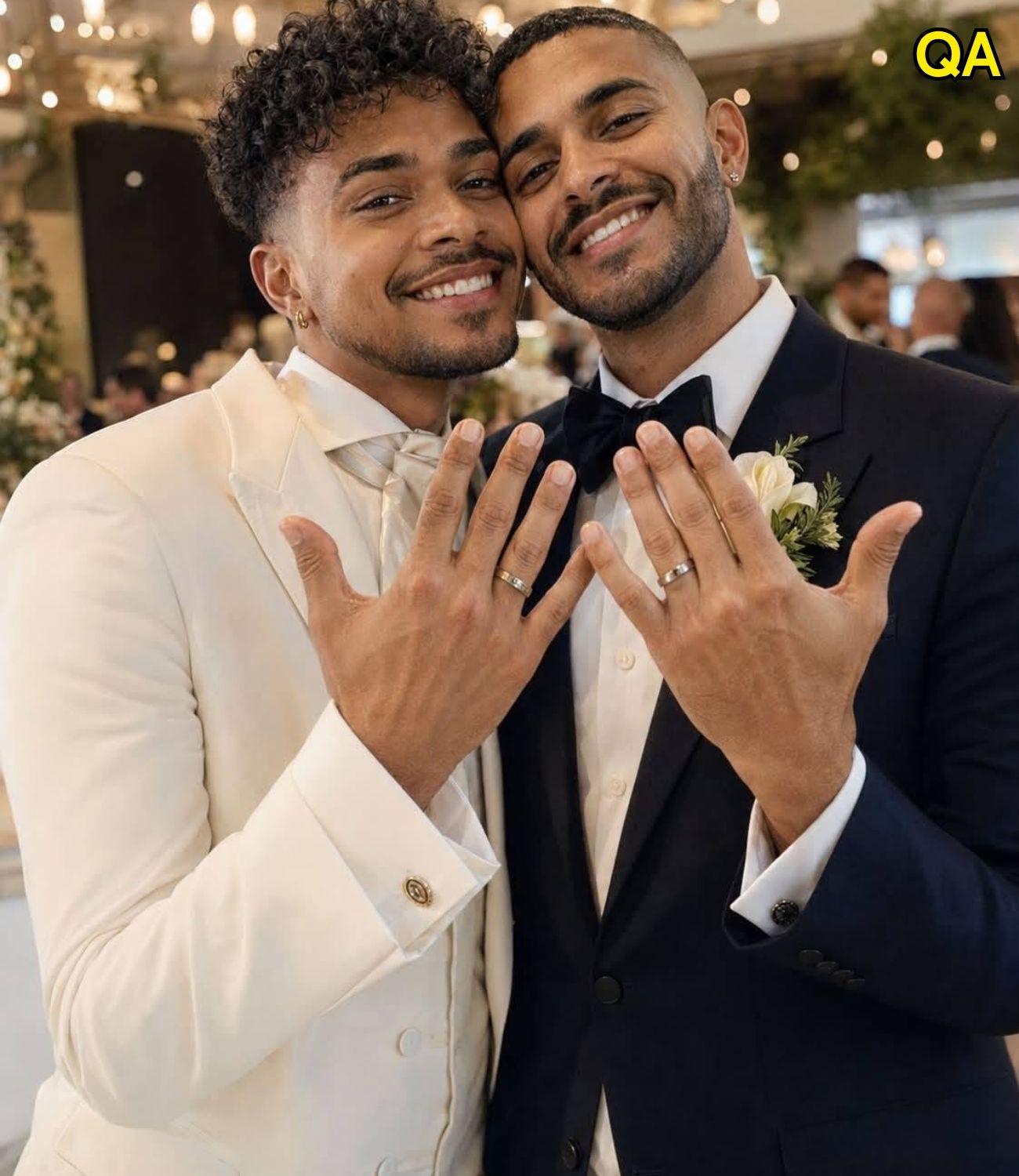
He stood alone beside the display of photographs arranged for the reception. Noah at three. Noah on his first day of school. Noah at fifteen, telling me who he truly was. Noah graduating. Noah beside Adrian, laughing beneath a summer rainstorm.
The stranger touched one photograph—Noah at six, wearing a blue sweater with a crooked smile—and whispered: “My boy.”
I stopped walking. There are voices your body remembers before your mind does. Twenty years disappeared in an instant. I dropped the champagne glass in my hand. It struck the carpet without breaking.
The man turned. For one second, neither of us moved. His eyes widened. “Claire?”
I felt cold everywhere. Thomas—my former husband. The man who had walked out before our son was born. The man Noah had spent his entire childhood asking about. The man I had trained myself not to harbor bitterness toward, simply because it took too much energy. He was standing inside my son’s wedding venue, and no one had warned me.
Then someone came running around the corner—Adrian Cole, my son’s husband of less than two hours. He stopped when he saw us together, and the color drained completely from his face.
That was when I knew Thomas had not simply wandered into Evermere Hall. Adrian knew he was there.
I looked from one man to the other. “What did you do?”
Adrian whispered, “Claire, please.” I had never heard fear in his voice before.
“What did you do?”
Thomas looked confused. “Is Noah here?”
I turned toward Adrian, who closed his eyes. That told me everything. Not the details—just the breach of trust. My son’s new husband had brought his missing father to his wedding, and Noah had no idea.
Chapter 2: The Weight of Twenty Years
To understand why that moment nearly shattered the happiest day of my son’s life, you need to understand what Thomas Bennett had already taken from us.
Twenty years earlier, I was twenty-six and expecting. Thomas and I had been married for two years. The pregnancy was planned—or so I thought. Thomas spent months talking about names, cribs, and the tiny bedroom at the back of our apartment. But when the ultrasound revealed we were having a boy, Thomas grew unusually quiet.
On the drive home, I asked what was wrong. He claimed it was nothing, then said he needed air. That turned into an argument. By midnight, he was pacing the apartment, saying he wasn’t ready for responsibility or the life ahead of us.
The next morning, half his clothes were gone, along with our emergency savings from the kitchen envelope. No note, no address, no phone call. For twenty years, there was complete silence.
I raised Noah alone. The reality meant working two jobs, buying secondhand furniture, and leaving the father’s section blank on school forms. It meant facing unexpected bills with barely a dollar left in my wallet, and answering an endless stream of heartbroken questions:
At six: “Did Dad know I liked dinosaurs?” At eight: “Do you know where he lives?” At twelve: “Was something wrong with me before I was even born?”
Every question was difficult, but I always gave him the same answer: “He left because of who he was then, not because of who you were.”
When Noah was fifteen, he came into the kitchen, his face pale and hands buried in his hoodie pockets. He told me he was gay. There was a single second of pause while my own traditional upbringing caught up with my fierce love for my child. Noah saw that pause, and I regretted it immediately. I crossed the room and held him tight. The important part was that Noah never had to earn my love—he already had it.
Years later, Adrian Cole entered his life. Adrian was quiet and worked in records research. He was polite, though guarded about his background. When Noah proposed, they chose Evermere Hall—a restored estate with stone courtyards and large windows overlooking lush gardens. The ceremony was intimate and beautiful. Adrian promised Noah he would never make him guess whether he was loved.
Looking back, that promise felt heavy with unintended irony.
Chapter 3: The Secret Unraveled
Back in the corridor, the tension was unbearable. Thomas looked bewildered and asked, “Did the ceremony start?”
Adrian’s expression softened. “It’s over, Thomas.”
Before we could say more, a woman in her late sixties hurried down the hall. She was Thomas’s care coordinator, Marian. She explained that Thomas had wandered off from where he was supposed to wait.
“Care coordinator?” I repeated.
We moved into a private meeting room near the ballroom. I closed the door and turned on Adrian. “Start talking.”
Adrian explained that three months prior, while filling out legal and medical paperwork for the marriage, he noticed Noah knew almost nothing about his paternal medical history. Using his background in records research, Adrian searched public archives and found Thomas living less than an hour away in Bellmere.
When Adrian contacted him, he learned Thomas had early-onset memory loss. His cognitive abilities had begun declining significantly over the past eighteen months.
“When I found him, he struggled with dates and names,” Adrian said quietly. “But he remembered Noah.”
Thomas looked up at me. “I never forgot Noah.”
My frustration flared again. “You were gone for twenty years! You were less than an hour away!”
Thomas stared at his hands. “I was overwhelmed back then… I owed people money, I was making terrible choices, and I convinced myself you both were better off without me.”
Adrian interjected, explaining that Thomas had written dozens of letters recently—capturing his memories, explanations, and apologies before his condition progressed further. Thomas desperately wanted to hand them to Noah in person once.
Adrian had arranged for Thomas to wait in a private room during the ceremony, planning to inform Noah afterward so Noah could decide whether he wanted to see his father.
“You decided to keep this from him on his wedding day?” I asked, stunned.
“I was afraid,” Adrian admitted softly. “If I told him before, it might ruin the wedding. If I waited until Thomas deteriorated, Noah might regret never having the choice.”
Before I could answer, a knock sounded at the door. Noah opened it, stepping inside with a smile that vanished the instant he saw Thomas.
Chapter 4: Facing the Past
Noah stood frozen in the doorway, looking between Adrian, Thomas, and me. He shared his father’s eyes—a striking resemblance that made the moment even heavier.
“Who is this?” Noah asked. When no one answered, the truth registered. “Mom?”
“That’s Thomas,” I said gently.
Noah took a step back. “No.”
Thomas stood up slowly. “Noah…”
Noah turned toward Adrian, his voice shaking. “You knew about this? How long?”
“Three months,” Adrian confessed.
“You knew where my father was for three months, and you didn’t tell me?” Noah’s voice cracked. “You married me today keeping this from me?”
Adrian tried to explain his intention to protect the day, but Noah shook his head. “Everybody keeps deciding what I’m allowed to know. My mother tried to protect me growing up, you tried to protect the wedding, and Thomas protected himself by leaving.”
Noah placed his floral boutonniere on the table. “I need ten minutes alone.”
No one followed him. He needed space to process a lifetime of decisions made on his behalf.
When Noah returned twenty minutes later, his face was washed and his composure regained. He set clear boundaries immediately.
To Thomas, he said: “You will not be attending the reception. But I want those letters.” Thomas handed over the thick bundle of papers. Noah asked, “Did you write these expecting forgiveness?”
“No,” Thomas replied softly. “I wrote them because soon I may forget why you shouldn’t give it.”
To me, Noah said: “Mom, we’re okay. But from now on, let me handle questions about him. I make my own choices.”
Finally, he turned to Adrian. “You kept a massive secret from me for three months out of fear. We will return to the reception tonight because our guests are here and I worked hard for this day. But afterward, we are going to have a serious conversation about trust.”
Chapter 5: Reclaiming Choice
The reception continued. To the guests, nothing seemed amiss. Noah and Adrian shared their dances, cut the cake, and celebrated with friends. I delivered my toast, reflecting on how raising a child is ultimately about learning to let them belong to themselves.
Late that night, after the guests departed, Noah returned to the private room. Thomas was sleeping in a chair, looking fragile. When he awoke, his confusion briefly surfaced before he recognized Noah.
Noah sat across from him and began reading the first letter. He asked Thomas why he had never tried to see them. Thomas confessed that when Noah was four, he had driven past our apartment once and seen Noah riding a red bicycle, laughing with me. Feeling inadequate, Thomas chose to stay away, convincing himself we didn’t need him.
Noah listened quietly. He didn’t offer immediate forgiveness, but he stayed and listened to his father talk about his early life and medical history.
In the months that followed, recovery was gradual. Noah and Adrian began counseling to rebuild complete transparency in their marriage. They didn’t sweep the issue under the rug; instead, they addressed the root of their communication head-on.
Thomas moved into a specialized care facility near Bellmere. Noah visited him periodically—not out of obligation, but on his own terms. Some days Thomas remembered details clearly; other days his memory drifted. But the twenty-six letters remained preserved in a wooden box at Noah’s home—a permanent record of truth.
A year later, during an anniversary dinner, Noah asked if I would change anything about how that day unfolded.
I looked at my son—strong, independent, and secure in his own choices.
“You deserved the truth,” I told him gently. “Pain doesn’t turn into kindness just because someone hides it from you.”
We had all thought we were protecting him in different ways. But Noah didn’t need a life shielded from difficult realities. He simply needed the respect and trust to navigate his own story.
