
Chapter 1: Outside Evergreen Elementary
Classes had just let out for the day.
Parents crowded the curb. Teachers waved goodbye from the main entrance. Kids crossed the pavement with oversized backpacks bouncing against their small backs. I had been patrolling this school area for four years, and I thought I had seen most of what a child might bring to a police officer at school dismissal.
Then he was standing beside me before I even heard him approach.
He was seven years old. Small for his age, with an oversized backpack, sneakers worn completely down and clearly too small for his feet, and a homemade buzz cut. None of those details held my attention as much as his face.
There was no excitement at seeing an officer. No shy grin. He studied me with a seriousness that belonged on someone much older.
“Officer Dunham?” he asked. “Would you walk home with me after school? I need to show you something. I can’t talk about it here.”
I crouched down until we were eye level. “Is somebody hurting you?”
He shook his head and glanced toward the neighborhood several blocks away. “Everyone thinks it’s normal. If I tell them, they say I’m trying to cause problems. But if you see it for yourself, they won’t be able to pretend it isn’t happening anymore.”
He looked right into my eyes. “Right?”
That changed the entire nature of the question. I agreed to walk with him.
Chapter 2: The House
It was a six-block walk. He stayed close to my side but barely spoke a word. Most children his age wanted to ask about my badge or sit inside the patrol car, but he kept his eyes locked on the houses we passed.
“Does your father know you asked me to come?” I asked gently.
He stared straight ahead. “He believes families are supposed to live this way. Everyone I know believes that too.”
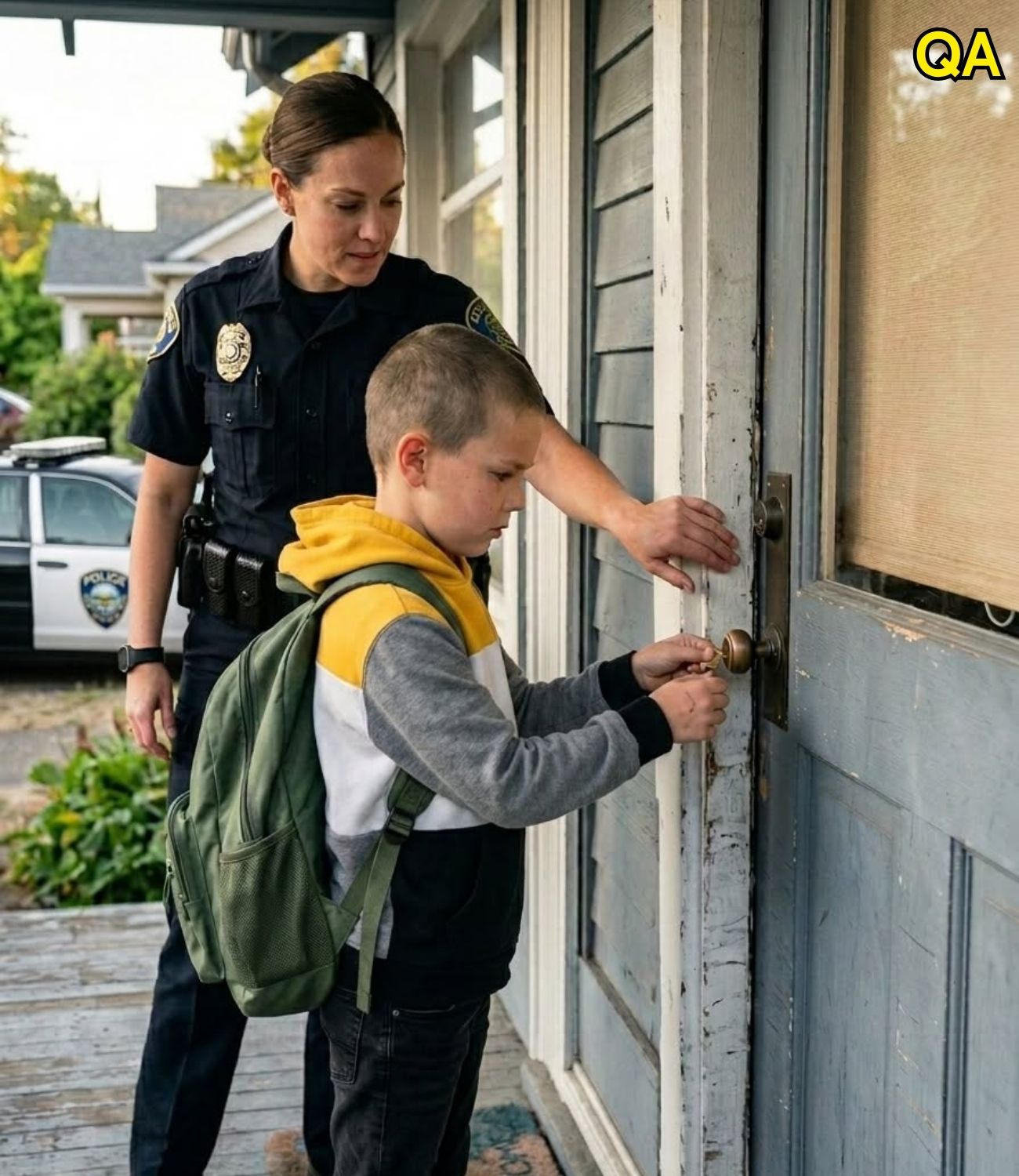
We stopped outside a small single-story house I had driven past dozens of times. Every single blind was pulled shut despite the bright afternoon sun. There were no bicycles in the yard, no toys on the porch—nothing on the outside suggesting a child lived there.
He reached into his pocket and pulled out a key. His fingers shook badly enough that the metal rattled against his palm.
Then he looked up at me. “Can you promise me something before we go inside?”
“Tell me what you need,” I replied.
“If I show you what’s in there, please don’t let them force me to come back and pretend everything is fine.”
He had asked adults before. They had not believed him. He was not asking me to investigate something strange; he was asking whether I would believe him after I saw it with my own eyes.
“I will take what I see seriously,” I promised. “I give you my word.”
He unlocked the door.
Chapter 3: Inside
What I found inside that house must be described carefully, as it is part of an active case record and involves a child’s privacy. What I can state plainly is that the conditions inside were entirely inconsistent with appropriate care for a child.
The house was unclean, with limited food accessible. The child’s bedroom contained a mattress without proper bedding, and a heating unit that served that area of the house was completely non-functional.
The father was present. He had been home the entire time.
He greeted me at the interior doorway with the specific expression of someone who had been caught doing something they had successfully explained away to authority figures for a long time.
“I can tell you what this looks like,” he said defensively.
“Please do,” I replied.
What he told me was what he had apparently told teachers, a school counselor, a neighbor who had called a non-emergency line once, and at least one other officer who had responded to a concern six months earlier. It was a coherent explanation. It was also, as I stood in that house with the boy beside me, clearly insufficient relative to the reality I was looking at.
I called it in.
Chapter 4: What Happened Next
My supervisor arrived within fifteen minutes, and a child protective services worker arrived within thirty.
The boy sat beside me on the front step while the adults moved through the house. He did not speak for a long time.
Then he asked, “You stayed.”
“Yes,” I said.
“The other officer didn’t stay last time.”
“I know. I’m staying.”
“Are you going to believe me?”
“I already do.”
“Even though my dad has an explanation?”
“Yes.”
He looked out at the street. “I practiced what to say to you for four days.”
“You chose the right words.”
“I said if you see it yourself.”
“Yes. That was exactly right.”
“Because adults believe what they see more than what kids say.” He said it without bitterness—just as a practical observation, the kind a seven-year-old makes when he has thought carefully about how to get someone to save him.
“Officer Dunham?”
“Yes?”
“You’re not going to make me go back inside tonight, are you?”
“No,” I told him. “You’re not going back inside tonight.”
He leaned very slightly against my arm. Not much—just enough to register that he had heard me and believed me.
Chapter 5: After
The boy’s name was Marcus. He went to a relative placement that evening—his maternal aunt, who lived forty minutes away. She arrived within two hours of being contacted and held him in the parking lot of the CPS office for a long time without saying a word.
She spoke to me afterward. “He called me once, about six months ago. He said things weren’t right. I didn’t know what to do. I told him to tell his teacher.”
“He told his teacher,” I said.
“And then what?”
“And then his teacher reported it, and there was a response, and that response determined the explanation was sufficient.”
“But it wasn’t.”
“No.”
“He kept trying,” she whispered.
“For four days, he practiced what to say to me specifically.”
“Why you?”
“Because he had seen me at the school. He knew my name. He decided I would be the right person.”
“Was he right?”
“I hope so. The record is what it is now. The documentation is thorough.”
“Will it be enough?”
“That’s for the process to determine. What I can tell you is that what I saw today will be in the record accurately.”
She thanked me for staying on the step with him, reminding me that he had asked me to believe him.
Marcus attended a new school the following fall. His aunt later sent a note to the precinct saying he had joined the soccer team, made two friends, and that he still sometimes asked adults to promise things before telling them something important. She thought he would probably always do that, and she thought it was wise.
I think she is right.
Some children practice for four days before they find the right words. Some of those words are: If you see it yourself, they can’t pretend it isn’t happening anymore.
Some keys rattle in small shaking hands at the front doors of houses with closed blinds. And some officers stay on the front step until the family arrives.
Believe the child. Stay on the step. That is the whole of what was needed.
