
Chapter 1: The Hard-Earned Sanctuary
Grant Holloway believed retirement would finally sound like silence instead of sacrifice. After forty years of overtime shifts, unpaid favors, and postponed dreams, he disappeared into the mountains to breathe again.
Every board in that cabin carried his fingerprints. Every nail held together pieces of a life built slowly, painfully, and honestly. He did not inherit peace; he earned it.
The mountain mornings were cold enough to sting his lungs awake. The evenings smelled of cedar smoke, rainwater, and soup simmering quietly beside the fire. For the first time in decades, nobody demanded anything from him.
Then the phone rang.
His son Daniel did not call to ask how he was doing. He did not ask whether his father felt lonely, healthy, or alive. He called to announce an invasion disguised as family support.
“Claire’s parents are moving into your mountain house.”
Not asking. Telling.
That single moment exposed something millions of parents secretly fear: sometimes the children you sacrifice everything for begin treating your love like permanent unpaid rent.
Chapter 2: The Demand and the Disrespect
Grant sat silently in his kitchen while chili bubbled on the stove beside him. Outside the window, pine trees swayed against a dark October sky. Inside, something much colder settled into his chest.
Daniel spoke with the confidence of someone who already believed ownership belonged to him. That confidence did not appear overnight. It came from years of unchecked entitlement—years of assuming Dad would always bend first.
Daniel insisted Claire’s parents “needed somewhere peaceful” while their condo was renovated. He spoke as though peace were a public utility instead of his father’s private refuge.
Grant asked one simple question: “Why didn’t you ask me first?”
That question should have ended the conversation. Instead, it became an argument, because entitled people become angry the moment permission enters the discussion. Daniel accused his father of “making things weird.”
Grant remained calm, because calmness irritates controlling people more than shouting ever does. Then came the sentence that changed everything:
“If you don’t like it, go back to the city.”
Not “we’ll figure something out.” Not “can we compromise.” Just leave. Leave the home you built. Leave the life you earned. Leave because younger people had decided your comfort mattered less than theirs.
Chapter 3: The Weight of Memory
That sentence hit harder because it came from his own son. A stranger’s disrespect wounds pride; a child’s disrespect wounds memory.
Grant remembered the years he carried Daniel on his shoulders through snowstorms. He remembered hospital bills, school lunches, broken bicycles, and sleepless nights beside fevers. Parents never fully forget those invisible investments, but children often do.
Many aging parents feel emotionally discarded once their usefulness declines. They become backup wallets, free childcare, or temporary housing solutions instead of respected human beings.
Still, Grant did not yell. He did not threaten. He did not beg for respect from people already determined to ignore it. Instead, he became quiet. Quietness frightens arrogant people because they mistake silence for surrender. But silence often means preparation.
Chapter 4: Paperwork Versus Assumptions
At exactly 6:22 that evening, Grant opened the property folder beside his kitchen table. Inside were deeds, insurance documents, tax records, and occupancy restrictions carrying only one legal name: his own.
Daniel had spoken emotionally. Grant responded legally. One generation relied on assumptions; the other relied on paperwork. That difference changed the entire battle. The old mountain cabin was never family property, shared ownership, or a future inheritance waiting for early access. It belonged solely to the man who built it.
Grant refused to become invisible inside his own lifetime. He photographed every room carefully, emailed documents to his attorney before nightfall, removed the spare key hidden beneath the lantern, and prepared one final surprise: an envelope. Simple. Quiet. Devastating.
Grant packed a single canvas bag afterward—not because he had been defeated, but because he wanted complete control over what happened next.
Chapter 5: Accountability at the Door
Saturday morning arrived sharp and cold. Frost covered the porch rails like powdered glass under sunlight. Grant watched from a hidden turnout nearby while his dashboard camera recorded everything.
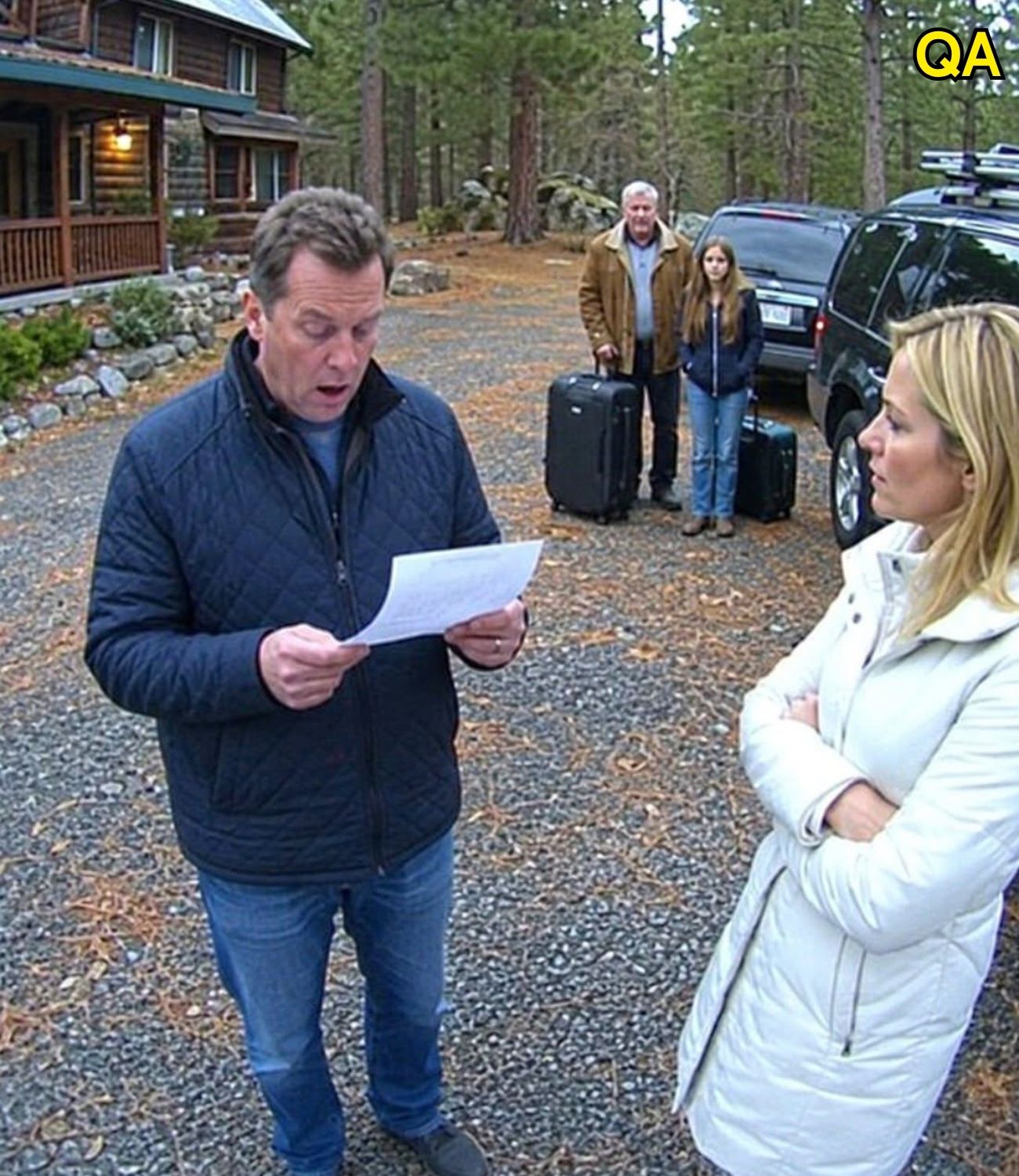
At 10:07 a.m., Claire’s parents arrived carrying rolling suitcases and casual confidence. Daniel arrived smiling behind them, looking proud of himself for solving a problem using someone else’s life.
Then he noticed the envelope resting against the front door. The smile disappeared immediately.
Reality had finally interrupted entitlement—not through violence or revenge, but through accountability. The strongest part of Grant’s story was not his anger, but his restraint. He simply reminded everyone that kindness is not weakness, and that an older man’s desire for peace is not an invitation for exploitation.
When Daniel reached for that envelope, he finally realized something life-changing: his father had stopped playing the role of obedient background character. And once that happens, the entire family dynamic changes forever.
Chapter 6: The Aftermath and the New Horizon
The crisp mountain air carried the sharp scent of pine and impending change as Daniel stared down at the sealed envelope resting on the weathered porch boards. Around him, the sudden, heavy silence of the wilderness amplified the sudden drop in his stomach. Claire’s parents stood awkwardly beside their rolling suitcases, their initial aura of casual entitlement instantly evaporating under the weight of an uninvited reality.
Daniel reached down, his fingers trembling slightly as he picked up the envelope. His name was written across the front in his father’s precise, steady handwriting—the same handwriting that had once signed permission slips, endorsed college loan applications, and filled out countless overtime work sheets to keep a roof over his head.
He broke the seal. Inside was a single, laminated notice from Grant’s attorney, alongside a printed copy of the local county sheriff’s trespassing ordinances and the formal property deed bearing only one name: Grant Holloway. Attached to the back was a brief, typed note from his father:
“A house built with forty years of sweat is not a hotel, nor is it a storage unit for your convenience. The spare key is gone. The locks have been legally changed as of 6:00 AM today. If you step past the property line, local authorities will handle the rest. Enjoy your trip back to the city.”
The words hit Daniel with the force of a physical blow. For his entire life, he had operated under the unspoken, comfortable assumption that his father existed as a permanent safety net—a quiet fixture in the background who would always fold, always forgive, and always absorb the inconveniences of younger generations without complaint. He had never once paused to consider what would happen if the net was suddenly pulled away.
Claire’s mother crossed her arms, her face flushing with a mix of embarrassment and sudden anger. “Well? What does it say, Daniel? Are we going inside or not? It’s freezing out here.”
“We can’t,” Daniel muttered, his voice barely audible over the rustle of the autumn wind through the pines.
“What do you mean we can’t?” Claire stepped forward, her eyes narrowing as she looked past him toward the front door. “It’s your dad’s place. Just call him. Tell him to stop playing games.”
“I tried,” Daniel said, pulling out his phone with a shaking hand and dialing his father’s number.
The line rang three times before going straight to voicemail. No custom greeting, just the standard automated message. He tried again. Same result. His father hadn’t just stepped out; he had effectively severed the connection, leaving behind a hard boundary that could no longer be barged through with emotional manipulation.
Down the winding dirt road, hidden safely behind a thick cluster of evergreen trees, Grant sat quietly in his parked car. Through the rearview mirror, he watched the small group huddled on his porch. He didn’t feel a surge of triumphant rage, nor did he feel the bitter sting of regret. Instead, an overwhelming sense of profound, long-overdue peace washed over him.
For decades, his worth had been measured entirely by what he could provide, how much he could sacrifice, and how quietly he could endure. He had spent forty years carrying the burdens of others, often at the expense of his own health and mental well-being. But today, looking at the dashboard camera recording the scene of absolute bewilderment unfolding at his cabin door, he realized something vital: it was never too late to reclaim the authorship of your own life.
Back on the porch, reality was finally setting in for the uninvited guests. Realizing that no amount of complaining or entitlement was going to bypass a legally secured property, Claire’s father let out a heavy, frustrated sigh, grabbed the handle of his suitcase, and turned back toward the car.
“This is ridiculous,” he muttered, shaking his head. “Your father has completely lost his mind.”
“No,” Daniel said quietly, watching his parents trudge back to their vehicle with a sudden, sinking clarity. “He hasn’t lost his mind at all. He just finally found his spine.”
Daniel stood alone on the porch for a long moment, staring at the empty doorway. The silence of the mountain, which had once felt peaceful to his father, now felt deafening to him—a stark reminder of what happens when you take unconditional love for granted until there is nothing left to take.
Miles away, driving down the scenic highway toward a cozy coastal town he had always dreamed of visiting, Grant turned up the radio. The hum of the engine blended with the quiet rhythm of the road ahead. He rolled the window down just an inch, letting the cool wind rush past his face.
He didn’t know what tomorrow would bring, and for the first time in his life, he didn’t need to have a plan for everyone else. He only needed the road, the quiet, and the freedom of a life finally lived entirely on his own terms.
