

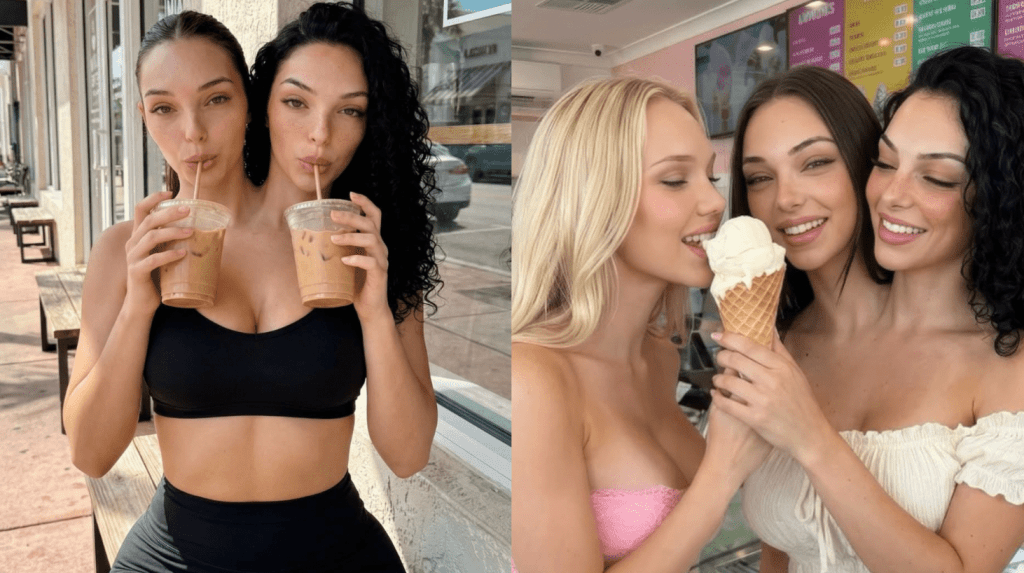
In recent months, a social media account featuring two individuals known as Valeria and Camila has attracted widespread attention across Instagram and other platforms. Presented as conjoined twins, the account quickly gained hundreds of thousands of followers, prompting curiosity, admiration, and skepticism in equal measure. As the audience grew, so did questions about the authenticity of the images and videos being shared.
The case has become a notable example of how rapidly advancing artificial intelligence technology is reshaping digital content, blurring the line between real people and computer-generated personas.
Rapid Growth and Online Visibility
The Valeria and Camila account began posting content in late 2025 and experienced rapid follower growth within a short period. The profile features highly polished photos and short videos portraying everyday activities, social interactions, and lifestyle moments. The visual consistency, professional aesthetic, and frequent posting schedule contributed to strong engagement and visibility within Instagram’s recommendation system.
From a purely technical perspective, such growth is not unusual in the influencer economy. Social media algorithms tend to amplify visually striking content, particularly when it aligns with current trends in fashion, lifestyle, or digital storytelling. However, the unusually rapid rise of this account, combined with its unique premise, drew closer scrutiny from users familiar with digital media production.

Rising Skepticism and Public Debate
As the account gained popularity, online discussions emerged questioning whether Valeria and Camila were real individuals or digitally generated figures. Some users noted visual inconsistencies across images, while others pointed to recurring patterns in facial features, body proportions, and backgrounds—elements that are often associated with AI-generated imagery.
These observations reflect a broader public awareness of generative AI tools, which have become increasingly capable of producing realistic human figures. Platforms such as Instagram, TikTok, and X have already seen a surge in AI-created models, virtual influencers, and synthetic personalities designed for engagement rather than representation of real individuals.
Importantly, no verified medical, institutional, or governmental sources have confirmed the real-world existence of individuals named Valeria and Camila as described by the account. In the absence of such confirmation, responsible reporting requires acknowledging uncertainty rather than asserting authenticity or fabrication as fact.

The Emergence of AI-Generated Influencers
The discussion surrounding Valeria and Camila fits into a larger, well-documented trend: the rise of AI-generated influencers. According to academic research and technology industry reports, brands and creators increasingly experiment with synthetic personalities due to their controllability, scalability, and cost efficiency.
AI-generated figures can be designed to meet idealized aesthetic standards, maintain consistent branding, and avoid the unpredictability of human behavior. Marketing and digital ethics experts have noted that these characteristics make such personas attractive for engagement-driven platforms, but also raise concerns around transparency, authenticity, and audience trust.
Major social platforms have acknowledged this shift. Meta and other technology companies have publicly discussed the need for clearer labeling of AI-generated content to help users understand what they are viewing, though enforcement standards continue to evolve.
Visual Consistency and Technical Limitations
While AI image generation has advanced significantly, it still exhibits identifiable limitations. Experts in artificial intelligence and digital imaging frequently point out that generative models can struggle with consistent anatomical details, lighting logic, background coherence, and object symmetry across multiple images.
When audiences analyze viral content more closely, these limitations often become part of the discussion. However, it is important to note that visual anomalies alone are not definitive proof of AI generation, especially as editing tools and filters are also widely used by human creators.
As of now, no independent forensic analysis by an accredited institution has been publicly released regarding the Valeria and Camila account. Therefore, conclusions about the nature of the content remain interpretive rather than definitive.

Ethical and Social Implications
The popularity of accounts like Valeria and Camila highlights important ethical considerations in digital media. Transparency is a key concern, particularly when content is presented in a way that encourages emotional investment or personal identification.
Experts in media literacy and digital ethics emphasize that audiences should be clearly informed when they are engaging with synthetic or AI-generated characters. Lack of disclosure can contribute to misinformation, unrealistic expectations, and erosion of trust in online spaces.
In response to similar cases, some countries and regulatory bodies have begun discussing disclosure standards for AI-generated media, particularly in advertising and political contexts. While social media entertainment remains less regulated, public awareness continues to grow.
Conclusion
The Valeria and Camila social media phenomenon illustrates how quickly AI-generated or AI-assisted content can capture public attention. While questions about authenticity remain unresolved due to the lack of verified, independent confirmation, the case underscores the importance of critical media consumption in an era of rapidly advancing technology.
Rather than focusing on speculation, the broader takeaway is clear: artificial intelligence is transforming social media, influencer culture, and digital storytelling. As these tools continue to evolve, transparency, responsible reporting, and informed audiences will play a central role in shaping how such content is created and received.
