

For millions of years, the East African Rift has quietly reshaped the landscape of the continent—stretching, cracking, and slowly carving out the future coastline of a world that today looks stable only on the surface. But in late 2025, a new wave of volcanic and seismic activity in Ethiopia has captured the attention of geologists worldwide, breaking a geological quiet that spanned roughly 10,000 years in the region and offering a rare opportunity to observe continental rifting in action.
The Afar Depression in northern Ethiopia—long known as one of the most geologically dynamic regions on Earth—has entered a fresh phase of activity. New lava flows, ground deformation, and increased seismicity are providing strong evidence that magma movement beneath the Earth’s crust is accelerating the slow separation of the African continent. While this process unfolds over millions of years and poses no immediate threat to populations across Africa, it is scientifically significant: events like these help experts understand how oceans form, how continents rearrange, and how Earth continually reshapes itself from within.
A Surge of Activity Under the Erta Ale Volcanic System

The latest observations began in early November 2025, when seismic monitoring stations detected an abrupt increase in tremors beneath the Erta Ale volcanic complex. Residents near the Afar lowlands described deep vibrations and distant roaring sounds—phenomena typical when magma begins moving upward through fractures in the crust.
“It felt like the ground was alive,” said Abebe Tekle, a farmer living several kilometers from the volcano. “The earth was moving in a way we haven’t felt in years.”
Teams from the Ethiopian Geological Survey quickly deployed drones and field researchers to analyze lava flows, map new fissures, and collect gas samples. Early data indicated that magma was rising through the crust at a rate faster than previous episodes in recent decades. Satellite measurements later confirmed significant ground deformation—specifically horizontal extension—consistent with an active continental rift system.
Dr. Hana Alemayehu, a volcanologist at Addis Ababa University, noted that while eruptions in the Afar region are not unusual, the scale and speed of the recent changes indicate that rifting forces are currently more active than expected.
“The ground movement we’re measuring aligns with what we see during rift accelerations,” she explained. “This is not an isolated eruption—it is part of a much larger tectonic pattern that tells us Africa’s interior is still evolving.”
Understanding the Rift: A Window Into Planetary Change
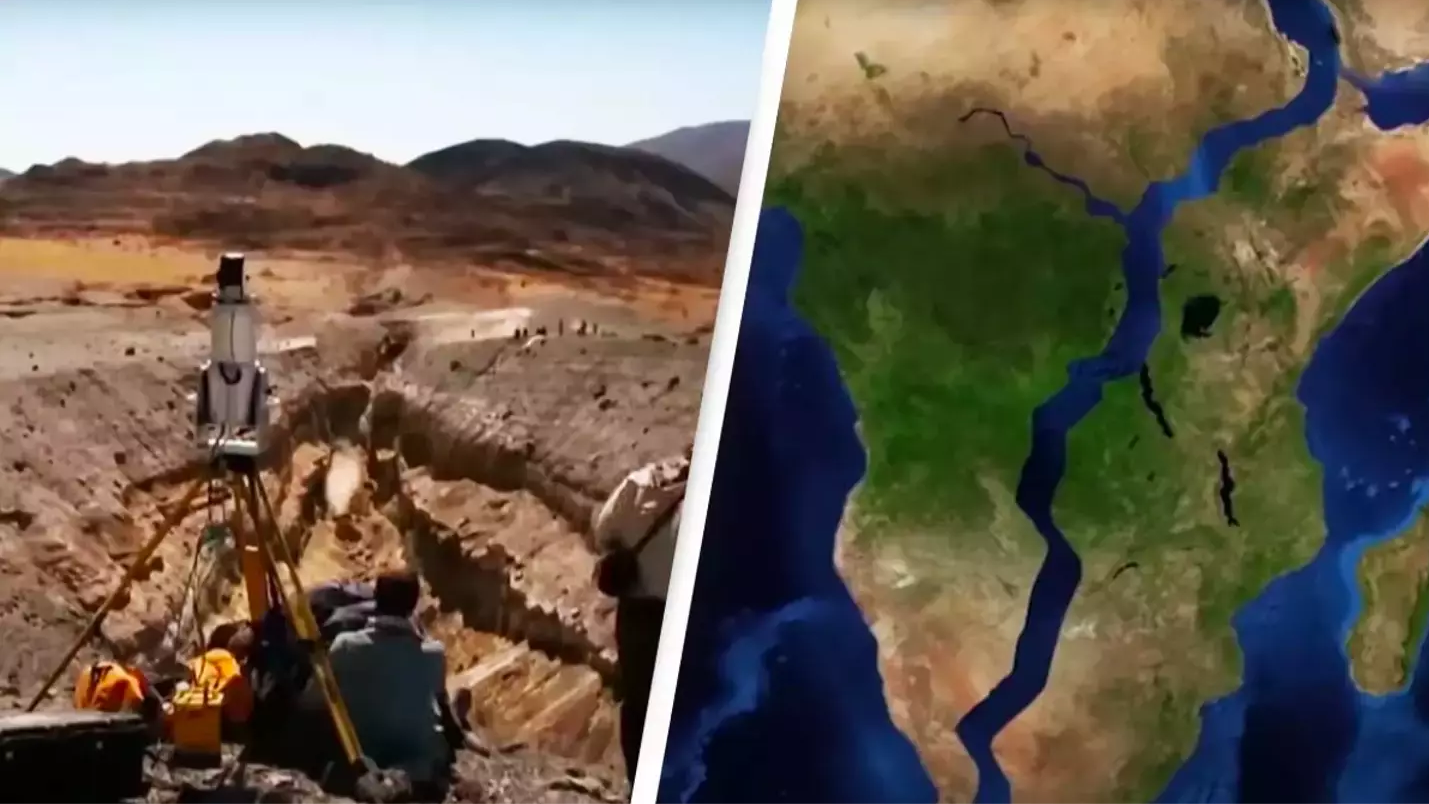
The East African Rift System stretches more than 3,000 kilometers from the Red Sea through Ethiopia and Kenya to Mozambique. It is a place where the African Plate is slowly splitting into two separate tectonic plates: the Nubian Plate in the west and the Somali Plate in the east. The Afar Depression—one of the lowest points on the African continent—is the center of this tectonic divergence.
At the heart of this slow-motion divide lies a deeper force: the African superplume, a large column of hot mantle material rising from deep within the Earth. Scientists believe the superplume contributes to increased heat, magma generation, and uplift across eastern Africa, influencing long-term regional geology.
Signs of this process are visible on the surface:
-
long cracks forming in desert terrain
-
volcanoes aligned along rift segments
-
gradual widening of the landscape
-
geothermal hotspots producing steam vents
Although the ground moves only a few millimeters per year—barely perceptible in human timescales—combined movement over millions of years eventually forms oceans. The Atlantic Ocean began as a rift very similar to the one in East Africa.
The 2025 Activity: Why It Matters
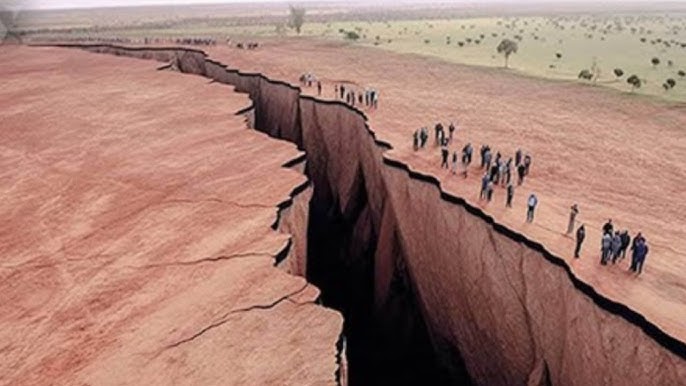
This year’s volcanic surge stands out not because it represents danger, but because it provides new empirical data for understanding continental breakup. Drone footage captured broad lava flows advancing across the desert, while GPS stations recorded measurable horizontal spreading across several kilometers.
Satellite imagery from orbiting Earth-monitoring systems revealed:
-
new fissures opening parallel to older rift lines
-
significant ground subsidence in localized areas
-
fresh basalt flows extending across previously stable terrain
-
ash plumes rising high enough to be observed from space
To local pastoralist communities, the most visible changes are glowing lava channels at night and the smell of volcanic gases carried on the wind. Authorities have advised short-term precautions and monitoring, but experts emphasize that the long-term tectonic process remains extremely slow and does not pose sudden continental-scale dangers.
A Rare Chance for Scientists
For geologists, the current activity in Ethiopia is akin to watching a natural laboratory come alive.
“This is a chance to observe what normally takes place on timescales far beyond human experience,” said Dr. Alemayehu. “We’re witnessing the earliest phase of what, in millions of years, may become a fully formed ocean basin.”
Researchers are now analyzing:
-
gas emissions to understand magma chemistry
-
high-resolution seismographic data to map underground structures
-
ground-deformation measurements to model how plates are moving
-
thermal images to determine magma distribution beneath the surface
Some scientists have even suggested weak correlations between mantle plume activity and minor fluctuations in Earth’s rotational dynamics. While these ideas remain speculative, they highlight the scientific interest that the Afar Depression continues to attract.
A Geological Event With Global Significance
The resurgence of activity in Ethiopia has sparked renewed international collaboration. Universities and research agencies across Africa, Europe, and the United States are sharing data to refine models of how rift zones evolve. The findings may help researchers better understand similar regions around the world, such as Iceland’s Mid-Atlantic Ridge or the Basin and Range Province in North America.
Online, satellite images and drone videos of glowing lava flows have captured global fascination. While some social media commentary drifts into sensationalism, scientists emphasize that the real story is one of long-term planetary change—not imminent catastrophe.
Africa is not “splitting in half” in any sudden way, nor is the continent at risk of collapse. Rather, it is undergoing a natural tectonic process that has shaped continents throughout Earth’s 4.5-billion-year history.
Looking Ahead: The Slow Formation of a Future Ocean
If the rifting continues for millions of years, seawater from the Red Sea may eventually flood the Afar Depression, creating a new ocean basin and separating eastern Africa from the rest of the continent. Geologically speaking, such a transformation is typical of plate tectonics. For now, however, these changes occur too slowly to affect day-to-day life.
Still, the recent events remind us that Earth is not a static world. Beneath familiar landscapes lie immense forces constantly pushing, pulling, heating, and reshaping the planet.
As the Afar Depression continues to shift and Ethiopia’s volcanoes remain active, scientists will keep watching, measuring, and learning. The renewed activity marks the end of a long period of quiet and the start of a new chapter in our understanding of Africa’s deep geological history.
The Earth’s crust may move only millimeters each year, but the story unfolding in Ethiopia today offers humanity a rare opportunity to witness the earliest steps of a continental transformation—one that, over the vastness of geological time, could eventually reshape the map of the world.
