

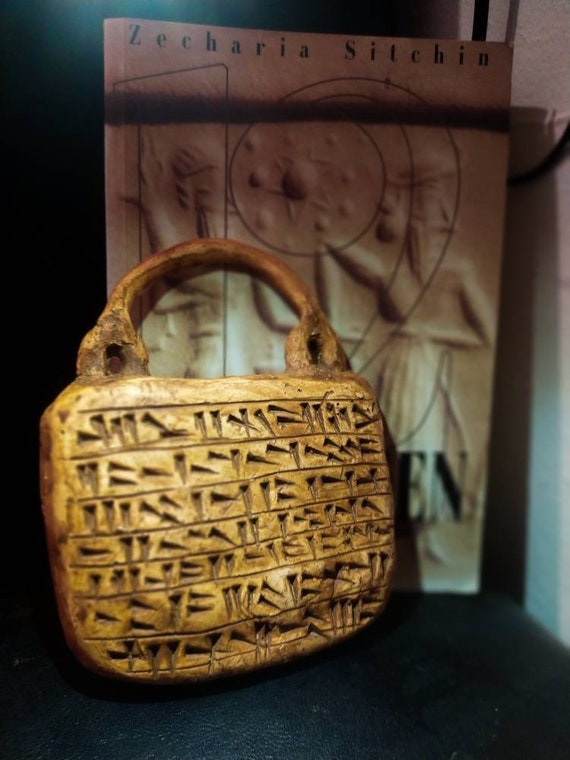
Across the ruins of ancient temples, carved reliefs, and monumental stone pillars from cultures separated by oceans and millennia, one symbol emerges again and again: a small, arched object with a flat base and a rounded handle — a shape that modern viewers instinctively compare to a handbag.
From the circular enclosures of Göbekli Tepe in modern-day Türkiye to sculptures of the Olmec world in Mesoamerica, from Assyrian palace reliefs to carvings found in ancient Indonesia, this same shape appears, remarkably consistent in form. Archaeologists have documented it for decades, yet its meaning remains elusive.
Why did so many civilizations — with no known contact — preserve the same motif?
What did this object signify?
And how did it endure across vast distances and thousands of years?
This long-form exploration digs into archaeological evidence, symbolic interpretations, and cross-cultural connections to shed light on what many call the “Handbag of the Gods.” Rather than promoting speculative lore, this investigation examines what scholars actually know — and what remains an open question in the study of ancient symbolism.
A Symbol Older Than Civilization Itself

The earliest known depictions of the “handbag” appear at Göbekli Tepe, a site dating back roughly 12,000 years — long before organized agriculture, ceramics, or writing. Here, the symbol appears above carved animals and alongside humanoid figures. Because Göbekli Tepe predates known written language, its meaning must be deciphered through archaeological context.
The motif resurfaces about 6,000 years later in Mesopotamia, especially in Assyrian and Sumerian art. Carved in the hands of divine or semi-divine figures, the object appears structured and uniform, suggesting that the shape had a standardized symbolic meaning.
Far across the world, in ancient Mesoamerica, Olmec stone sculptures also depict figures holding nearly identical forms. Meanwhile, in parts of Indonesia and Polynesia, stone reliefs show a strikingly similar outline.
Across continents and centuries, the form barely changes. This universal consistency is what makes the “handbag” one of the most intriguing cross-cultural symbols in human history.
Understanding Its Form: Simple Tool or Sacred Object?
At first glance, the object resembles a practical container — perhaps used to carry seeds, pigments, or ritual materials. Some anthropologists suggest that this shape may represent a basic human tool, one so essential that different cultures naturally arrived at similar artistic forms.
However, this explanation does not fully account for context: the symbol is rarely drawn in mundane scenes. Instead, it appears in sacred or ceremonial spaces, held by deities or spiritual figures. This placement suggests a deeper symbolic meaning.
Several theories have emerged from the academic community.
Theory 1: A Symbol of Fertility or Creation
Some researchers propose that the handbag represents a container for life-giving substances — seeds, water, or ritual offerings. In many early cultures, containers were symbols of abundance, fertility, and renewal.
In this interpretation, the object may have represented the origin of life, or the tools used by early societies to sustain themselves.
The fact that the symbol appears alongside animals, vegetation patterns, and celestial motifs supports the idea that it may represent a cosmic vessel — something that held spiritual or creative significance.
Theory 2: A Celestial or Cosmological Map
Another widely discussed interpretation is that the handbag represents a simplified cosmogram — a symbolic map of the universe.
Across ancient civilizations, the universe was often conceptualized as a structured container with upper, middle, and lower realms. In this light:
• The curved top could represent the heavens
• The flat base the earth or underworld
• And the interior space the world inhabited by humans
Such symbolic structures appear in many ancient religions. The uniform shape of the handbag could reflect a shared way early societies visualized cosmic order, even without direct contact.
Theory 3: A Ritual Object Depicted Across Cultures
Some archaeologists argue that the symbol may simply represent a common ceremonial item, used in rituals across diverse societies. Ritual bags, pouches for sacred herbs, and carved containers appear throughout prehistoric cultures.
In this interpretation, the “handbag” does not represent the same idea everywhere — instead, it reflects the widespread importance of ritual containers in ancient spirituality.
This theory aligns with the fact that the object is usually depicted in the hands of divine or symbolic figures.
Theory 4: A Symbol of Knowledge or Authority
A compelling idea among symbolic anthropologists is that the handbag represents knowledge held by priestly or spiritual leaders.
Throughout ancient cultures, the ability to record, preserve, or interpret knowledge conferred authority. In the absence of writing, containers of physical or symbolic significance often represented the transfer of wisdom.
The motif’s presence in sacred reliefs suggests that early societies might have viewed the handbag as a vessel of ritual power, ancestral knowledge, or spiritual guidance — a symbolic object representing responsibility and leadership.
Why the Symbol Endured for Millennia
![Handbag of the gods” Neo-Assyrian Alabaster Relief Panel, Mesopotamia. Circa 900 B.C. [564x807] : r/ArtefactPorn](https://preview.redd.it/handbag-of-the-gods-neo-assyrian-alabaster-relief-panel-v0-0qfz59fjhadc1.jpeg?auto=webp&s=ca981d1f81b2e9879c79b88b3396be4469f3238c)
One of the most striking aspects of the handbag motif is its resilience. Civilizations rose and fell, languages evolved and disappeared, and yet the symbol persisted — reimagined but recognizable.
This endurance suggests that the symbol represented a universal concept, not limited to a single culture. It may have connected to early human themes: life, order, spirituality, or leadership. And its simple, geometric form made it easy to carve into stone and transmit across generations.
The motif’s survival across continents hints at shared human concerns, not cross-continental travel. In other words, it may reflect parallel cultural evolution — different societies developing similar symbols to represent similar ideas.
The Global Trail: Evidence Without Speculation
Some fringe theories have suggested ancient global contact, but mainstream archaeology emphasizes that similar symbols can arise independently. Containers were crucial for early human societies, ritual objects often developed similar shapes across unrelated cultures, and geometric symbols like circles or crescents appear globally.
Thus, the handbag may reflect how early societies visualized spiritual or functional concepts using simple forms. The similarities are fascinating — but do not require assuming direct cultural contact.
A Legacy That Continues to Inspire
Today, the “Handbag of the Gods” captures public imagination because it sits at the intersection of archaeology, art, and human curiosity. It invites modern viewers to question how much we truly understand about early societies — and how symbols can survive long after languages and rituals have vanished.
Museums feature these carvings in exhibitions exploring humanity’s earliest artistry. Historians analyze their stylistic evolution. Anthropologists study their meaning. Meanwhile, the general public remains captivated by the mystery.
Rather than representing an unsolved secret hidden from the world, the handbag is better understood as a shared human symbol, passed down through cultures seeking to represent what mattered most to them.
Its mystery endures not because knowledge was lost, but because the symbol transcends any single interpretation.
Conclusion: A Symbol That Connects Humanity Across Time
The so-called “Handbag of the Gods” is one of the oldest known symbols shared across early civilizations. Its presence from Göbekli Tepe to Mesoamerica raises profound questions about how humans developed symbols, rituals, and spiritual concepts long before written history.
Whether representing a daily tool, a sacred ritual object, a cosmological map, or a vessel of ancestral wisdom, the handbag reflects humanity’s early attempts to understand the world and express intangible ideas through tangible imagery.
Its persistence for over 12,000 years does not point to a hidden truth withheld from the world — but rather to a shared thread in humanity’s story: a universal desire to carry, protect, transmit, and honor what we consider sacred.
In studying this ancient symbol, we reconnect not with lost civilizations, but with each other, across time, continents, and cultures.
