

Hospitals have a strange way of distorting time. Fluorescent lights hum without mercy, machines breathe in place of people, and every hallway carries the faint echo of someone’s hope—or someone’s ending. In Room 412, where the curtains stayed half-drawn and the air smelled faintly of antiseptic and mint cough drops, Walter Hargrove lay suspended between both possibilities.
He was eighty-three, small in stature but once known in town as “the man who walked every morning, rain or shine.” Now his breaths rattled like brittle leaves, and every few moments he whispered a name no one recognized.
“Murphy… Murphy…”
At first, the nurses assumed he meant a child or a brother. Some thought maybe a comrade—one of those ghosts old veterans summon when pain or morphine pulls them backward in time. I thought so too, until I leaned closer one evening, trying to make out his slurred words.
His lips parted again. The sound was faint, but unmistakable.
“Murphy… find Murphy…”
He wasn’t pleading for someone to find Murphy. He was begging Murphy to find him.
When I called his daughter, she immediately understood. Her voice cracked on the phone.
“Oh God,” she whispered. “He’s calling for his dog.”
She was traveling from three states away and would need hours before she could get here. “If there’s anything—anything—you can do,” she asked, “please do it.”
Ordinarily, hospitals aren’t lenient about animals visiting rooms—especially rooms like Walter’s. The infection-control rules alone could fill a binder. But sometimes the human heart demands exceptions.
Our charge nurse, a woman who looked like she’d been carved from granite but possessed a tenderness that surprised even her, made a few quiet calls. Arrangements were made. A visitor badge was printed—not for a person, but for a dog.
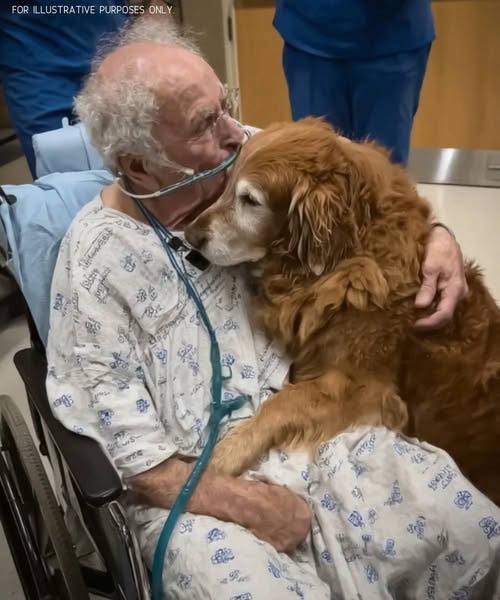
Late that evening, the elevator doors slid open, and a golden retriever stepped out like he had every right to be there.
Murphy.
He walked calmly down the corridor as if he were following an invisible thread that led straight to Walter’s door. His tail wagged softly, not with excitement, but with recognition—like someone greeting an old friend after a long winter apart.

When he entered the room, Walter stirred.
His eyelids—so heavy minutes before—lifted just a sliver. His gaze sharpened. His pale, trembling hand reached out.
And Murphy climbed gently onto the bed, curled against Walter’s frail chest, and pressed his head under the old man’s chin.
Walter exhaled, long and trembling, as though he had been holding that breath for months.
Then he whispered something unexpected.
“Tell her… Murphy found her.”
His daughter and I exchanged puzzled looks. I asked him softly, “Who’s ‘her,’ Walter?”
But he was already drifting back to sleep, his fingers tangled tightly in Murphy’s fur.
The next morning, his condition had changed—not miraculously, but undeniably. His oxygen levels steadied. His voice, though hoarse, grew clearer. And Murphy lay faithfully at his side, head resting on Walter’s hip like a guardian who had finally reached his post.
By the third day, Walter was well enough to ask for a private conversation. I assumed he wanted to speak with his daughter, but he shook his head.
“You,” he said, gesturing to me. “Stay. You’re the one who brought him here.”
I sat beside his bed.
“This is a story that isn’t mine alone,” he warned softly. “But maybe it’s time someone else carries it.”
He began with a girl named Lizzie.
She had been sixteen—sharp-tongued, funny, a storm of contradictions. The kind of teenager who could walk into a room and make it feel both brighter and louder. Walter’s arthritis had been worsening, and she’d offered to walk Murphy in the afternoons. She called Walter “Mr. W,” and over time their routine became a small but constant anchor in each other’s days.
Then one autumn afternoon, she didn’t show up.
When she didn’t return the next morning, or that evening, or the next, the town launched a search. Volunteers combed the woods, ditches, and abandoned sheds. After a week, when hope had thinned to a thread, officials deemed it unlikely she’d be found alive.
But Walter refused to stop looking.
Every morning at dawn, he grabbed his cane, and Murphy trotted beside him. They searched for hours—along the creekbed, behind the derelict barn, through the thicket where blackberry vines grew like traps.
On the twelfth morning, Murphy froze mid-step. His body tensed.
Then he bolted.
Walter followed as quickly as his stiff joints allowed. Murphy barked twice—sharp and insistent. At the top of a slope, caught in a web of brambles, lay a turquoise scarf.
Lizzie’s.
They found her in a shallow ditch, semi-conscious, shaking from cold and shock. Her stepfather had hurt her—more times than anyone knew. She had run into the woods to escape him, but he followed. He left her when he thought she wouldn’t survive.
But Murphy didn’t leave her.
He stood guard for hours, keeping her warm with his body, nudging her to stay awake, barking for help until Walter arrived.
The town called it a miracle.
Lizzie lived with Walter for a while afterward—until child services placed her with a new family. She left behind a note taped to Murphy’s collar.
“You saved me,” it read. “Both of you.”
Then she disappeared from their lives, leaving only that memory behind.

I felt the weight of the story settle on my chest.
But what Walter said next hit even harder.
“She’s alive,” he told me quietly. “And Murphy… he knows.”
Later that night, one of the nurses dug up an old newspaper article online. The grainy black-and-white photo showed Walter younger, Lizzie wrapped in a blanket, and Murphy looking straight at the camera like he understood the gravity of what he’d done.
I couldn’t shake the story either. So I shared it anonymously on a small community forum—no names, just gratitude for a man, a dog, and a lost girl who had been found.
Three days later, someone replied.
“I think you’re talking about me.”
The woman who arrived at the hospital didn’t look like the frightened teenager from the photo. Her hair was dark now, tied neatly behind one ear. She held the hand of a five-year-old girl who clutched a stuffed rabbit.
Her name wasn’t Lizzie anymore. It was Elena.
When she stepped into Walter’s room, he recognized her instantly. His face transformed—wrinkles softening, eyes brightening like a lamp being turned on after a long dusk.
“Elena,” he breathed.
She leaned down, kissed his forehead, and whispered, “I told you I’d come back someday.”
The hours that followed felt sacred. They talked about her adoptive family, her college years, her daughter’s artwork, the music she fell in love with. She showed him photos—birthdays, picnics, a little house painted yellow.
Walter listened with tears sliding down his temples.
“Murphy,” he murmured once, voice trembling. “He found you again.”
Walter recovered more in that week than anyone predicted. Not enough to return home alone, but enough to sit up, eat small meals, and laugh at Murphy’s attempts to steal his pudding.
Then, one afternoon, Elena returned with a folder.
Inside were papers—formal ones.
“Move in with us,” she said. “Into the guesthouse. It’s not charity. It’s family.”
Walter protested out of habit, out of pride. But Elena shook her head.
“You saved my life. Let me help you live the rest of yours.”
With hospital approval and his daughter’s blessing, Walter moved into the small guesthouse behind Elena’s home. Murphy settled in instantly—sleeping on the porch, following Elena’s daughter around like a cheerful shadow, and letting her tie ribbons around his collar.
Walter lived another year and a half.
They were gentle months—porch sunsets, quiet mornings, stories retold over mugs of tea. Sometimes he and Elena walked the edge of the woods together, and Murphy trotted ahead, nose in the wind as if still searching for someone who might need him.

When Walter passed, it was peaceful.
Murphy lay beside him, just like in that hospital room, guarding him through his final breath.
At the funeral, Elena stood before the small gathering of neighbors and friends.
“I’m alive because of this man,” she said. “Because he didn’t stop searching. Because he loved a dog who refused to forget me.”
The next morning, in her garden, she placed a smooth river stone beneath the apricot tree.
She carved the words herself:
Murphy — Guardian Angel.
Good Boy Forever.
And underneath, in smaller letters, she added:
“He found me twice.”
