
How LIDAR Technology Revealed a Hidden Network of Ancient Cities Beneath the Rainforest
For decades, the Amazon rainforest was often imagined as a region that supported only small, dispersed communities due to its challenging ecosystem. But recent advances in remote-sensing technology are rapidly changing that assumption. In the eastern foothills of the Ecuadorian Andes, researchers have uncovered evidence of a large, organized ancient civilization that flourished more than two thousand years ago. This discovery is reshaping global understanding of pre-Columbian South America and demonstrating how advanced societies engineered complex landscapes even in dense tropical environments.
At the center of this revelation is a powerful technological tool—LIDAR (Light Detection and Ranging). By using laser pulses sent from above the forest canopy, researchers can digitally remove vegetation to reveal what lies below. This method has revolutionized archaeology in jungle regions, and in the case of the Upano culture, it uncovered the outlines of an extensive urban system hidden beneath centuries of growth.
A Technological Breakthrough in the Amazon
The research, published by an international team of archaeologists, used LIDAR to scan more than 300 square kilometers of the Upper Amazon region. While archaeologists were aware of ancient settlements in the area due to earlier excavations, the full scale of the landscape remained unknown until the new scans were analyzed.
Once processed, the imagery revealed:
-
Dozens of settlements connected by engineered roadways
-
Large platforms and mound complexes
-
Agricultural fields arranged in organized grids
-
Terraced landscapes designed for drainage and cultivation
-
Possible ceremonial and community structures
These findings point not to a small cluster of hamlets, but to a planned urban network that extended across valleys and ridges, built centuries before the rise of the Inca Empire.
The Upano Civilization: Skilled Engineers of the Rainforest
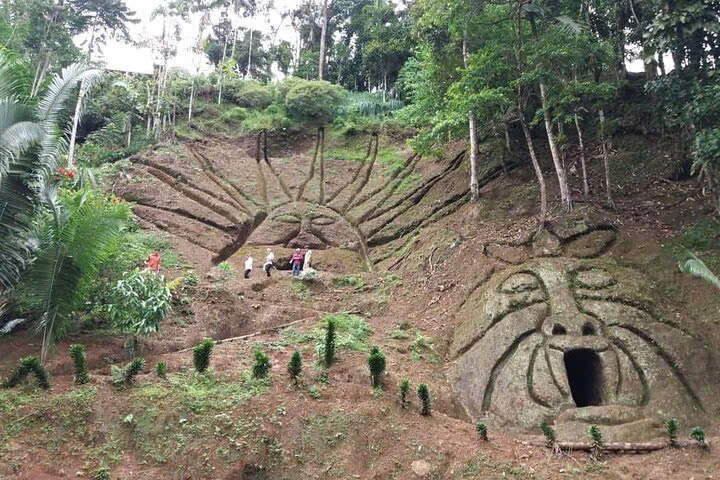
The newly analyzed landscape belongs to the Upano people, who lived in the region from approximately 500 BCE to 600 CE. Archaeological evidence—ceramics, tools, food remains, and settlement structures—had long indicated a stable agricultural society. However, the full extent of their engineering capabilities remained underestimated.
The LIDAR images changed that perception dramatically. Beneath the dense green canopy, the Upano had constructed:
-
Roadways up to 10 meters wide
-
Straight causeways extending more than 20 kilometers
-
Rectangular city layouts organized around central platforms
-
Sophisticated drainage canals
-
Large, elevated terraces designed to protect fields from seasonal flooding
These features required considerable labor, planning, and environmental knowledge. Far from being an untouched wilderness, this part of the Amazon was a carefully shaped cultural landscape.
An Urban Network That Challenges Old Narratives
For much of the 20th century, scholars believed that Amazonian societies were relatively small and dispersed, limited by soil fertility and climate conditions. The Upano cities challenge that assumption. Instead of isolated settlements, researchers found a network of interconnected communities arranged across a broad region—evidence of a population possibly numbering in the tens of thousands.
Comparable discoveries in Bolivia’s Llanos de Moxos and Brazil’s Upper Xingu have already begun changing how scholars view the Amazon. The Upano sites strengthen the growing argument that significant urban societies once thrived across multiple regions of the rainforest.
Road Systems: The Backbone of Ancient Organization
One of the most remarkable findings is the system of engineered roadways. Their straightness suggests intentional planning, while their width and length indicate regular use for transporting goods, people, and resources.
These roads likely connected:
-
ceremonial centers
-
agricultural areas
-
residential zones
-
neighboring settlements
In several places, the roads intersected at planned angles or converged at central platforms, further suggesting a coordinated urban plan.
Agriculture and Environmental Knowledge
The Upano were skilled agriculturalists who adapted ingeniously to the rainforest. The LIDAR scans revealed patterns of:
-
raised fields
-
drainage lines
-
irrigation channels
-
terraces carved into hillsides
These modifications helped regulate water flow during heavy rains and protected crops during seasonal changes. Soil studies indicate the cultivation of crops such as maize, yucca, and various fruits, which supported a stable food supply.
Rather than overpowering the environment, the Upano worked with it—enhancing fertility, managing water, and maintaining long-term sustainability.
Understanding Social Complexity
Archaeology provides more than structural maps; it helps reconstruct the social world of the Upano. The new findings suggest:
Organized Settlements
The presence of large central platforms and plazas points to communal or ceremonial life.
Labor Coordination
Constructing large terraces and roads required shared effort and possibly leadership roles.
Cultural Practices
Excavations have revealed pottery styles, household tools, and ritual objects that may indicate religious traditions or community gatherings.
Long-Distance Interaction
Some ceramics and artifacts resemble styles from neighboring regions, suggesting trade or cultural exchange.
The Upano civilization was not isolated; it was part of a broader network of connections across ancient Amazonia.
Why This Discovery Matters
The newly revealed urban network has global significance. It challenges long-held assumptions about how societies form, how humans adapt to challenging environments, and how history is written.
Key implications include:
-
The Amazon was home to multiple large, complex societies—not only small-scale communities.
-
Urban planning in rainforest regions existed long before later Andean civilizations.
-
The idea of “untouched wilderness” does not accurately describe ancient Amazonia.
-
Indigenous engineering traditions were far more advanced than previously recognized.
This discovery continues a global trend: as LIDAR becomes more accessible, researchers are uncovering complex ancient landscapes in places once thought uninhabited or sparsely populated.
The Future of Amazon Archaeology
With only a fraction of the region scanned so far, scholars believe many more ancient sites remain hidden beneath the rainforest. LIDAR has now made large-scale surveys possible without disturbing the vegetation, preserving both cultural and ecological heritage.
Future research aims to investigate:
-
the political structure of Upano society
-
how their urban systems developed over centuries
-
environmental changes that may have influenced their decline
-
how their agricultural practices can inform modern sustainability
These questions highlight the importance of ongoing collaboration between archaeologists, Indigenous communities, and environmental scientists.
Conclusion: A Civilization Rediscovered
The story of the Upano is a reminder that human societies have long adapted to diverse environments with creativity and precision. Their hidden cities, now revealed through cutting-edge technology, show that ancient Amazonian civilizations were far more complex than earlier narratives suggested.
As researchers continue piecing together this remarkable chapter of history, the Upano emerge not as a mysterious anomaly, but as a vibrant and sophisticated culture whose legacy enriches our understanding of the ancient world. Their rediscovery stands at the intersection of science, history, and exploration—opening a new window into humanity’s shared past.
