
The Ancient Bodies of Pompeii: Understanding a City Preserved in Time
How Archaeology, Science, and History Reconstruct a Day That Changed the Ancient World
Pompeii, lying at the base of Mount Vesuvius in southern Italy, is one of the most extraordinary archaeological sites ever discovered. Its sudden burial in 79 CE preserved an entire Roman city in remarkable detail, offering historians and researchers a rare opportunity to study architecture, daily life, technology, and the lived experiences of people in the ancient world.
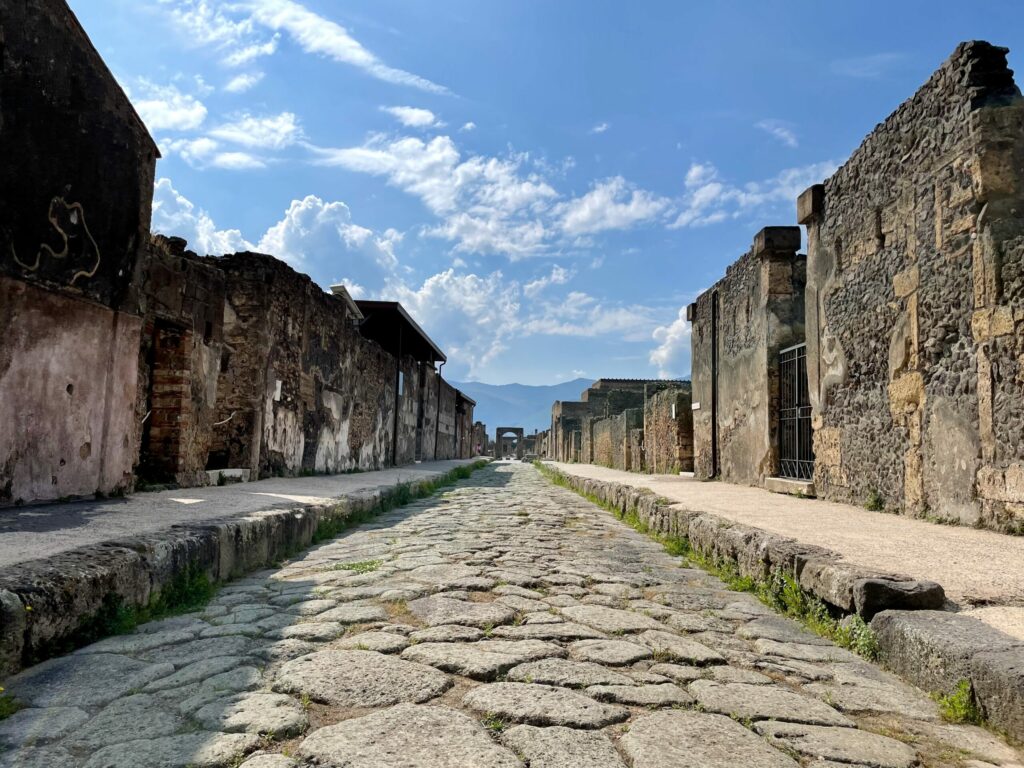
The site’s preservation allows modern audiences to look directly into a moment in history with clarity that few ancient civilizations can match. Rather than focusing on tragedy alone, Pompeii provides a comprehensive picture of Roman economic life, cultural values, craftsmanship, and city planning.
The Day Mount Vesuvius Transformed Pompeii
In late August of 79 CE, Mount Vesuvius erupted unexpectedly, sending a towering column of ash, pumice, and volcanic gases high into the sky. While volcanic activity was not unheard of in the region, nothing prepared the local communities for the scale of this event. Over a period of hours, volcanic debris accumulated across the city, causing roofs to collapse and streets to fill with ash.
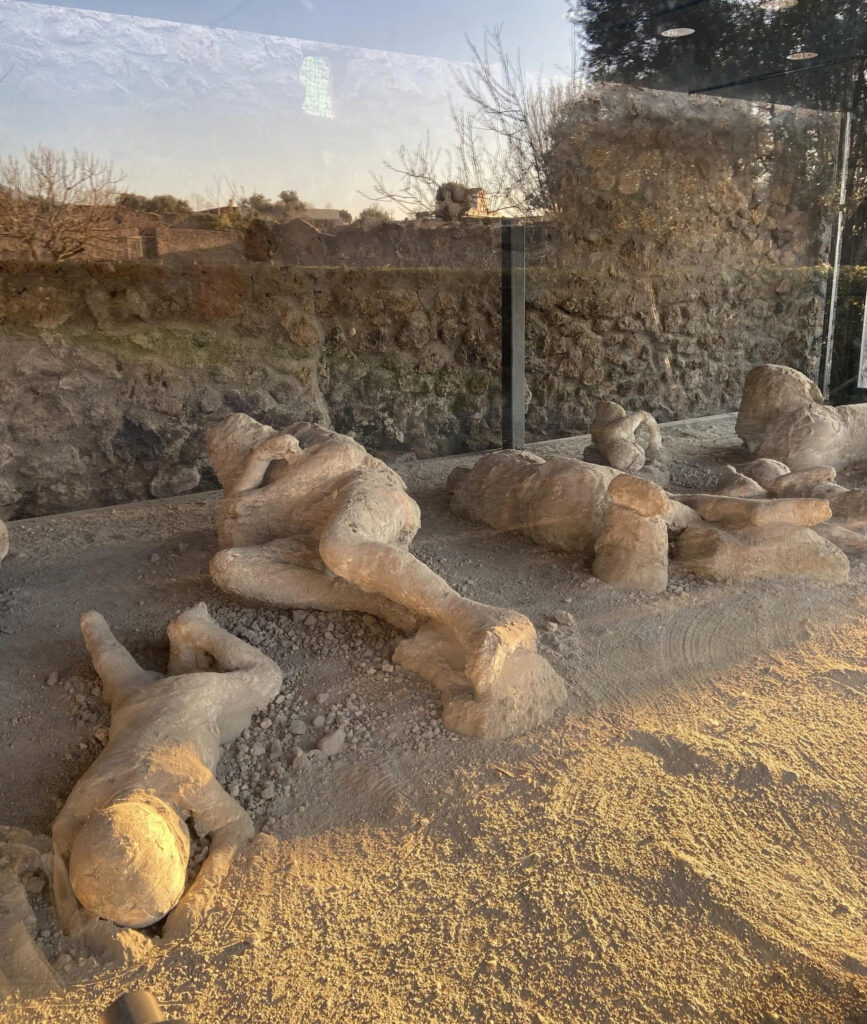
Later in the eruption, fast-moving clouds of hot gas and fine material—called pyroclastic surges—moved through the area. These surges caused near-instant devastation, halting movement throughout Pompeii and nearby Herculaneum.
The suddenness of the event meant that homes, public baths, shops, temples, and household objects remained exactly where they were left. This natural “snapshot” is what makes Pompeii so valuable to archaeology.
Rediscovery of a Buried City
After the eruption, Pompeii disappeared beneath meters of ash and volcanic debris, gradually fading from memory. Although some structures were uncovered by chance over the centuries, the city was not systematically excavated until 1748, during the rule of the Bourbon monarchy in Naples.
These early explorations revealed an astonishingly well-preserved Roman city:
-
streets paved with basalt
-
intact houses with colorful frescoes
-
shops stocked with jars and tools
-
mosaics depicting myths, animals, and daily activities
-
public baths with functioning heating systems
-
villas decorated with fine sculptures
The discoveries reshaped European understanding of Roman life, influencing art, architecture, literature, and the emerging discipline of archaeology.
The Evidence of People’s Final Moments
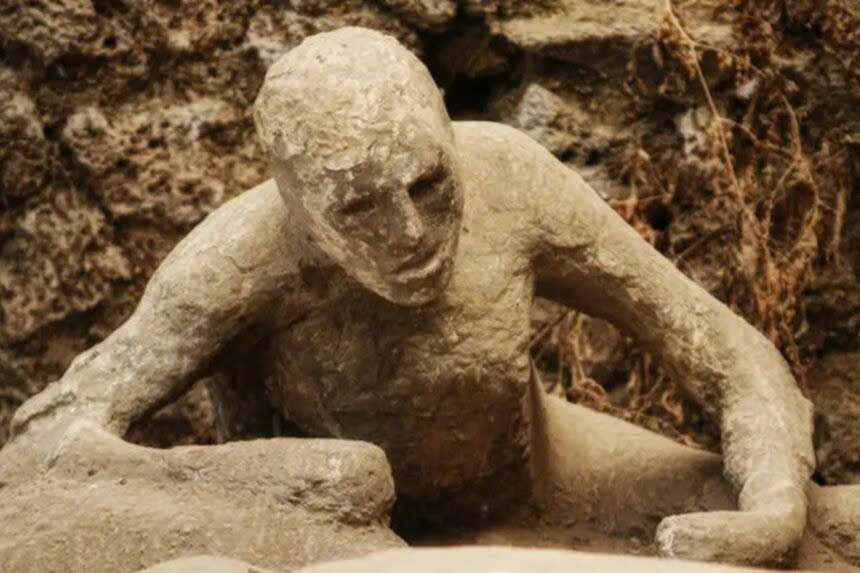
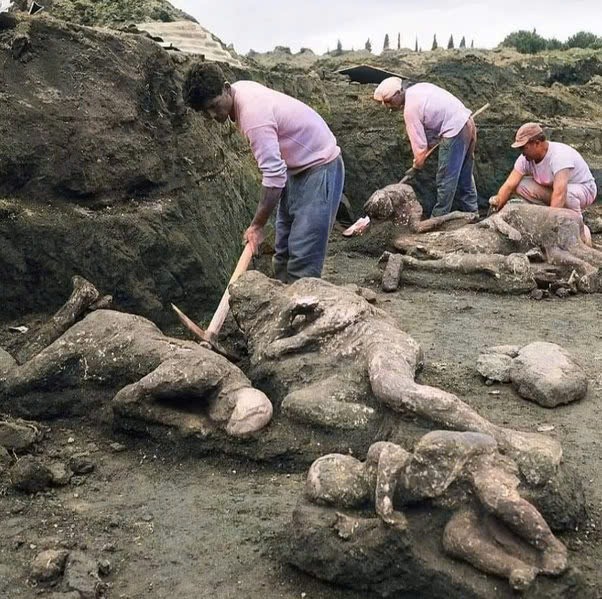
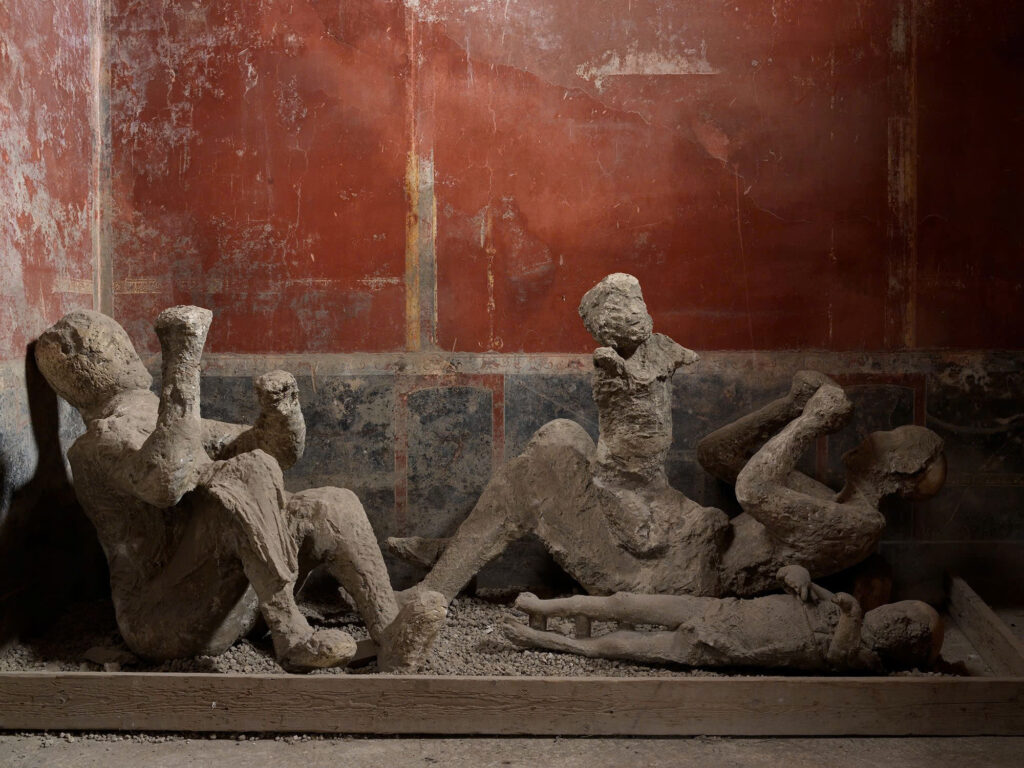
Among the findings were the impressions left in the volcanic layer where organic material—including human bodies—had once been. Over centuries, the soft tissues disappeared, leaving hollow voids within the hardened ash. Archaeologists in the 19th century developed a method for preserving these spaces: they poured plaster into the cavities to create three-dimensional casts.
These casts do not contain human tissue but recreate the outer shape of the spaces left behind. They serve as historical documentation, illustrating the positions people occupied when the volcanic surge reached them.
Rather than focusing on graphic detail, these casts are treated as archaeological artifacts that help researchers understand:
-
where people were located during the eruption
-
how they attempted to respond
-
where families sought shelter
-
how city layout influenced movement during emergencies
They offer glimpses into daily life, showing clothing outlines, accessories, and posture.
Archaeological Innovation: The Plaster Cast Technique
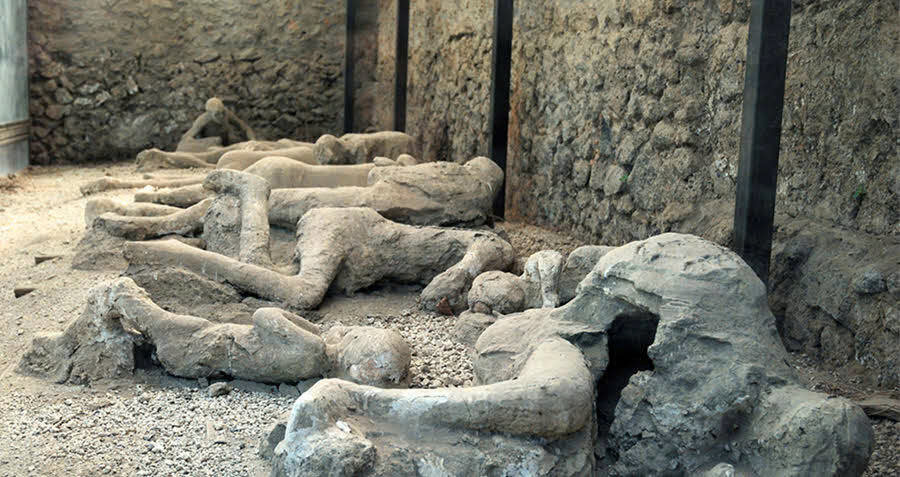
Developed by Giuseppe Fiorelli in the 1860s, the casting technique revolutionized excavation at Pompeii. The process works as follows:
-
An excavator identifies a hollow space within the volcanic layer.
-
A small hole is drilled to confirm the cavity’s shape.
-
Liquid plaster is poured inside.
-
After hardening, surrounding ash is removed.
-
The resulting cast reveals the outer form of the object or person once in the space.
Today, researchers use modern materials like resin and CT scanning to produce casts with less impact on the surrounding environment. These technological advances help preserve original layers for future study.
What the Casts Tell Us About Ancient Life
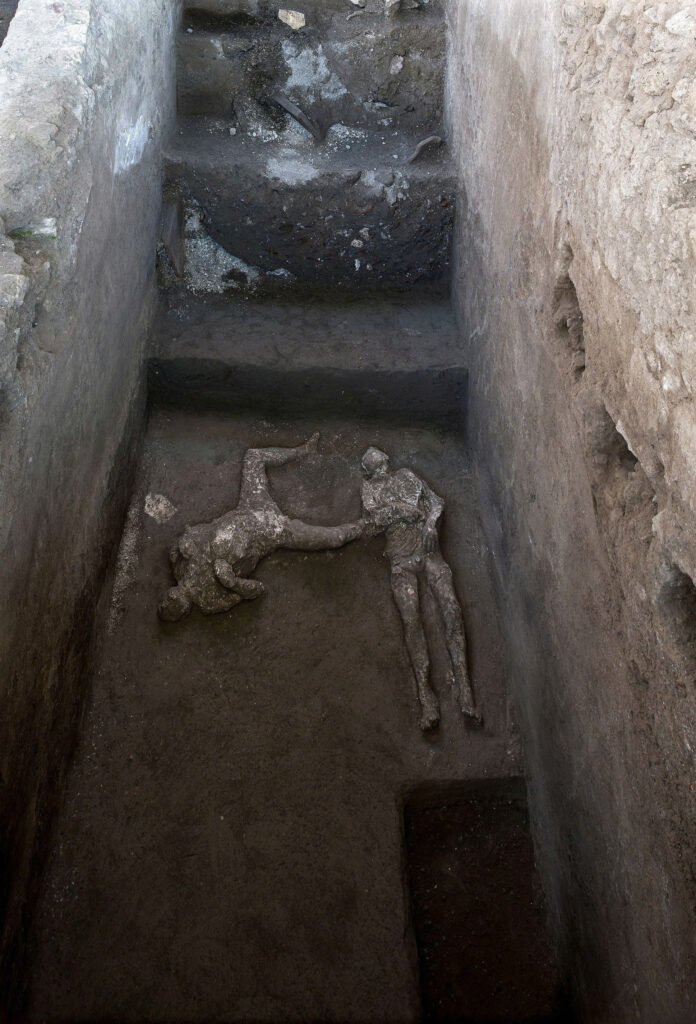
The casts are best understood as historical records. Each one offers insight into how people lived, worked, and moved within Pompeii’s urban environment.
Examples include:
-
groups sheltering in storage rooms or basements
-
individuals found along major roads, suggesting attempts to flee
-
casts near marketplaces, workshops, and kitchens, showing people in their daily routines
-
a number of casts in public bath areas, reminding us how central these facilities were to Roman life
Other discoveries include pets, work tools, household items, and personal belongings—each one adding another layer to the understanding of daily life in Pompeii.
The Scientific Value of Human Remains
While casts represent the space where bodies once lay, the bones inside many cavities have provided significant scientific information. Modern research techniques—such as DNA analysis, isotope studies, and advanced imaging—have revealed details about:
-
diet and nutritional patterns
-
dental health
-
skeletal development
-
common illnesses and medical care
-
population demographics
For example, studies have shown that many Pompeii residents had diets rich in grains, seafood, legumes, and olives. Isotope analysis shows variation in diet between social classes and professions. Tools found near certain casts provide hints about their trades, daily habits, and roles in the community.
A City Frozen in Everyday Activity
Pompeii offers one of the most complete looks into ancient urban life ever documented. Homes reveal:
-
vibrant frescoes with mythological themes
-
bright wall paintings showing food, birds, landscapes, and daily objects
-
intricate mosaics constructed from tiny colored stones
-
atriums designed to collect rainwater
-
private gardens decorated with sculptures
Shops and workshops reveal:
-
bakeries with brick ovens
-
fulleries (laundries) equipped for large-scale work
-
fast-food-style street counters
-
metalworking and pottery studios
This extraordinary preservation provides scholars with information that would otherwise be unavailable in typical Roman ruins.
Modern Technology Deepens Our Understanding
In the past two decades, new research tools have transformed how Pompeii is studied:
-
Ground-penetrating radar reveals hidden structures.
-
3D digital scanning creates detailed models of streets and homes.
-
Chemical residue analysis identifies ingredients in ancient food containers.
-
Microscopic pollen studies reconstruct ancient gardens.
-
Portable X-ray scanners analyze metal objects without damaging them.
These techniques continue to refine the picture of who lived in Pompeii, how they organized their city, and how they responded to natural hazards.
A Lasting Legacy
The site of Pompeii is not only a window into a moment of catastrophe—it is a testament to resilience, reconstruction, and the lasting impact of archaeological discovery. Millions of visitors come each year to walk the ancient streets and learn how Romans lived nearly two thousand years ago.
In classrooms, museums, and documentaries, Pompeii remains one of history’s most powerful teaching tools. It shows:
-
how natural disasters reshape human communities
-
how ancient engineering functioned
-
how art and culture thrived in Roman cities
-
how archaeology can turn tragedy into knowledge
Conclusion: A Meeting Point Between Past and Present
The preserved shapes, structures, and artifacts of Pompeii remind us that history is not abstract. It is lived by real people in real places. Through careful archaeological work, researchers continue to uncover new layers of information, helping us understand both the fragility and resilience of past societies.
Pompeii is more than a story of loss—it is a place where science, history, and human experience intersect. Through ongoing research and preservation efforts, the ancient city continues to educate and inspire, linking modern viewers to a world that once flourished at the base of Mount Vesuvius.
